
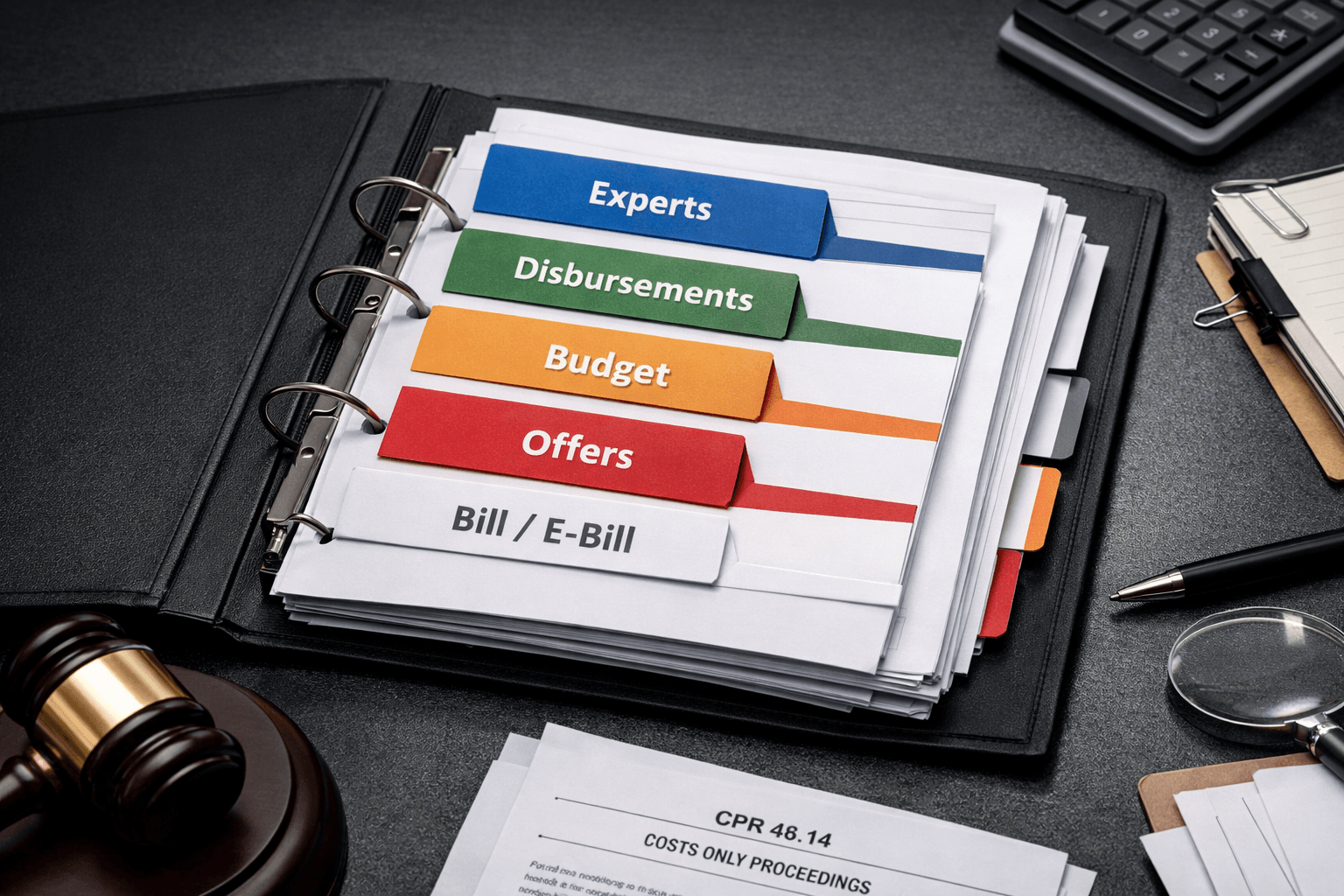
Clinical negligence costs are rarely “just a bill”. They are scrutinised, defended hard, and often hinge on how well the file tells the story of why the work and disbursements were necessary and reasonable.
This guide is written for claimant clinical negligence solicitors, partners, heads of department and practice managers who want cleaner recoveries and faster settlements by getting their costs files “DA-ready” from the start.
B2B-only filter: DMD Costs acts only for solicitor firms. We do not advise patients or take instructions from the public.
A DA-ready file is not about over-lawyering the paperwork. It’s about making the inevitable arguments predictable, winnable, and quick to resolve.
• “DA-ready” means your bill, e-bill and supporting documents can withstand Points of Dispute and (if needed) detailed assessment without a rescue mission.
• The most common recovery leaks are preventable: vague attendance notes, weak expert fee justification, disbursement gaps, and budgets that don’t match reality.
• If you outsource, you want a partner who understands CPR realities: standard basis assessment, proportionality, budgets, and the defendant playbook.
• The best time to fix a costs file is before service of the bill, not after PoDs land.
• A structured handover process reduces fee earner time, avoids rework, and speeds negotiation.
________________________________________
A DA-ready file is one where an experienced opponent can read the documents and see, quickly and clearly:
• what was done
• why it was needed
• when it was done (and by whom)
• how it ties to the case theory, causation and quantum pathway
• how disbursements were chosen, instructed and controlled
• how the costs budget (if applicable) links to the phases and decision points
• how the claimed figures remain defensible on a standard basis with proportionality in mind
In practice, “DA-ready” means fewer gaps that invite defendant assumptions.
It also means your costs drafting is aligned to your litigation strategy. A beautifully drafted bill that conflicts with the pleaded issues, the expert map, or the budgeting history will still get chopped.
If you’re considering outsourcing, the question is not “can they draft a bill?”. It’s “can they draft, evidence, and negotiate the bill to settlement in the real world of clinical negligence scrutiny?”.
________________________________________
Clinical negligence costs are heavily influenced by what the case required, when, and why. Your costs chronology should make the logic obvious:
• pre-action steps and early liability positioning
• records acquisition and analysis
• screening expert(s) and subsequent discipline expansion
• breach and causation development
• quantum evidence pathway and valuation shifts
• key defendant engagement points (requests, denials, concessions)
• ADR and settlement negotiations
If the chronology is unclear, defendants default to “too early, too much, too senior”.
Even sophisticated claimant teams get tripped up by inconsistent funding paperwork. A DA-ready file typically includes:
• CFA/retainer documents and variations
• success fee and ATE documentation (where relevant to the case and recoverability issues)
• client care letters that align with the scope of work
• counsel and expert terms that match the actual instructions
You do not need a textbook recital in the bill. You need a coherent documentary trail that avoids unnecessary technical disputes and supports the work actually done.
Time records should be capable of being understood by someone who was not on the file.
Defendants tend to attack:
• block entries that hide multiple tasks
• “review file” with no purpose
• repeated reviews without decision points
• duplication between solicitor and counsel
• seniority levels that look unnecessary
• unexplained bursts of time around routine steps
A DA-ready file uses attendance notes and short, purposeful narratives to show the decision-making:
• why a particular expert discipline was required
• why additional records were necessary
• why a conference or advice was proportionate at that stage
• why counsel input was efficient, not duplicative
If you want an example of how we structure narratives in bills and Replies, see “Bills of Costs & Precedent S e-bills” (link to Services page).
________________________________________
Expert fees and medical evidence sit at the heart of clinical negligence costs. They are also the easiest target for defendants because they can look large in isolation.
A DA-ready file makes expert disbursements defensible by showing:
Include a simple rationale in the file materials for each discipline:
• what issue the expert addressed (breach, causation, condition and prognosis, quantum, care/OT, accommodation, employment, etc.)
• why that discipline was required in the context of the pleaded case and known risks
• what changed when additional disciplines were added (new disclosure, defendant stance, joint statement outcomes, Part 36 strategy)
Make sure you can evidence:
• the instruction letter and scope
• the questions asked
• the report(s) received
• any supplementary reports and why they were needed
• conference notes where experts attended, with purpose and outcomes
Defendants will argue “excessive hours” or “market rate”. A DA-ready file helps by keeping:
• quotes/estimates where available
• staged approvals for significant uplifts
• explanations for urgency or complexity
• clarity on cancellations or rebookings (if relevant)
This doesn’t need to be over-engineered. It needs to be present.
________________________________________
Clinical negligence claims can involve intense work, but proportionality arguments still land, particularly where:
• liability remains in issue for a prolonged period
• causation is difficult and expert-heavy
• quantum evidence multiplies
• the damages figure is modest relative to the work done
A DA-ready approach is to show the “why” behind the work at the time, not hindsight.
Practical ways to protect recovery:
• record decision points in real time (why this step now)
• link major workstreams to the defendant’s stance or disclosure gaps
• ensure senior time is clearly strategic (not doing junior admin)
• show how counsel involvement reduced overall time or risk
• keep the story consistent across pleadings, correspondence, and costs documents
This is exactly where a specialist costs partner can save fee earner time: building the proportionality narrative once, properly, and then using it consistently in the bill and any Reply to PoDs.
________________________________________
Where the case is subject to costs management, your bill and any negotiation stance should be consistent with:
• the approved/agreed budget figures by phase
• any budget revisions (and why they were sought)
• costs management orders and assumptions
• significant developments that drove departures
A DA-ready file typically includes:
• the most recent Precedent H, plus earlier versions if changes are material
• budgets and directions orders
• any correspondence around revisions and opponent positions
• a clear mapping of major work to phases
If you want to tighten up budgeting workflows alongside costs drafting, see “Precedent H/R/T budgets support” (link to Services page).
________________________________________
Most Points of Dispute follow predictable themes. A DA-ready file anticipates them:
Common PoD themes
• “too much partner time / grade too high”
• “duplication with counsel”
• “excessive attendance notes and internal communications”
• “too many experts / wrong discipline / disproportionate”
• “unreasonable frequency of review”
• “unnecessary letters/emails”
• “travel time and waiting”
• “conference time not justified”
• “success fee / funding technical points” (where raised)
Pre-emptive steps that reduce PoD pain
• ensure time entries show purpose and outcome
• separate routine admin from legal analysis
• anchor expert work to pleaded issues and defendant stance
• keep counsel work clearly distinct (or show why it replaced solicitor time)
• maintain a clean record of settlement strategy steps, especially around offers
If you need support drafting PoDs/Replies and negotiating to settlement, see “Points of Dispute & Replies” (link to Services page).
________________________________________
Checklist: what to include when instructing costs drafting (handover pack)
• pleadings and key statements of case
• schedule/counter-schedule where used and any key quantum documents
• key orders and directions (including costs management orders)
• funding documents and relevant variations
• counsel advices that drove key steps (as appropriate)
• expert instruction letters, reports and joint statements
• disbursement invoices and proof of payment where available
• Part 36/Calderbank offers and dates, plus acceptance position
• key correspondence showing defendant stance shifts
• time records exported cleanly with fee earner grades and rates
Checklist: “DA-ready” time recording habits (light-touch, high impact)
• avoid block entries where possible; separate discrete tasks
• note purpose: “review disclosure to identify causation gaps” beats “review disclosure”
• record outcome: decision, advice sought, strategy change
• log conferences with agenda and purpose
• keep senior time strategic and obvious
• capture why additional experts or reports were required
Checklist: disbursements and experts (defensibility essentials)
• clear discipline rationale on file
• scope of instructions and deliverables saved centrally
• estimates/quotes where obtainable
• staged approvals for significant uplifts
• conference notes that show necessity and outcomes
Checklist: pre-service bill review (your “leaks” check)
• do bill phases and chronology match the case?
• do expert fees have a clear necessity trail?
• do counsel and solicitor roles look distinct (or justified)?
• do budgets and phases align where applicable?
• are the largest items supported by documents you can produce quickly?
________________________________________
Clinical negligence matters are high-value and expert-heavy. They need proper scoping and a controlled drafting process, not a one-size-fits-all handover.
Here’s how we typically work with claimant firms on clinical negligence costs:
1. You send a single matter for scoping
We ask for a clean handover pack (pleadings, funding documents, key orders, expert instructions/reports, disbursements and time data).
2. We confirm what’s needed and what will move the needle
For example: bill vs e-bill approach, budget alignment, the likely PoD pressure points, and any proportionality vulnerabilities.
3. We agree a fixed fee or quoted scope
Typical scopes include:
• Bills of Costs and Precedent S e-bills
• Points of Dispute and Replies
• N260 statements of costs
• Precedent H/R/T budgets support
• Negotiation strategy support (and negotiation handling where agreed)
4. We draft to a DA-ready standard
Meaning the bill, narratives and supporting documents are built to withstand defendant scrutiny and keep settlement discussions focused.
5. We support negotiation to settlement (optional)
Some firms want drafting only; others want us to handle negotiation end-to-end. We’ll align to your preference and internal process.
________________________________________
Clinical negligence
Clinical negligence costs are scoped and priced per matter due to size and complexity. We can work on:
• Fixed-fee components (for defined tasks), or
• A quoted scope for end-to-end drafting and negotiation support
If you want an accurate figure, send one matter for scoping and we’ll come back quickly with a clear scope and fee.
HDR and MoD NIHL (where the Free Trial applies)
Our Free Trial to Settlement is available on:
• Claimant Housing Disrepair costs
• MoD NIHL (military hearing loss) costs
One live file, no fees, no commitment. If you’re happy, you can move onto:
• Option A: fixed fee per file to settlement (no commitment)
• Option B: monthly retainer (works out cheaper) with a 6-month commitment
________________________________________
FAQs (solicitor objections, answered)
1) We already have someone who can draft bills. Why outsource?
Because the bottleneck is rarely the drafting alone. It’s the end-to-end: getting the file DA-ready, handling PoDs/Replies properly, and negotiating efficiently to settlement without dragging fee earners back into costs work.
2) Will outsourcing increase write-off risk or create more queries for the team?
Not if the handover process is tight. A good partner reduces rework by using a clear pack, asking targeted questions once, and producing drafts that stand up to defendant scrutiny.
3) How do you handle costs management and budgeting issues in clinical negligence?
We work to the costs management framework you’re operating under, align drafting to the phases and assumptions, and keep the narrative consistent with the budget history so you’re not fighting yourself at negotiation.
4) We worry about confidentiality and file handling. What’s your process?
We work solicitor-to-solicitor with secure file transfer workflows and clear document control expectations. You remain in control of strategy; we support recovery and settlement as your outsourced costs function.
5) Can you just do the drafting and leave negotiation to us?
Yes. Some firms prefer drafting only; others want drafting plus negotiation to settlement. The trial can be scoped either way, but the best results usually come when drafting and negotiation are aligned.
________________________________________
Final CTA: clinical negligence costs support (B2B only)
If you want a costs partner who understands clinical negligence scrutiny and drafts matters to a DA-ready standard, send one live file for scoping.
• We’ll confirm what we need, what we’ll deliver, and the fee structure (fixed-fee or quoted scope).
• You keep control of strategy; we support recovery and settlement readiness.
B2B-only: We act only for claimant solicitor firms. We do not accept instructions from patients or the public.
If you also run Housing Disrepair or MoD NIHL, ask about our Free Trial to Settlement on those work types.