
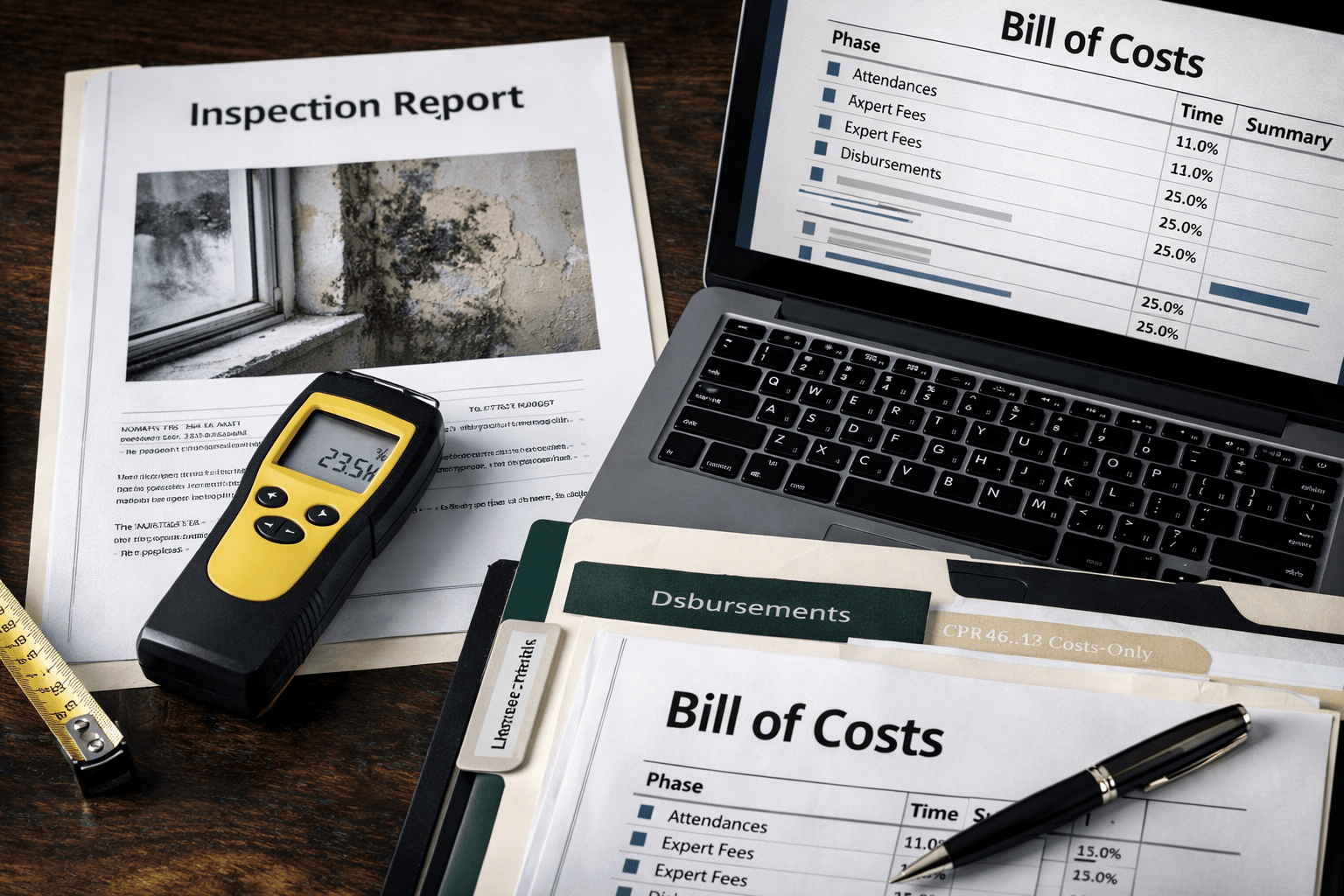
If you run claimant Housing Disrepair (HDR) work, you already know the real commercial pressure point isn’t just winning liability or getting the works done. It’s recovering costs efficiently, compliantly, and without bleeding fee-earner time into a never-ending costs argument.
This article is written only for claimant solicitor firms and practice managers. DMD Costs is B2B only: we act only on instruction from solicitors and do not advise or act for tenants/lay clients.
Outsourcing HDR costs can work brilliantly, but only when the drafting and negotiation are set up to match how defendant teams attack claims: proportionality, hourly rates, attendances, expert fees, and “DA threats” used as leverage. The difference between an average bill and a DA-ready bill is often the difference between an early settlement and months of avoidable grind.
Key takeaways
• A “DA-ready” HDR bill is built to survive CPR 44.3 reasonableness and proportionality arguments, not just to look impressive on paper.
• The biggest recoverability wins usually come from structure, narrative, and evidence linkage, not just higher hours.
• Outsourcing works best when your costs partner can take you from bill through PoDs/Replies to settlement, without you needing to micromanage.
• You can drastically cut write-offs by standardising what you send over and what “ready for costing” means internally.
• A true low-risk trial is one live file, handled end-to-end, with a clear B2B filter that protects your intake team from tenant enquiries.
________________________________________
A lot of firms hear “outsourcing” and think it means “draft the bill and send it back”. In HDR, that’s usually where the value leaks out.
For claimant firms, outsourcing should mean a partner who can:
• Draft Bills of Costs and Precedent S e-bills with the right structure and schedules
• Prepare for (and respond to) Points of Dispute and draft Replies
• Deal with N260 statements of costs where relevant
• Assist with Precedent H/R/T budgeting where the case requires it
• Build costs-only packs (CPR 46.14) when appropriate
• Negotiate to settlement in a way that reflects your commercial priorities and litigation risk
The winning model is simple: you want a costs partner who reduces solicitor time spent on costs while protecting recoverability and shortening the distance to settlement.
________________________________________
HDR costs disputes tend to follow the same fault lines. If your bill doesn’t proactively address them, you end up firefighting after PoDs land.
You’ll see proportionality arguments whether the claim is modest or substantial. The best response isn’t a lecture. It’s a bill that:
• Shows why the work was required at each stage
• Links time to issues and progression (not vague admin)
• Demonstrates that the steps taken were reasonable in the circumstances (CPR 44.3 mindset)
Defendants love to label routine management as duplication. You reduce the attack surface by:
• Keeping attendances clear on purpose and outcome
• Separating pure admin from legal work
• Avoiding repeated “review file” style entries without a narrative of why
In HDR, disbursements are a frequent battleground (inspection reports, schedules, counsel, court fees, etc.). The bill should make it easy to see:
• What the disbursement was for
• How it moved the matter forward
• Why it was justified (and properly evidenced)
Where counsel is involved, defendants often argue it was premature or excessive. A DA-ready approach makes the rationale obvious: complexity, urgency, tactical value, or procedural necessity.
________________________________________
“DA-ready” doesn’t mean you’re planning to go all the way to detailed assessment. It means the bill is drafted and supported so that:
• The defendant can’t easily pick it apart with generic PoDs
• Your negotiating position is stronger because the work is clearly justified
• If a Part 8 or DA route becomes necessary, you’re not rebuilding everything under pressure
A DA-ready HDR bill usually has:
• Clear phase structure and consistent narrative
• Time entries that evidence decision-making and progression
• Proper treatment of routine steps vs legal analysis
• Disbursements that are evidenced and contextualised
• A coherent story that supports reasonableness and proportionality
________________________________________
If you want speed and fewer queries, standardise what “ready for costing” means internally.
Send:
• The complete electronic file (or a clean costs bundle) with key correspondence
• Statements of case and any key orders/directions
• Any Part 36 offers, Calderbank offers, and without prejudice positions
• Funding documents and retainer details relevant to recovery and compliance
• Disbursement invoices/receipts and brief notes of purpose
• Counsel docs (where used): instructions, advice, notes, fees
• A short “case map” note if the file is messy (what happened, what mattered, what the defendant is likely to dispute)
Avoid sending:
• Partial files “to get started” (it usually creates delays later)
• Unexplained blocks of time with no supporting context
• Disbursements without invoices or clarity on why they were needed
________________________________________
This is where many recoverability issues start.
Before service, check:
• Is the bill presented on the right basis (typically standard basis) and aligned with the procedural posture?
• Are there any obvious proportionality flashpoints that need explanation in the narrative?
• Are the largest time items supported by documents on file (not just “we did the work”)?
• Are disbursements evidenced and easy to follow?
• If you expect a fight: are you prepared for PoDs/Replies and do you have a negotiation plan?
Outsourcing works best when these checks are built into your workflow, not done in a panic after the defendant responds.
________________________________________
A well-drafted bill is only half the job in HDR. The other half is what happens after the defendant responds.
A costs partner who negotiates to settlement should:
• Identify which points are commercially worth pressing and which are noise
• Respond quickly, with a consistent rationale aligned to CPR principles
• Keep your fee-earners out of the weeds while still reflecting your strategy
• Protect the file from drifting into months of correspondence with no movement
This is exactly where many firms lose money: not because the bill was weak, but because nobody owned the settlement pathway.
________________________________________
If you’re considering outsourcing, the lowest-risk way to test a costs partner is one live file handled end-to-end.
Here’s how our Free Trial to Settlement is designed to work:
1. You send one HDR file ready for costing
We agree what “ready” means upfront so there’s no drip-feed.
2. We draft the Bill of Costs / Precedent S e-bill
Structured for recoverability, not just presentation.
3. We handle the defendant’s Points of Dispute and prepare Replies
Targeted responses that focus on the real leverage points.
4. We negotiate to settlement
You stay in control of authority, but we do the heavy lifting.
5. You decide if we’re a fit
No commitment and no obligation to send further work.
This trial is B2B only. We accept instructions only from solicitor firms and do not act for tenants/lay clients.
________________________________________
If you like the workflow and results, you have two ways to continue:
Option A: Fixed fee per file to settlement (no commitment)
• One fee per matter, taking the file through drafting and negotiation to settlement
• Useful if you want flexibility and predictable per-file cost
• No ongoing commitment
Option B: Monthly retainer (works out cheaper) with a 6-month commitment
• Best for firms with consistent HDR (and/or MoD NIHL) volume
• Priority capacity and streamlined delivery
• Designed to reduce per-file cost compared to ad-hoc instruction
________________________________________
1) Will outsourcing reduce our recoveries or weaken our negotiating position?
Not if it’s done properly. The goal is a DA-ready bill with a settlement strategy that protects reasonableness and proportionality arguments, so you can settle sooner without unnecessary concessions.
2) How fast can you turn around a bill and respond to PoDs?
Turnaround depends on file readiness and complexity. The quickest matters are the ones where “ready for costing” is standardised and the key documents are all present from day one.
3) Do you just draft, or do you actually negotiate to settlement?
We take the file through bill drafting, PoDs/Replies, and negotiation to settlement. That end-to-end ownership is where outsourcing delivers the biggest time savings for your fee-earners.
4) What do you need from us to avoid back-and-forth queries?
A complete file, clear disbursement evidence, and visibility of offers and key procedural steps. If the file has quirks, a short “case map” note saves days.
5) Do you work with in-house costs teams or only firms without one?
Both. Some firms use us as overflow capacity during peaks; others outsource fully. The key is agreeing workflow, authority limits, and what “DA-ready” means for your matters.
________________________________________
If you want to test whether outsourcing HDR costs will actually save fee-earner time and improve settlement outcomes, the cleanest approach is simple:
• Send one live Housing Disrepair file ready for costing
• We draft the bill (including Precedent S e-bill where needed)
• We handle Points of Dispute/Replies and negotiate to settlement
• You judge us on the result
B2B-only filter: DMD Costs accepts instructions only from solicitor firms. We do not act for tenants or the general public.