MoD NIHL costs require a different approach.
Military hearing loss claims often involve service history, exposure evidence, audiology, medical evidence, Matrix settlement issues and careful costs presentation after damages resolve.
DMD Costs helps claimant solicitor firms draft, negotiate and recover costs in MoD NIHL and military hearing loss claims. We prepare bills of costs, Precedent S electronic bills, N252 documents, Points of Dispute replies and costs negotiation strategy.
We understand the key point in these claims: the damages matrix does not automatically cap recoverable legal costs. If the claim has been properly investigated and the settlement preserves the right to costs, the costs file still needs to be presented, justified and pursued properly.
Specialist Military Hearing Loss Costs Support
MoD NIHL files can look simple from the outside, but the work behind them is often detailed. A properly handled file may require:
- service history review;
- noise exposure instructions;
- audiology evidence;
- ENT evidence;
- tinnitus evidence;
- hearing aid evidence;
- limitation consideration;
- medical report review;
- Matrix settlement advice;
- offer review;
- settlement wording review;
- costs entitlement review;
- post-settlement costs recovery.
We draft the costs file so the work is properly explained.
What We Do
DMD Costs can assist with:
- MoD NIHL bills of costs;
- military hearing loss bills;
- Precedent S electronic bills;
- N252 and Notice of Commencement;
- Points of Dispute;
- Replies to Points of Dispute;
- costs negotiations;
- Matrix settlement costs issues;
- CPR 46.14 costs-only support;
- Part 8 costs-only preparation support;
- disbursement disputes;
- medical evidence disputes;
- audiology fee disputes;
- hourly rate arguments;
- proportionality arguments.
Why MoD NIHL Costs Need Proper Presentation
After damages settlement, paying parties may try to reduce costs by arguing that the claim was routine, matrix-driven or low value. That approach ignores the work often needed to get the claim to the point of settlement. A MoD NIHL costs file may involve:
- obtaining detailed instructions from the claimant;
- reviewing military service;
- considering occupational noise exposure;
- reviewing medical and audiology evidence;
- considering tinnitus;
- considering hearing aid need;
- advising on the Matrix settlement;
- reviewing offers;
- dealing with the MoD’s position;
- preserving costs entitlement;
- negotiating costs after settlement.
The bill should reflect that work clearly. A generic bill creates an easy opening for reductions.
The Damages Matrix Does Not Cap Costs
The Matrix Agreement may help resolve the damages aspect of a military hearing loss claim: it compromised recurring liability and defence issues, such as Crown immunity, breach and limitation, leaving causation and quantum to be determined claim by claim before the agreed percentage reduces the damages. It does not, by itself, fix or cap the claimant’s recoverable legal costs. Costs remain a separate issue unless the parties have expressly agreed a global inclusive settlement or otherwise compromised costs. Fixed costs still need checking: Annex E to the Pre-Action Protocol for Disease and Illness Claims excludes military claims from the special NIHL fixed costs scheme (para E4(a)), but the ordinary fast track or intermediate track fixed costs in CPR Part 45 (Sections VI and VII) can still apply where the rules bring a claim within them, and then ordinarily bind unless both parties expressly agreed that Part 45 should not apply (CPR 45.1(3)).
That distinction matters. If the settlement preserves the claimant’s entitlement to reasonable costs, those costs should be presented properly, served properly and negotiated properly. An order that does not mention costs ordinarily gives no entitlement to them (CPR 44.10), and costs ordered without a stated basis are assessed on the standard basis (CPR 44.3). The paying party can still challenge reasonableness, proportionality, rates and disbursements, though proportionality weighs several factors, not a fixed ratio to the damages (CPR 44.3(5)). But that is different from saying the matrix caps the bill — a point we explore in detail in MoD NIHL costs after Matrix settlement.
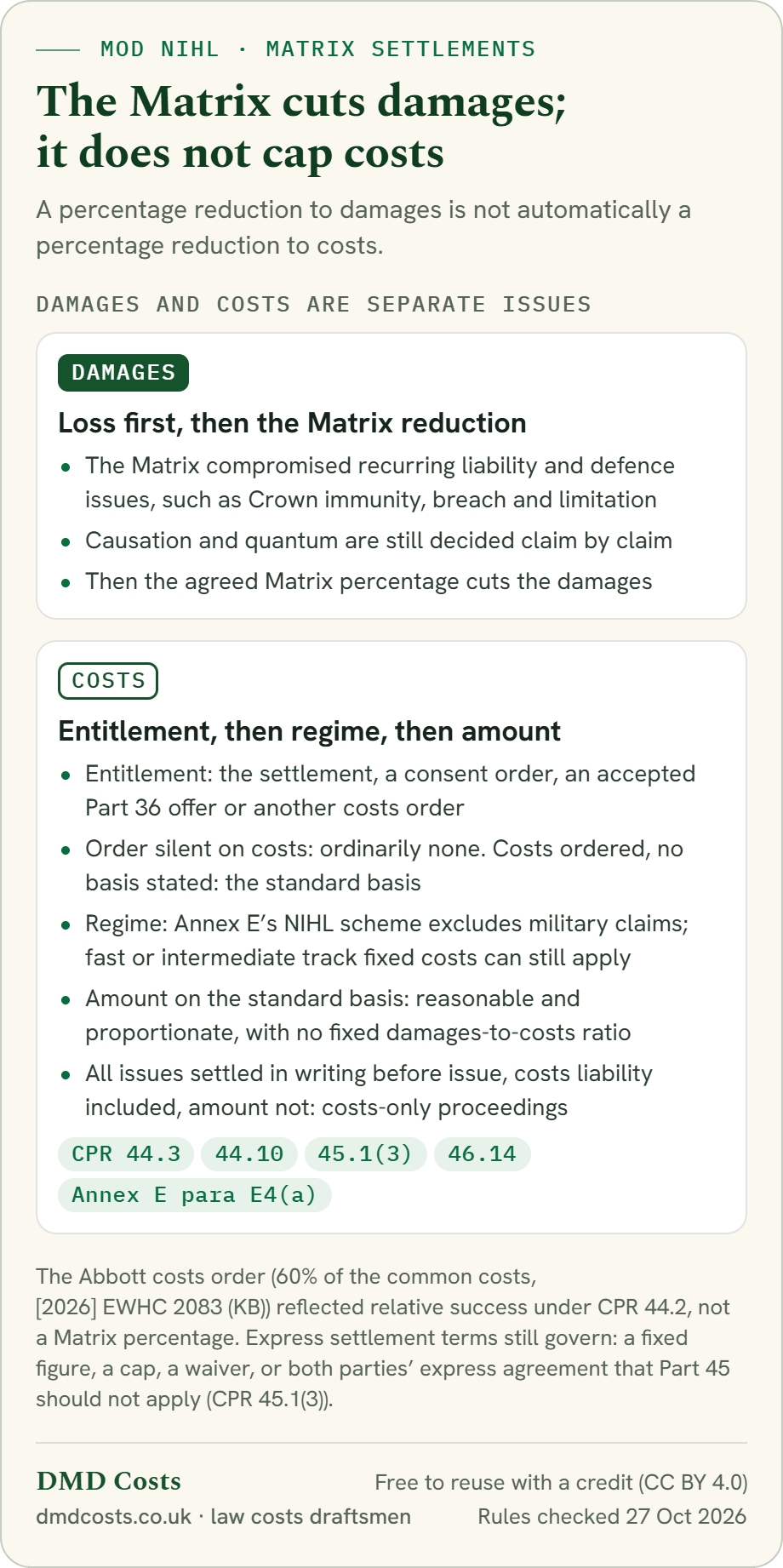
In MoD noise-induced hearing loss claims, the Matrix percentage cuts damages but is not, by itself, a costs cap; express settlement terms still govern, and costs need an entitlement. Annex E of the Disease and Illness Protocol excludes military claims from the NIHL fixed costs scheme (para E4(a)), but fast or intermediate track fixed costs can still apply (CPR Part 45, Sections VI and VII). On the standard basis, costs must be reasonable and proportionate, with no fixed ratio to damages (CPR 44.3). If all but the amount of costs, including who pays them, is agreed in writing before issue, the route is costs-only proceedings (CPR 46.14).
Free to reuse under CC BY 4.0: credit “DMD Costs (dmdcosts.co.uk)” and link to this page. Download the PNG.
Text version of this diagram
A percentage reduction to damages is not automatically a percentage reduction to costs.
Damages and costs are separate issues:
- Damages: Loss first, then the Matrix reduction.
- The Matrix compromised recurring liability and defence issues, such as Crown immunity, breach and limitation
- Causation and quantum are still decided claim by claim
- Then the agreed Matrix percentage cuts the damages
- Costs: Entitlement, then regime, then amount.
- Entitlement: the settlement, a consent order, an accepted Part 36 offer or another costs order
- Order silent on costs: ordinarily none. Costs ordered, no basis stated: the standard basis
- Regime: Annex E’s NIHL scheme excludes military claims; fast or intermediate track fixed costs can still apply
- Amount on the standard basis: reasonable and proportionate, with no fixed damages-to-costs ratio
- All issues settled in writing before issue, costs liability included, amount not: costs-only proceedings
- Rules: CPR 44.3, 44.10, 45.1(3), 46.14, Annex E para E4(a)
The Abbott costs order (60% of the common costs, [2026] EWHC 2083 (KB)) reflected relative success under CPR 44.2, not a Matrix percentage. Express settlement terms still govern: a fixed figure, a cap, a waiver, or both parties’ express agreement that Part 45 should not apply (CPR 45.1(3)).
Rules checked 27 October 2026.
Common Paying Party Arguments in MoD NIHL Costs
We regularly see the same objections in MoD NIHL costs disputes.
“The claim settled under the matrix, so the costs should be low”
The matrix may assist with damages valuation, but the solicitor still had to investigate, evidence and advise on the claim. We make sure the bill explains the work carried out before settlement.
“The costs are disproportionate to damages”
Proportionality is a common argument in NIHL claims. We address this by setting out the claim history, service evidence, medical evidence, Matrix issues and work needed to reach settlement.
“The work was routine”
Paying parties often try to treat military hearing loss files as volume claims. We identify the file-specific work, including service details, audiology, tinnitus, expert evidence, offers and settlement advice.
“Review time is excessive”
Reviewing service records, medical evidence and audiology documents can be necessary. We make sure review entries are specific and linked to file progression.
“The hourly rates are too high”
We check fee earner grades, rates and allocation before service so the bill is cleaner and more defensible. (See our guide to the 2026 Guideline Hourly Rates.)
What a Strong MoD NIHL Bill Should Include
A strong MoD NIHL bill will usually include:
- a concise case summary;
- claimant service background;
- period of alleged exposure;
- hearing loss and tinnitus issues;
- medical evidence chronology;
- audiology evidence;
- Matrix settlement reference;
- offer history;
- settlement outcome;
- costs entitlement;
- fee earner details;
- hourly rates;
- disbursement schedule;
- VAT position;
- proportionality narrative;
- assessment-ready time entries.
The aim is to make the paying party understand why the work was required.
Precedent S for MoD NIHL Claims
Where an electronic bill is required, we can prepare Precedent S for MoD NIHL files. We focus on:
- correct phase coding;
- fee earner details;
- accurate rates;
- clear descriptions;
- medical evidence work;
- review entries;
- offer and settlement work;
- disbursements;
- VAT;
- proportionality;
- assessment readiness.
A clean electronic bill improves the prospects of sensible settlement.
Points of Dispute and Replies
If the paying party serves Points of Dispute, we can prepare Replies and assist with negotiation. We deal with objections relating to:
- matrix settlement;
- proportionality;
- hourly rates;
- fee earner grade;
- medical evidence;
- audiology evidence;
- hearing aid evidence;
- service record review;
- duplication;
- routine work;
- telephone calls;
- disbursements;
- settlement work.
Our replies are drafted to move the matter forward, not to repeat generic wording.
The deadlines run from service: Points of Dispute are due 21 days after service of the notice of commencement, and any Reply 21 days after the Points of Dispute are served. Our deadline calculator sets out the full Part 47 timetable from the dates you have.
When the notice of commencement goes out, our free N252 builder fills in the form; if no Points of Dispute arrive in time, the N254 builder requests the default costs certificate. Every free tool, with plain answers to the questions fee earners ask, is on our costs help page.
Costs-Only Proceedings
Where damages have settled pre-issue, in an agreement made or confirmed in writing that settles who pays the costs but not how much, costs-only proceedings may need to be considered. We can assist with the costs work required, including:
- checking settlement wording;
- identifying costs entitlement;
- preparing the bill;
- preparing the costs chronology;
- assisting with CPR 46.14 costs-only support;
- preparing the file for negotiation or assessment.
If the paying party is delaying or making unrealistic offers, we can help you decide whether the matter is ready to be escalated.
Settlement-Led Costs Negotiation
MoD NIHL costs often settle by negotiation. The key is knowing when an offer is commercial and when it is simply too low. We review:
- the bill total;
- the damages settlement;
- the Matrix position;
- disbursements;
- VAT;
- likely assessment risk;
- proportionality;
- hourly rates;
- Part 36 risk;
- paying party conduct;
- whether Part 8 may be needed.
We aim to resolve matters commercially while protecting the value of the work properly done.
Secure Client Portal
DMD Costs has a secure client portal for solicitor firms. You can upload MoD NIHL files directly into our system without using third-party file transfer apps. The portal allows you to:
- upload files securely;
- provide service records, medical reports and correspondence;
- track the progress of each matter;
- see file status updates;
- reduce email attachments;
- keep all costs documents in one place.
This gives your team a clearer and more efficient way to manage outsourced costs work.
We work for claimant firms across England and Wales, including a firm in London. Files, papers and bills are exchanged electronically, so where your firm is based makes no difference to the work.
Flexible Instructions
You can use DMD Costs whenever required. There is no long-term commitment unless separately agreed. You can instruct us on:
- one MoD NIHL file;
- a batch of military hearing loss files;
- overflow work;
- urgent bills;
- PoDs and Replies;
- files stuck in negotiation;
- costs-only matters.
We work around your firm’s needs.
Fixed Fee Agreed Before Instructions
Our fee is fixed and agreed before the file is accepted.
Unless we agree otherwise in writing, our agreed fee is payable when your firm receives the recovered costs from the paying party. This gives claimant firms certainty on price and a practical payment structure.
Why Choose DMD Costs for MoD NIHL Costs?
Claimant firms instruct DMD Costs because we understand the costs issues that arise in military hearing loss claims. We know how paying parties attack these bills and how to present the work properly. We focus on:
- clear MoD NIHL costs drafting;
- Matrix-aware costs presentation;
- strong proportionality narratives;
- accurate fee earner rates;
- proper medical and audiology disbursement presentation;
- settlement-led negotiation;
- fixed-fee certainty;
- payment on receipt of costs;
- secure portal upload and tracking.
Further Reading on MoD NIHL Costs
Our practitioner notes on the current state of this litigation, written from the primary judgments and orders:
- Henderson v MoD [2026] EWHC 2645 (SCCO) — why the MoD could not rely on without prejudice costs breakdowns that were higher than the certified bills.
- the Abbott costs judgment — 60% of common costs, set on relative success under CPR 44.2 rather than any Matrix percentage, the £2.5m payment on account, and why the interim award was reduced.
- recovering costs after a Matrix settlement — why a damages-matrix settlement does not cap the recoverable costs.
- what Abbott means for audiology, experts and bill preparation — the practical consequences for how a military hearing loss bill is built.
Who Leads This Work
Our MoD NIHL costs guidance is written and reviewed by Mentor Nika, law costs draftsman and Head of Housing Disrepair Costs, who has more than six years’ experience in claimant legal costs and whose specialisms include MoD NIHL costs. The notes above are written from the primary judgments and orders rather than summarised from secondary reporting, so the reasoning can be checked against the source. Mentor Nika wrote about Matrix settlements and the costs that follow in the New Law Journal (30 October 2026).
The work is drafting and negotiation by a specialist costs draftsman. If a bill goes to a contested hearing, we arrange the advocate (counsel or a Costs Lawyer) and prepare the papers.
We do not publish case results we have not produced. Across our settled files, average recovery is above 70% of the bill as drafted. Beyond that, what we offer as evidence is the experience behind the work, named responsibility for it, and technical guidance you can check yourself.