On 29 October 2026 the Civil Justice Council published its Final Report on the use of AI for preparing court documents. It does not ban AI, and it does not ask lawyers to declare every use of it. It recommends a Practice Direction built on a functional, risk-based approach, and targeted changes to the Civil Procedure Rules, chiefly for witnesses of fact and experts.
These are recommendations, not rules, and none is in force. The procedural changes need the Civil Procedure Rule Committee (CPRC) to make a Practice Direction or amend the CPR, others are for the legal regulators and the CJC, and the report sets no date. Until then the existing duties apply: the statement of truth, professional obligations and the court’s powers when AI is misused.
The report is not about costs. When it mentions cost at all, it is to warn that new declarations, tool notices or permission rules could breed costly procedural disputes. But it proposes the framework in which a costs question will increasingly be argued on detailed assessment: if AI makes a task quicker, how much time remains reasonably recoverable, and how much human checking, supervision and judgment is still reasonably required? This article looks at that question for claimant firms, from fee earners’ time to expert fees.
The short answer: will using AI reduce recoverable costs?
Not automatically. Nothing in the report says that AI-assisted work must be reduced or disallowed on assessment, or charged at a lower hourly rate. The tests stay the same. The court will not allow costs that were unreasonably incurred or are unreasonable in amount (CPR 44.3(1)); on the standard basis it allows only proportionate costs and resolves any doubt in the paying party’s favour (CPR 44.3(2)). In deciding those questions it has regard to all the circumstances, including the complexity of the matter, the skill, effort, specialised knowledge and responsibility involved, and the time spent on the case (CPR 44.4).
What AI changes is the evidence. If a tool made a task quicker, a paying party may ask why so much manual time was still needed. The receiving party’s answer is the human work the task still required: checking the output against the documents, verifying authorities, applying judgment, correcting errors, protecting confidential information and taking responsibility for the finished document.
So the question on assessment is unlikely to be “was AI used?” It is: what work was actually needed to produce a reliable document, and was the time claimed for that work reasonable?
What the CJC recommends
The working group, chaired by Sir Colin Birss, published an interim report and consultation on 17 February 2026, and its final report makes 15 recommendations. Its starting point is that guidance on how lawyers use AI stays with their professional regulators, such as the SRA and the Bar Standards Board, supplemented by a Practice Direction from the CPRC that consolidates the courts’ approach to AI use and to sanctions for its misuse. Sir Geoffrey Vos, the Master of the Rolls and Chair of the CJC, described the result as “a proportionate, risk-based approach which maintains professional responsibility”.
“Functional” means the rules should not sort AI tools into categories such as generative, non-generative, administrative or analytical (Recommendation 11). They should look at what a use does: whether it can generate the substantive content of a document, or influence that content without generating it (Recommendation 12). The report defines substantive content as facts, evidence, opinion, reasoning or argument, including a witness’s own words (para 2.6). “Risk-based” means the procedural obligations should follow the risks a particular use poses to the integrity of proceedings (Recommendation 13).
Transcription shows why categories fail. An AI transcription tool looks administrative, but it can produce text that does not reflect what was said, or invent content altogether (para 9.19). Spelling and grammar checks that cannot generate or influence substantive content were outside the working group’s terms of reference and need no specific guidance (para 1.2).
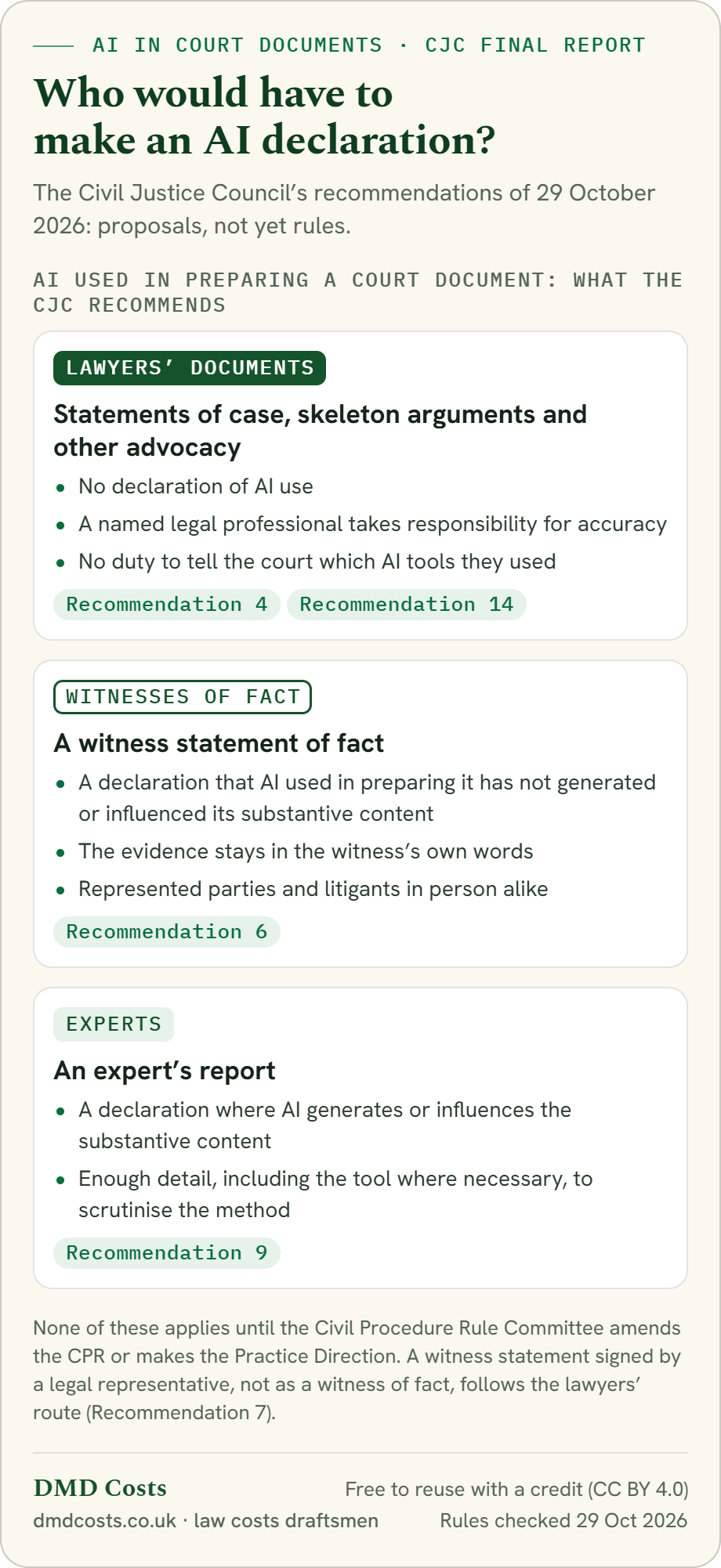
The Civil Justice Council’s Final Report on AI in court documents (29 October 2026) recommends no declaration of AI use for statements of case, skeleton arguments or other advocacy, and no duty on legal representatives to give the court details of the AI tools they used: the named legal representative stays responsible for accuracy. It recommends amending the CPR so that a witness of fact declares that AI used in preparing their statement has not generated or influenced its substantive content, and so that an expert declares AI use that generates or influences the substantive content of their report.
Free to reuse under CC BY 4.0: credit “DMD Costs (dmdcosts.co.uk)” and link to this page. Download the PNG.
Text version of this diagram
The Civil Justice Council’s recommendations of 29 October 2026: proposals, not yet rules.
AI used in preparing a court document: what the CJC recommends:
- Lawyers’ documents: Statements of case, skeleton arguments and other advocacy.
- No declaration of AI use
- A named legal professional takes responsibility for accuracy
- No duty to tell the court which AI tools they used
- Rules: Recommendation 4, Recommendation 14
- Witnesses of fact: A witness statement of fact.
- A declaration that AI used in preparing it has not generated or influenced its substantive content
- The evidence stays in the witness’s own words
- Represented parties and litigants in person alike
- Rules: Recommendation 6
- Experts: An expert’s report.
- A declaration where AI generates or influences the substantive content
- Enough detail, including the tool where necessary, to scrutinise the method
- Rules: Recommendation 9
None of these applies until the Civil Procedure Rule Committee amends the CPR or makes the Practice Direction. A witness statement signed by a legal representative, not as a witness of fact, follows the lawyers’ route (Recommendation 7).
Rules checked 29 October 2026.
The report also recommends against two proposals. Legal representatives should not have to give the court details of the AI tools they used (Recommendation 14): the working group was concerned that naming a tool could become a proxy for reliability, when the real question is whether the content is accurate (para 9.28). And no new rule should let the court grant permission to use AI (Recommendation 15): the court’s case management powers already cover an unusual case, and a party that wants confirmation that a particular use is permitted can apply under CPR 3.1(2)(p) (para 9.35).
| Recommendation | What it says | Who would act |
|---|---|---|
| 1 | Guidance for lawyers on using AI stays with the legal services regulators, who should work together, consider joint guidance and build responsible AI use into training | The regulators, with the Legal Services Board |
| 2 | Consider, as a matter of urgency, the approach to litigants in person using AI | The CJC, with the CPRC |
| 3 | A plain-language Practice Direction codifying the case law on the use of AI, and sanctions for its misuse, by legal representatives and litigants in person | The CPRC |
| 4 | No declaration of AI use for statements of case, skeleton arguments or other advocacy; the specific legal professional who takes responsibility for the document is identified | The CPRC (Practice Direction) |
| 5 | No reform for AI in disclosure for now, subject to the Disclosure Review Working Group | None for now |
| 6 | A witness of fact declares that AI used in preparing the statement has not generated or influenced its substantive content | The CPRC (CPR amendment) |
| 7 | A witness statement prepared and signed by a legal representative, other than as a witness of fact, stays the representative's responsibility, under the functional, risk-based approach | The CPRC (Practice Direction or CPR) |
| 8 | No new substantive rules for AI translation: a professional human translator certifies every translation and an AI translation comes with the original text; CPR Part 32 and its Practice Direction amended to make clear that certification covers AI translation | The CPRC (CPR Part 32); the CJC (guidance for litigants in person) |
| 9 | A new expert declaration where AI generates or influences the substantive content of the report, with enough information, including the tool where necessary, for effective scrutiny | The CPRC (CPR amendment) |
| 10 | Good practice guidance on AI use by experts in the revised Guidance for the Instruction of Experts in Civil Claims (2014) | A CJC working party |
| 11 | No categories of AI tool in the CPR (generative, non-generative, administrative, analytical, substantive or otherwise) | The CPRC |
| 12 | Define AI use by function: activities that can generate substantive content, and activities that can influence it | The CPRC |
| 13 | A risk-based approach: the procedural obligations follow the risks a use poses to the integrity of proceedings | The CPRC |
| 14 | No requirement for legal representatives to give the court details of the AI tools they used | No new rule |
| 15 | No new rules for the court to grant permission to use AI | No new rule |
Summarised from the Final Report's Summary of Recommendations (section 3). The CPRC is the Civil Procedure Rule Committee.
Recommendations, not rules: what happens next
The final report is advice to the rule-makers and the regulators. The CPRC would have to draft the Practice Direction and the CPR amendments, and the report gives no timetable; the CJC will review how far its recommendations have been taken forward in its next Annual Review (para 1.4).
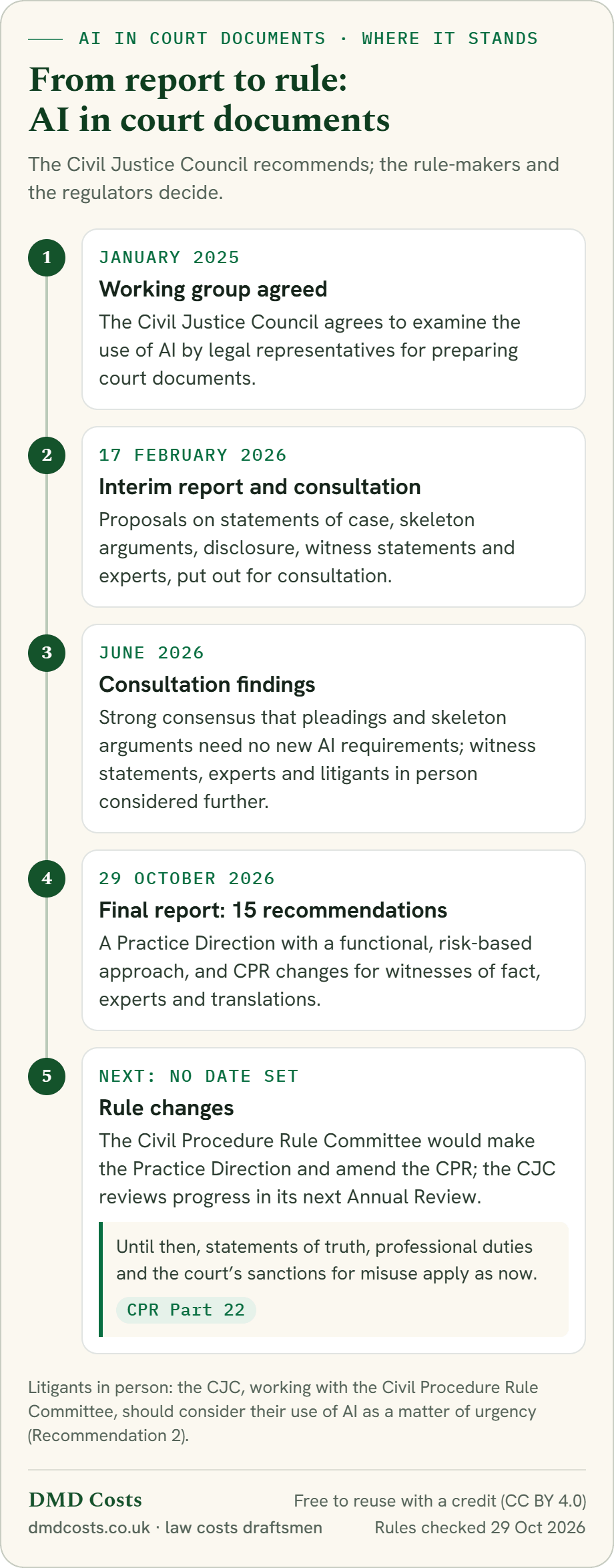
The Civil Justice Council agreed in January 2025 to set up a working group on AI in court documents. Its Interim Report and Consultation followed on 17 February 2026 and its Final Report, with 15 recommendations, on 29 October 2026. The procedural changes need the Civil Procedure Rule Committee to make the recommended Practice Direction and amend the CPR for witness of fact and expert declarations and AI translations; no date has been set. Until then the existing duties apply, including statements of truth (CPR Part 22), professional obligations and the court’s sanctions for misuse.
Free to reuse under CC BY 4.0: credit “DMD Costs (dmdcosts.co.uk)” and link to this page. Download the PNG.
Text version of this diagram
The Civil Justice Council recommends; the rule-makers and the regulators decide.
- January 2025: Working group agreed. The Civil Justice Council agrees to examine the use of AI by legal representatives for preparing court documents.
- 17 February 2026: Interim report and consultation. Proposals on statements of case, skeleton arguments, disclosure, witness statements and experts, put out for consultation.
- June 2026: Consultation findings. Strong consensus that pleadings and skeleton arguments need no new AI requirements; witness statements, experts and litigants in person considered further.
- 29 October 2026: Final report: 15 recommendations. A Practice Direction with a functional, risk-based approach, and CPR changes for witnesses of fact, experts and translations.
- Next: no date set: Rule changes. The Civil Procedure Rule Committee would make the Practice Direction and amend the CPR; the CJC reviews progress in its next Annual Review.
- Until then, statements of truth, professional duties and the court’s sanctions for misuse apply as now (CPR Part 22).
Litigants in person: the CJC, working with the Civil Procedure Rule Committee, should consider their use of AI as a matter of urgency (Recommendation 2).
Rules checked 29 October 2026.
Until then, nothing changes procedurally. Statements of case are still verified by a statement of truth, professional duties still apply, and the courts already deal with misuse, including fictitious citations, through the case law the report wants consolidated. The report also cites the SRA’s warning notice on the misuse of AI (17 August 2026) and the Bar Standards Board’s guidance on AI and other technologies (18 May 2026).
Pleadings and skeletons: responsibility, not declarations
For statements of case, skeleton arguments and other advocacy, the CJC recommends no new declaration of AI use (Recommendation 4). The working group concluded that a declaration focused on whether a tool was used would not necessarily make the content more reliable, and that arguments over what counts as an AI tool could produce satellite litigation with no benefit (para 5.10). For statements of case, the statement of truth and the named responsible lawyer are enough; skeleton arguments carry no statement of truth, but they bear the name of the lawyer responsible and are treated the same way (paras 5.4, 5.5 and 5.12).
The emphasis is on accountability. Legal representatives remain responsible for the accuracy and reliability of their documents, and the Practice Direction should make clear that, at least where AI is used, the specific legal professional who takes responsibility for a document is identified. The question is not “did a chatbot draft this?” but “which lawyer checked it and stands behind it?”
That has a costs consequence in both directions. If AI produces a first draft of a pleading in ten minutes, it does not follow that only ten minutes of fee earner time can reasonably be claimed. The draft still has to be checked against the evidence, its authorities verified, its procedural points confirmed (limitation, jurisdiction, the client’s instructions), errors corrected and judgment applied. That is professional work. Equally, a firm cannot assume that every hour its old way of working took will stay reasonable whatever technology is available. Detailed assessment arguments are likely to develop in the space between the two.
The costs tests do not change: CPR 44.3 and 44.4
The existing rules already provide the framework, and nothing in the report suggests a separate costs rule for AI-assisted work:
- CPR 44.3(1): on either basis, the court will not allow costs which have been unreasonably incurred or are unreasonable in amount;
- CPR 44.3(2): on the standard basis, only proportionate costs are allowed; disproportionate costs may be disallowed or reduced even if they were reasonably or necessarily incurred, and any doubt is resolved in favour of the paying party;
- CPR 44.4(3): the court has regard to, among other things, the complexity of the matter or the difficulty or novelty of the questions raised, the skill, effort, specialised knowledge and responsibility involved, and the time spent on the case.
A costs judge already has what is needed to decide whether time spent on an AI-assisted task was reasonable. Our step-by-step guide to detailed assessment explains how those tests are applied to a bill, from the notice of commencement to the final costs certificate.
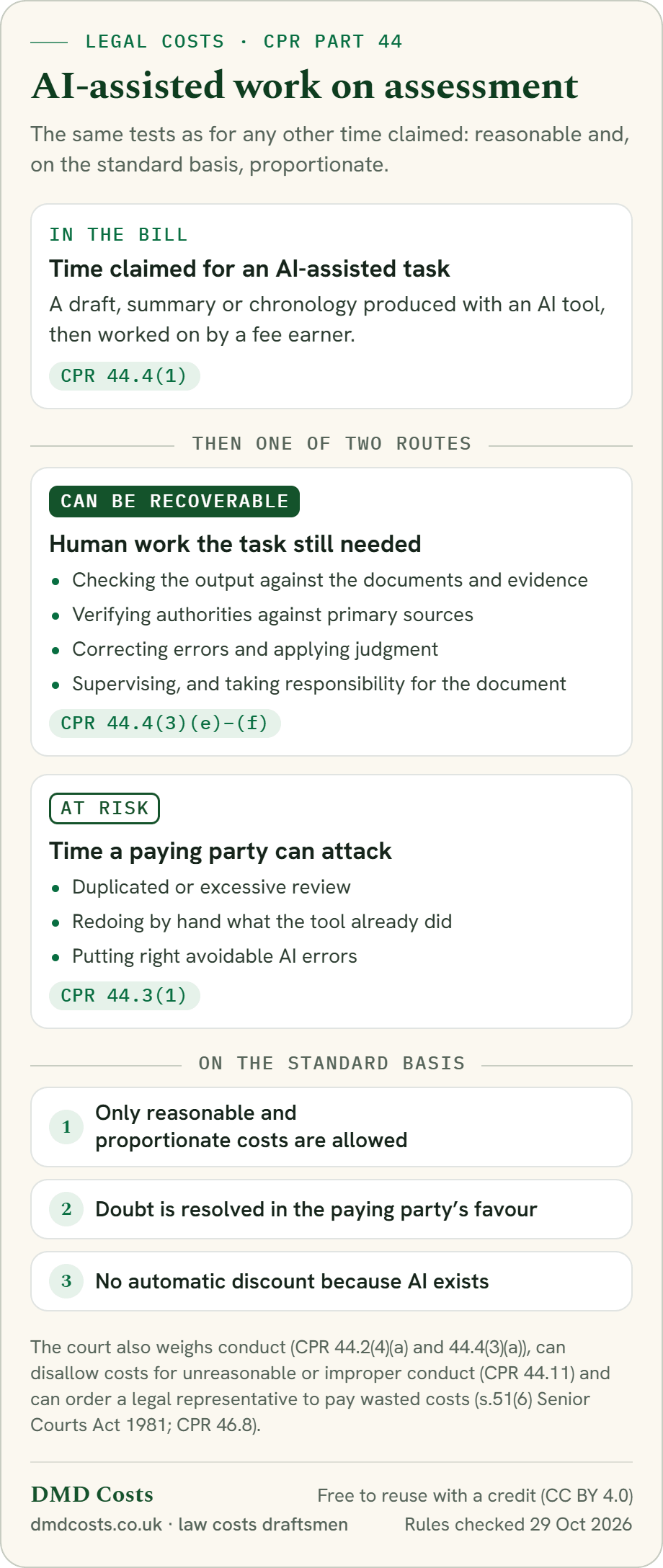
No rule reduces or disallows costs because AI was used. The court will not allow costs unreasonably incurred or unreasonable in amount (CPR 44.3(1)); on the standard basis it allows only proportionate costs and resolves doubt in the paying party’s favour (CPR 44.3(2)), having regard to factors including skill, effort, specialised knowledge, responsibility and time spent (CPR 44.4(3)). Time spent checking AI output, verifying authorities and applying judgment can be recoverable if reasonable; duplicated work and correcting avoidable AI errors are at risk.
Free to reuse under CC BY 4.0: credit “DMD Costs (dmdcosts.co.uk)” and link to this page. Download the PNG.
Text version of this diagram
The same tests as for any other time claimed: reasonable and, on the standard basis, proportionate.
In the bill: Time claimed for an AI-assisted task. A draft, summary or chronology produced with an AI tool, then worked on by a fee earner (CPR 44.4(1)).
Then one of two routes:
- Can be recoverable: Human work the task still needed.
- Checking the output against the documents and evidence
- Verifying authorities against primary sources
- Correcting errors and applying judgment
- Supervising, and taking responsibility for the document
- Rules: CPR 44.4(3)(e)–(f)
- At risk: Time a paying party can attack.
- Duplicated or excessive review
- Redoing by hand what the tool already did
- Putting right avoidable AI errors
- Rules: CPR 44.3(1)
On the standard basis:
- Only reasonable and proportionate costs are allowed
- Doubt is resolved in the paying party’s favour
- No automatic discount because AI exists
The court also weighs conduct (CPR 44.2(4)(a) and 44.4(3)(a)), can disallow costs for unreasonable or improper conduct (CPR 44.11) and can order a legal representative to pay wasted costs (s.51(6) Senior Courts Act 1981; CPR 46.8).
Rules checked 29 October 2026.
No automatic AI discount, but expect new Points of Dispute
AI should not produce a crude argument that, because a tool exists, the work should have taken half the time. Different uses need very different levels of human involvement. Using a tool to summarise 500 pages of medical records is not the same as letting it draft a pleading for filing without review, and using technology to find potentially relevant documents does not remove the need for a solicitor to understand the issues, verify the material and stand behind the conclusions. The question remains whether the time actually claimed was reasonable for the task actually performed.
The other side of the argument matters as much. AI gives paying parties a new factual basis for testing large time claims, and Points of Dispute may start to ask:
- why a document needed five hours to prepare;
- whether document review technology or automated transcription was available and used;
- whether a chronology was built by hand;
- whether the same material was reviewed more than once;
- what human checking was needed after an automated analysis;
- whether AI-generated material was reproduced without real professional input.
Not every such question will be legitimate, and some will be speculative. A point that says “this could have been done with AI, so reduce it by 75%” is not a costs argument. A stronger challenge still identifies objective features of the claim: excessive time, duplication, unnecessary senior involvement or disproportionate document review. AI may be part of the factual context; it does not replace the ordinary analysis.
The same applies to Replies. A Reply should not become an essay on the dangers of artificial intelligence. If the time was reasonably incurred, say why: the verification that was needed, source documents that had to be checked by hand, authorities checked against primary material, output that was incomplete or unreliable, client confidentiality that ruled out a public tool, or legal analysis that no tool could do. Our guide to Points of Dispute and Replies covers the format and the deadlines for both.
Time entries and bill narratives
Contemporaneous time records matter more as working methods change, not less. A bill must describe the work actually done, and a generic precedent description that no longer reflects an AI-assisted workflow is harder to defend. “Research case law, 3 hours” is difficult to justify if the task was largely automated and the fee earner’s work was checking a short list of authorities a tool produced. An entry that says what the fee earner did tells the costs judge why the time was needed:
| Task | A vague entry | An entry that shows the work |
|---|---|---|
| Legal research | Research case law, 3 hours | Review authorities identified through a research tool; check the judgments against primary sources; analyse how they apply to the Part 36 issue; prepare advice |
| Drafting | Drafting | Review AI-assisted first draft against the medical records; verify authorities and citations; amend the causation section; check the chronology against the expert evidence |
| Records review | Perusal of records | Check an automated summary of the GP and hospital records against the originals; correct the dates; note gaps for the expert |
Illustrations only. Whatever the description, the time claimed must be the time actually spent on the work described.
Our guide to the bill of costs and Precedent S explains how narratives, parts and phases fit together in a paper or electronic bill.
Checking AI output is professional work
It is tempting to assume that AI removes legal work. The report’s emphasis on verification and responsibility suggests why that is only partly true: the more substantive the AI use, the more verification matters. Whoever stands behind a document remains responsible for making sure that authorities exist and say what they are cited for, that quotations are accurate, that the evidence supports each factual statement, that the procedural rules relied on are current, that confidential information is protected and that the client’s case has not been distorted. That checking is professional work, and the fact that a tool produced the draft does not make the review unnecessary. The costs question is whether the level of review was reasonable.
DMD Costs has measured the risk on its own subject. In our study of AI and the costs rules, we put the same 102 questions on civil costs and procedure in England and Wales to Anthropic’s Claude models, with and without web search. Claude Opus 5.5, the strongest model we tested, gave a fully correct answer to 49% and a partly correct answer to a further 35.3%; it was wrong or out of date on 14.7%. The worst errors were not refusals but confident answers: old fees and rates, rules that had changed since the model was trained, and time limits stated the wrong way round. It is one provider’s models, tested once, but the lesson matches the report’s: AI can assist the professional, and it cannot take responsibility for the answer. A confidently wrong CPR deadline is still wrong.
Witness statements: the witness’s own words
Witnesses of fact are treated differently. The CJC recommends amending the CPR so that a witness of fact who makes a witness statement declares that AI used in its preparation has not generated or influenced its substantive content (Recommendation 6). The declaration bans no tool; it focuses on the result. The statement must be the witness’s evidence, in their own words. The report compares AI use that embellishes, strengthens or alters a witness’s evidence to witness coaching (para 7.14), and the declaration would apply whether a party is legally represented or a litigant in person (para 7.15).
A witness statement prepared and signed by a legal representative for a procedural or interim purpose, and not as a witness of fact, is treated like a statement of case: no declaration, with the representative primarily responsible for its accuracy and reliability (Recommendation 7). The current wording for each kind of document is in our statement of truth wording guide.
For costs, firms should not plan on witness evidence being generated from file notes and then simply approved by the witness. AI may help with administration, and an accurate transcription of the witness’s own words is not the problem (para 9.19). But the work that produces genuine evidence remains necessary: conferences with the witness, testing recollection against contemporaneous documents, resolving the chronology, taking the witness through drafts and recording their amendments, and confirming that the final statement is still their evidence. Efficiency cannot come at the expense of evidential integrity.
Translation follows the same logic. AI translation tools may be used, but every translation should be certified by a professional human translator, and an AI translation should come with the original text so that the other side and the court can check it (Recommendation 8). Where a client’s evidence needs translating, human certification remains a cost of the claim even if a tool does the first pass, recoverable if it is reasonable and proportionate.
Experts: AI that shapes the report would be declared
Experts are where the report goes furthest. The CJC recommends a new CPR requirement: where AI use generates or influences the substantive content of an expert’s report, the expert makes a specific declaration giving enough information, including the AI tool where necessary, for the opposing party and the court to scrutinise the evidence, the methodology, whether AI was appropriate for that purpose, and the content (Recommendation 9). The reason is that an expert’s method is part of the evidence: disclosure lets the opposing expert and the court see how the opinion was formed (paras 8.9 to 8.11).
Revised guidance for experts should take them through three questions (para 8.14):
- Has my use of AI generated or influenced the substance of my evidence? If so, the declaration is needed.
- What information will let the opposing party and the court scrutinise my methodology and analysis effectively?
- Is it necessary to disclose the AI tool I used?
Experts already verify their reports with a statement of truth (PD 35 para 3.3), and some consultees argued that the existing duty to explain methodology already covers AI. The working group accepted that it may, but preferred a separate obligation that highlights it (para 8.12).
What it could mean for expert fees
This is where the report could matter most to costs, even though it is not a costs report. In clinical negligence and MoD noise-induced hearing loss claims, expert fees are often among the largest disbursements, and they are already challenged on hourly rate, total hours, duplication, necessity, the scope of the instruction and proportionality.
A declaration of substantive AI use would add an evidential layer. Suppose an expert charges for 20 hours of analysis and declares that much of the analysis was carried out with an AI tool. That does not make the fee excessive: the expert may still have spent real professional time setting up the analysis, checking the source material, testing and rejecting output, reviewing the literature, applying clinical or technical expertise and taking responsibility for the opinion. But it becomes legitimate to ask what the expert actually did, and whether the fee reflects it. Declarations would give paying parties more visibility of how reports are produced, and so more material for testing fees on assessment.
Firms can get ahead of this by asking experts at instruction whether and how they use AI, and by making sure the invoice describes the work actually done, rather than discovering it during costs negotiations. Where a served report is unclear about how an analysis was carried out, written questions under CPR 35.6, put within 28 days of service and for the purpose of clarifying the report, are the existing route; our Part 35 questions template sets them out.
AI misuse can cost money
The CJC wants the Practice Direction to codify the case law on AI use and the sanctions for its misuse, including where documents contain hallucinated authorities (Recommendation 3). The report cites, for example, the Divisional Court’s judgment in R (Ayinde) v London Borough of Haringey [2025] EWHC 1383 (Admin). Earlier in the same claim, after five fake cases were cited for the claimant, Ritchie J ([2025] EWHC 1040 (Admin)) made wasted costs orders of £2,000 each against counsel and the claimant’s solicitors, and cut the claimant’s own costs award by £7,000, from £13,500 to £6,500. The judge made no finding that AI had been used. The point is that unchecked citations are expensive, whatever produced them.
The existing rules already deal with the cost of putting things right. The court considers conduct when deciding what costs order to make (CPR 44.2(4)(a)) and on assessment (CPR 44.4(3)(a)); it can disallow costs, or order a party or its legal representative to pay costs, where their conduct was unreasonable or improper (CPR 44.11); and it can make wasted costs orders against legal representatives (section 51(6) of the Senior Courts Act 1981 and CPR 46.8). A receiving party should not assume the paying party will fund the cost of correcting an inaccurate pleading, amending a skeleton argument, answering an application caused by invented authorities, or redoing expert work. AI does not need its own costs sanction for those principles to apply.
Will AI change hourly rates?
Not by itself. The report proposes nothing on the Guideline Hourly Rates or on how hourly rates are assessed. A Grade A fee earner doing Grade A work does not stop doing it because technology is part of the process, and sophisticated technology does not justify unnecessary senior input either. CPR 44.4(3)(e) already lets the court weigh the skill, effort, specialised knowledge and responsibility involved, so AI is more likely to affect the time reasonably spent on a task than the rate for it. Our guide to the 2026 guideline hourly rates covers how rates are argued on assessment.
Housing disrepair, clinical negligence and MoD NIHL
Housing disrepair
Housing disrepair work has many repeatable processes where AI and automation are likely to spread: chronologies, reviewing correspondence, identifying repair complaints, analysing disclosure, standard letters and organising surveyor evidence. That may make files more efficient, but it does not change the recoverability tests. Where AI saves genuine administrative time, the bill should reflect the work actually recorded; where human review was needed, the file should show it. Our housing disrepair costs service covers bills, Replies and negotiation.
Clinical negligence
The implications may be greater in clinical negligence because of the weight of expert evidence: breach, causation, condition and prognosis, life expectancy, care, occupational therapy, accommodation and other quantum disciplines. If the expert recommendations are implemented, substantive AI use by any of those experts would have to be declared, which could shape both how their evidence is challenged and how their fees are scrutinised on assessment. See our clinical negligence costs service.
MoD NIHL
MoD noise-induced hearing loss claims involve large volumes of service records, medical records, audiology and disclosure, often across groups of similar claims, so AI-assisted analysis has obvious uses. The same rule applies: efficiency does not remove professional responsibility, and where substantial solicitor or expert time is claimed, the file should show what was done and why it was needed. See our MoD NIHL costs service.
What claimant firms can do now
The Practice Direction is not yet written, but the principles behind it are clear enough to act on:
- Keep a clear internal policy on AI use, consistent with your regulator’s guidance.
- Make sure fee earners verify AI-assisted work that affects substance, and that a named lawyer takes responsibility for each document.
- Protect confidentiality and privilege when choosing tools.
- Keep witness evidence in the witness’s own words.
- Ask experts at instruction whether and how they use AI.
- Record time accurately, describing the work done rather than a generic task.
- Make sure the time claimed reflects work genuinely undertaken.
- Treat AI as a professional tool, not a substitute for professional judgment.
The costs question that will matter
Legal costs have always moved with technology. Email changed correspondence, electronic disclosure changed document review, Precedent S changed bills and remote hearings changed travel and attendance. AI will do the same, and the courts do not need a new principle of costs law to deal with it. CPR 44 already asks the questions that matter: was the work reasonable, was the amount reasonable, was it proportionate, what skill and responsibility did it involve, and how much time did it reasonably need? AI changes the evidence available to answer them. It does not make them disappear.
How DMD Costs can help
As more litigation work is technology-assisted, accurate time records and clear bill narratives matter more. DMD Costs draws bills of costs and Precedent S electronic bills, answers Points of Dispute with Replies, prepares Precedent H budgets, budget discussion reports (Precedent R), budget variations (Precedent T) and N260s, supports CPR 46.14 costs-only proceedings and handles costs negotiation to settlement. The aim stays the same: show what work was reasonably done and why it was needed, and recover the costs the client is properly entitled to. See our full costs drafting services.
Instructions can be sent through the DMD Costs secure client portal, where firms can upload papers, monitor progress and request updates; it is also available as a mobile app. The fee is fixed and agreed before any work begins. Our free calculators, form builders and guides are collected in our legal costs help hub.
Report details
| Report | Use of AI for Preparing Court Documents: Final Report |
| Published by | Civil Justice Council, Working Group on the Use of AI for Preparing Court Documents |
| Date | 29 October 2026 (interim report and consultation: 17 February 2026) |
| Chair | Sir Colin Birss |
| Scope | AI use by legal representatives and experts in preparing documents for civil proceedings; AI use by judges and litigants in person was outside the terms of reference |
| Recommendations | 15: guidance for lawyers stays with the regulators, supplemented by a Civil Procedure Rule Committee Practice Direction with a functional, risk-based approach to AI use; declarations for witnesses of fact and experts |
| Status | Recommendations only: not yet in the CPR or any Practice Direction |
Sources
- Civil Justice Council, Use of AI for Preparing Court Documents: Final Report (29 October 2026)
- Civil Justice Council, Use of AI in preparing court documents (working group page and June 2026 update)
- Civil Justice Council, Interim Report and Consultation (17 February 2026)
- Civil Procedure Rules, Part 44 (general rules about costs)
- Civil Procedure Rules, Part 35 (experts and assessors)
- R (Ayinde) v London Borough of Haringey [2025] EWHC 1040 (Admin) (Find Case Law)
- R (Ayinde) v London Borough of Haringey [2025] EWHC 1383 (Admin) (Find Case Law)