How to use the N242A builder
- Enter the claim. Enter the court, the claim number and the parties, with references. Leave the court blank if proceedings have not started.
- Describe the offer. Choose what it settles, whether it is a claimant’s or a defendant’s offer, the party making it, and the offeree with its address.
- Enter the sum. For a money offer, enter the sum. The builder suggests the wording, including how interest is treated, and you can edit it.
- Answer the counterclaim and injury questions. Say whether the offer takes any counterclaim into account and, in a personal injury claim, deal with provisional damages and recoverable benefits.
- Set the relevant period and service. Enter the relevant period, at least 21 days, and when and how the offer will be served. The builder shows when it is made and when the period ends.
- Sign and download. Add the name and date, download the filled N242A, check it, sign it and serve it. The notice of acceptance on page 5 can be filled in ready for the offeree.
What a Part 36 offer must contain
A Part 36 offer must (CPR 36.5(1)):
- be in writing;
- make clear that it is made under Part 36;
- specify a period of not less than 21 days within which the defendant will be liable for the claimant’s costs if the offer is accepted, the relevant period;
- state whether it relates to the whole of the claim, to part of it or to an issue that arises in it, and if so to which part or issue; and
- state whether it takes into account any counterclaim.
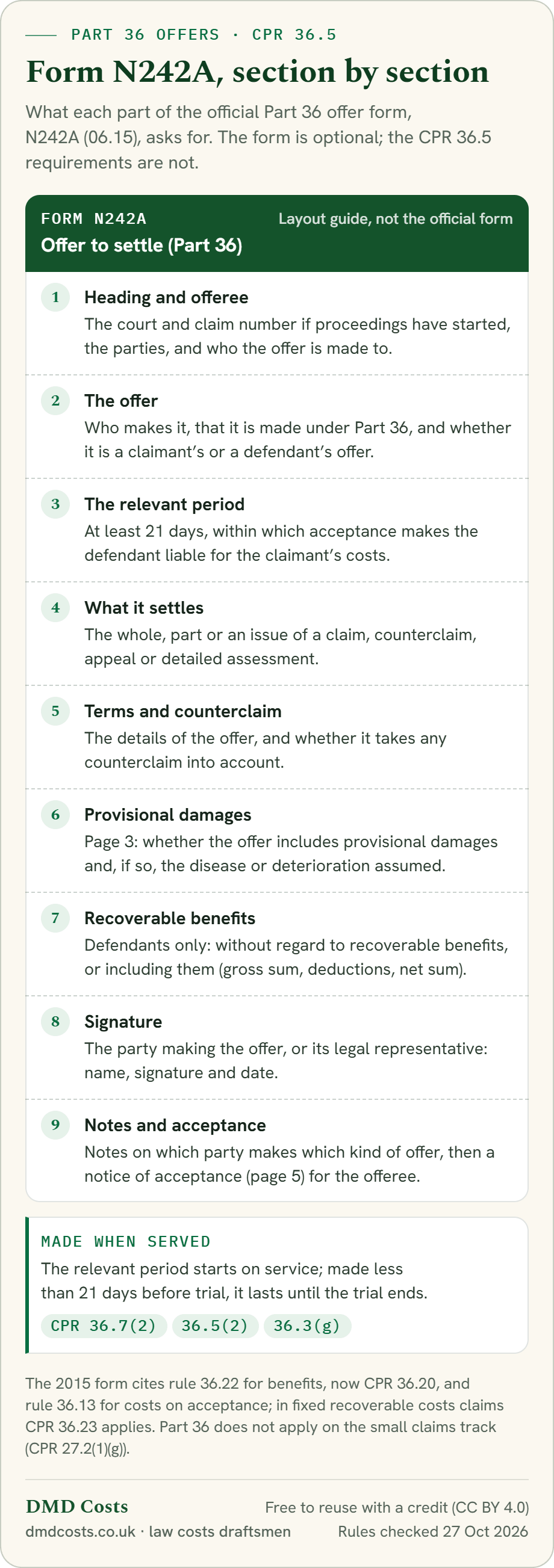
Form N242A, the Part 36 offer form, covers in order: the court and parties, the offeree, and who makes the offer under Part 36, as a claimant’s or a defendant’s offer; the relevant period, at least 21 days unless made less than 21 days before trial; whether it settles the whole, part or an issue of a claim, counterclaim, appeal or detailed assessment; the terms, and whether it takes any counterclaim into account; provisional damages; recoverable benefits, for defendants; and the signature, then notes and a notice of acceptance. The form is optional; any Part 36 offer must meet CPR 36.5, and it is made when it is served (CPR 36.7).
Free to reuse under CC BY 4.0: credit “DMD Costs (dmdcosts.co.uk)” and link to this page. Download the PNG.
Text version of this diagram
What each part of the official Part 36 offer form, N242A (06.15), asks for. The form is optional; the CPR 36.5 requirements are not.
Form N242A: Offer to settle (Part 36). Layout guide, not the official form.
- Heading and offeree: The court and claim number if proceedings have started, the parties, and who the offer is made to.
- The offer: Who makes it, that it is made under Part 36, and whether it is a claimant’s or a defendant’s offer.
- The relevant period: At least 21 days, within which acceptance makes the defendant liable for the claimant’s costs.
- What it settles: The whole, part or an issue of a claim, counterclaim, appeal or detailed assessment.
- Terms and counterclaim: The details of the offer, and whether it takes any counterclaim into account.
- Provisional damages: Page 3: whether the offer includes provisional damages and, if so, the disease or deterioration assumed.
- Recoverable benefits: Defendants only: without regard to recoverable benefits, or including them (gross sum, deductions, net sum).
- Signature: The party making the offer, or its legal representative: name, signature and date.
- Notes and acceptance: Notes on which party makes which kind of offer, then a notice of acceptance (page 5) for the offeree.
Made when served: The relevant period starts on service; made less than 21 days before trial, it lasts until the trial ends (CPR 36.7(2), 36.5(2), 36.3(g)).
The 2015 form cites rule 36.22 for benefits, now CPR 36.20, and rule 36.13 for costs on acceptance; in fixed recoverable costs claims CPR 36.23 applies. Part 36 does not apply on the small claims track (CPR 27.2(1)(g)).
Rules checked 27 October 2026.
The 21-day period is not needed where the offer is made less than 21 days before the start of a trial (CPR 36.5(2)); the relevant period then runs to the end of the trial (CPR 36.3(g)). An offer may relate to an issue, such as liability (CPR 36.2(3)). Form N242A has a box for each of these, and its notes say which kind of offer each party makes on a counterclaim, an appeal or a detailed assessment. Part 36 applies to an appeal or cross-appeal only where it is from a decision made at a trial (CPR 36.2(3)(b)), and there the ‘trial’ is the appeal hearing (CPR 36.4(2)). To make an offer to settle the claim outside Part 36 instead, marked ‘without prejudice save as to costs’, use our free Calderbank offer letter builder.
| Point | Part 36 offer | Calderbank offer |
|---|---|---|
| How it is made | In writing, saying it is made under Part 36, with a relevant period of at least 21 days unless it is made less than 21 days before trial; Form N242A may be used but is optional (CPR 36.5; PD 36 para 1.1) | In writing, marked “without prejudice save as to costs”. A letter marked only “without prejudice” generally cannot be shown to the court, even on costs, unless both parties agree (Reed Executive plc v Reed Business Information Ltd [2004] EWCA Civ 887 at [19] and [21]) |
| If judgment is no better for the other side than the offer | The CPR 36.17 consequences follow unless the court considers them unjust: on a defendant’s offer, the defendant’s costs from the end of the relevant period, with interest; on a claimant’s own offer, enhanced interest, indemnity costs and an additional amount. They do not apply to an offer that was withdrawn, changed to be less advantageous and then beaten, or made less than 21 days before trial unless the court abridged the relevant period (CPR 36.17(7)). In fast track, intermediate track and noise-induced hearing loss fixed costs claims, CPR 36.24 modifies them | Nothing follows automatically: an offer not made in accordance with rule 36.5 has none of Part 36’s consequences (CPR 36.2(2)). The court weighs it among all the circumstances (CPR 44.2(4)(c)) and may, for example, order costs from or until a date (CPR 44.2(6)(c)) |
| What counts as doing better | Better in money terms by any amount, however small (CPR 36.17(2)) | That test is not read into Part 44: an offer is unlikely to count for much if the other side did significantly better (Coward v Phaestos Ltd [2014] EWCA Civ 1256 at [98] and [102]) |
| Rejected, then accepted later | Can still be accepted at any time, even if the offeree has since made a different offer, unless it has been withdrawn; in some cases, such as while a trial is in progress, only with the court’s permission (CPR 36.11) | At common law a rejected offer cannot be accepted (MEF v St George’s Healthcare NHS Trust [2020] EWHC 1300 (QB) at [25]) |
| How long it stays open | Until withdrawn: by written notice, possible only before acceptance, or automatically under its own terms once the relevant period has expired (CPR 36.9); a withdrawal served before the relevant period ends takes effect only when it ends (CPR 36.10) | As its terms say: it is governed by contract. With no time limit it stays open for a reasonable time; the offeror can set a time limit, or withdraw it before it is accepted (MEF at [35], [37] and [43]) |
| Small claims track | Does not apply once a claim is allocated to the small claims track (CPR 27.2(1)(g)) | Rejecting an offer is not of itself unreasonable behaviour, but the court may take it into account when deciding whether a party behaved unreasonably (CPR 27.14(3)) |
Part 36 is a self-contained code: an offer made outside it counts only through the court’s discretion on costs. Civil claims in England and Wales; financial remedy proceedings and employment tribunals have their own rules (see the Calderbank offer letter builder). A guide, not legal advice.
When it is made, and interest
A Part 36 offer may be made at any time, including before proceedings start, and it is made when it is served on the offeree (CPR 36.7), on the deemed date of service: the same day for an email sent before 4.30pm on a business day, otherwise the next business day, and for first class post the second day after posting if that is a business day, or else the next business day (CPR 6.26). Email is good service only if the offeree has said in writing that it accepts it (PD 6A para 4.1). An offer to pay or accept a sum of money is treated as inclusive of all interest until the relevant period expires or, where the offer is made less than 21 days before trial, until 21 days after it was made (CPR 36.5(4)); a claimant’s offer that makes no provision for interest after that is treated, if accepted later, as inclusive of all interest to the date of acceptance (CPR 36.5(5)). A defendant’s money offer must be a single sum payable within 14 days of acceptance (CPR 36.6). The builder works out the dates from the date and method of service; to count any other time limit, use the CPR deadline calculator.
Part 36 offers in detailed assessment
Part 36 applies to the costs of detailed assessment proceedings, with modifications (CPR 47.20), so a well-judged offer on the bill can decide who pays the costs of the assessment. The receiving party makes a claimant’s offer and the paying party a defendant’s offer, and the ‘trial’ is the detailed assessment hearing (CPR 47.20(4)). Under Practice Direction 47 para 19 the offer should say whether it is intended to include the costs of preparing the bill and VAT; unless it says otherwise, it is treated as including them. Whether VAT can be recovered from the paying party at all is a separate question, which the free VAT on costs checker works through. To see the whole timetable, use the detailed assessment deadline calculator.
Personal injury claims
Page 3 of the form deals with damages for personal injury. Where there is a claim for provisional damages, the offer must say whether it includes an award of provisional damages and, if it does, that it assumes the claimant will not develop the disease or suffer the type of deterioration specified in the offer, and the period within which any claim for further damages must be made (CPR 36.19(2) and (3)); if it is accepted, the claimant must apply for the award within 7 days (CPR 36.19(5)). A defendant must also say, where relevant, whether the offer is made without regard to any liability for recoverable benefits or is intended to include deductible amounts; if it includes them, the offer states the gross compensation, each deduction and the net sum, and the defendant must apply for a certificate of recoverable benefits before making the offer, and clarify the offer within 7 days of receiving the certificate if it arrives later (CPR 36.20). The 2015 form still refers to rule 36.22 for this; the rules were renumbered in 2023.
After the offer is served
The offeree may ask for clarification within 7 days of the offer being made (CPR 36.8), and accepts by serving written notice of acceptance (CPR 36.11); page 5 of the form is a notice of acceptance for the purpose. If an offer on the whole claim is accepted within the relevant period, the claimant is entitled to its costs up to the date notice of acceptance is served (CPR 36.13(1)), or to the fixed costs in a claim to which Part 45 Section VI, VII or VIII applies (CPR 36.23). The court decides the costs, unless they are agreed, if the offer was made less than 21 days before trial, does not relate to the whole claim, or is accepted after the relevant period; on a late acceptance of an offer on the whole claim it will usually give the claimant its costs to the end of the relevant period and the offeree will pay the offeror’s costs after that (CPR 36.13(4) and (5)). In a fixed costs claim a defendant’s offer accepted late is costed under CPR 36.23 instead, and once the claim has moved to a later stage the claimant gets no costs order of its own: see Lintern v Haven Insurance. If the offer is not accepted and the result at trial is at least as advantageous to the offeror, the consequences in CPR 36.17 follow, unless the offer was made less than 21 days before trial and the court has not abridged the relevant period (CPR 36.17(7)(c)): work them out with the free Part 36 calculator.
Related guides and tools
- The terms, defined: Part 36 offer and its costs consequences
- Every costs form explained: our costs forms and precedents guide
- Related free tools: the Part 36 calculator, the interest on costs calculator and the deemed service calculator
- Late acceptance of a Part 36 offer and the CPR 36.17 uplift
Sources
- Form N242A: notice of offer to settle, Section I of Part 36 (HMCTS, GOV.UK)
- CPR Part 36 (rules 36.2 to 36.11, 36.13, 36.14, 36.17, 36.19, 36.20 and 36.23)
- CPR Part 27 (rule 27.2, the small claims track)
- CPR Part 47 (rule 47.20) and Practice Direction 47 (para 19)
- CPR Part 6 (rule 6.26, deemed service)