How to use the N215 builder
- Say what was served. Choose the claim form or another document, list what was served and on whom.
- Choose the method. Pick the method of service from the form’s list: post, leaving at a place, personal service, a method the court permitted, DX, fax or another electronic method.
- Enter the day and time. Enter the day of posting, leaving, handing over or sending and, where the 4.30pm cut-off matters, the time. The builder works out the deemed date.
- Give the address or number. Enter the address, DX number, fax number or email address used, and whose address it is.
- Sign. Tick the statement of truth, choose who signs and enter the name, firm and date.
- Download. Download the filled N215, check it, sign it and file it; for a claim form, within 21 days of service of the particulars of claim.
The deemed date of service
The builder uses the same rules as the free deemed service calculator. A claim form is deemed served on the second business day after the step required by CPR 7.5(1) (CPR 6.14); the claim form itself must be served by taking that step before 12 midnight on the calendar day four months after the date of issue (CPR 7.5(1)). Any other document follows the CPR 6.26 table. Where the time is not entered for a method with a 4.30pm cut-off, the builder assumes it was 4.30pm or later, which gives the later date, and says so. The official form, N215 (06.26), asks six numbered questions, then has a statement of truth, and explains these deemed service rules on page 5. To count any other time limit, use the CPR deadline calculator.
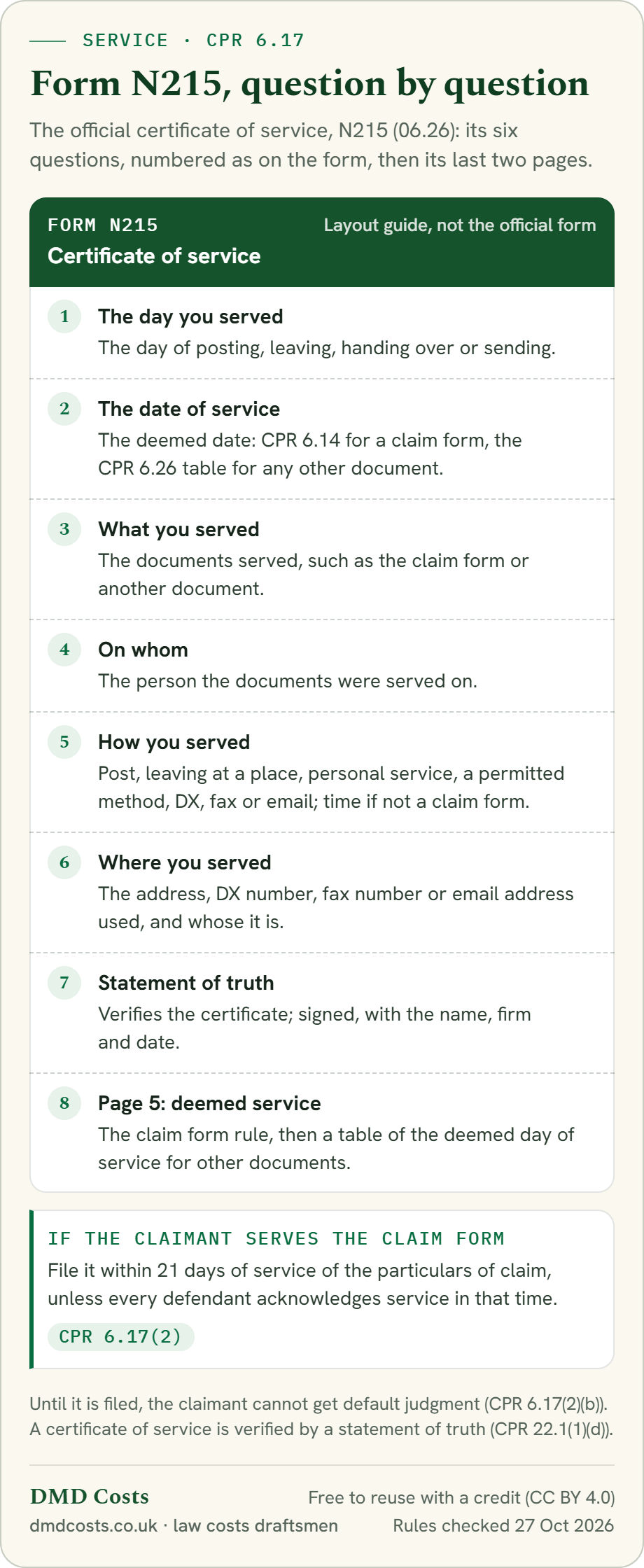
Form N215, the certificate of service, asks in order: the day the document was served and its deemed date of service (CPR 6.14 for a claim form, the CPR 6.26 table for other documents); what was served and on whom; how it was served, from post or DX to personal service, fax or email; and the address, DX, fax number or email used. A statement of truth follows (CPR 22.1(1)(d)), and page 5 explains deemed service. A claimant who serves the claim form must file a certificate within 21 days of service of the particulars of claim, unless every defendant has acknowledged service in that time, and needs one for default judgment (CPR 6.17(2)).
Free to reuse under CC BY 4.0: credit “DMD Costs (dmdcosts.co.uk)” and link to this page. Download the PNG.
Text version of this diagram
The official certificate of service, N215 (06.26): its six questions, numbered as on the form, then its last two pages.
Form N215: Certificate of service. Layout guide, not the official form.
- The day you served: The day of posting, leaving, handing over or sending.
- The date of service: The deemed date: CPR 6.14 for a claim form, the CPR 6.26 table for any other document.
- What you served: The documents served, such as the claim form or another document.
- On whom: The person the documents were served on.
- How you served: Post, leaving at a place, personal service, a permitted method, DX, fax or email; time if not a claim form.
- Where you served: The address, DX number, fax number or email address used, and whose it is.
- Statement of truth: Verifies the certificate; signed, with the name, firm and date.
- Page 5: deemed service: The claim form rule, then a table of the deemed day of service for other documents.
If the claimant serves the claim form: File it within 21 days of service of the particulars of claim, unless every defendant acknowledges service in that time (CPR 6.17(2)).
Until it is filed, the claimant cannot get default judgment (CPR 6.17(2)(b)). A certificate of service is verified by a statement of truth (CPR 22.1(1)(d)).
Rules checked 27 October 2026.
Related guides and tools
- The term, defined: deemed service
- Other free form builders: the N244 application notice, the N434 notice of change and the N252 notice of commencement
- Every free tool in one place: costs help for solicitors
Sources
- Form N215: certificate of service (HMCTS, GOV.UK)
- CPR Part 6 (rules 6.2, 6.14, 6.17, 6.26 and 6.29) and Practice Direction 6A (paras 4.1 and 4.2)
- CPR Part 7 (rule 7.5), CPR Part 2 (rule 2.8) and CPR Part 22 (rule 22.1)