Request a fixed-fee quote →
07900 008720info@dmdcosts.co.ukClient portal
Home / Costs help / Civil court fees calculator
Free tool

Civil Court Fees 2026 (EX50): Free Calculator and Main Fees List

Led by Diellza Nika Hyseni and Mentor Nika · Updated 1 November 2026

Work out the main court fees for a civil claim in England and Wales at the fees in force from 13 July 2026, and see the EX50 fees list: the issue fee on the value claimed, Part 8 claims, the hearing fee by track, applications and consent orders, appeals, detailed assessment, enforcement, and winding-up and bankruptcy petitions, each with its fee number. Or look up the fee for a form or step by its number, from N1 and N244 to N245, N293A and N379, in the court fee finder. From DMD Costs, law costs draftsmen in Westhoughton, Bolton.

  • Free, with no sign-up
  • No paywall
  • Fees from 13 July 2026
  • Fee numbers shown
  • Fee by form number
  • Nothing leaves your browser

Answer what applies. Each answer adds its fee, with the fee number from the Civil Proceedings Fees Order.

Issuing the claim
On the claim plus any interest claimed. If the claim form gives a range, entering the top of it avoids paying too little.
The hearing fee
Applications
Appeal
An appeal in detailed assessment proceedings has its own fee, in step 5
Costs
Enforcement

Your court fees

Nothing yet · from 13 July 2026

The fees build here as you answer, each with its fee number, grouped by stage, then the total.

Enter the sum claimed, with any interest, for the issue fee.

Nothing you enter leaves your browser. Help with fees is not taken into account.

Costs to recover when the claim ends? We work for solicitor firms: our law costs draftsmen draw the bill, court fees included, and negotiate the costs to settlement. The fee is fixed and agreed before any work begins.

Send us the file

The fees are those in the Civil Proceedings Fees Order 2008, as listed in HMCTS’s EX50 and EX50A, in force from 13 July 2026 and checked on 26 October 2026; the official receiver’s deposits are set by the Insolvency Proceedings (Fees) Order 2016. Fees change from time to time, so check the current EX50 before paying. Help with fees is not taken into account. It is a guide, not legal advice.

Example: made-up details, fixed dates

Worked example: court fees for a housing disrepair claim with £8,000 damages

A tenant’s housing disrepair claim in the County Court asks for an order for repairs, with £8,000 damages claimed in addition. The fees are worked out for issuing it, the fast track hearing fee, one application on notice and a request for detailed assessment of a £14,800 bill, including £2,466.67 VAT, at the fees in force from 13 July 2026.

Issuing the claim costs £842: £387 for the order for repairs (fee 1.5) and £455 for the £8,000 damages (fee 1.1(g)); the fast track hearing fee is £619 (fee 2.1(b)), the application on notice £321 (fee 2.4(a)) and the request for detailed assessment £398 (fee 5.2(a)), so the court fees come to £2,180.

Entered in the tool

Court
County Court
The claim
Repairs or another non-money remedy
Damages claimed, with interest
£8,000, in addition
Track
Fast track
Applications on notice
1
Detailed assessment (N258): bill total, with VAT
£14,800
VAT in the bill
£2,466.67
The court fees the calculator gives, at the fees in force from 13 July 2026
FeeFee numberBasisAmount
Issue fee: non-money remedy (County Court)1.5County Court£387.00
Issue fee: money claimed as well1.1(g)Claim of £8,000.00£455.00
Hearing fee: fast track2.1(b)Fast track£619.00
Application on notice2.4(a)Where no other fee is specified£321.00
Request for detailed assessment (N258)5.2(a)Costs claimed of £14,800.00£398.00
Total court fees£2,180.00
Points to note
  • Where money is claimed in addition to a non-money remedy (other than possession of land or the recovery of goods), both fees are paid: fee 1.5 and fee 1.1.
  • The hearing fee is charged when the court fixes the trial date or trial period, and must be paid by the date in the fee notice the court sends with it (CPR 3.7A1): at least 28 days before the trial, or the Monday of the first week of a trial period, where notice is given 36 days or more ahead, and otherwise within 7 days of the notice. If it is not paid by then, and help with fees is not applied for, the claim (or counterclaim) is struck out. The claimant pays it, unless the case continues on the counterclaim alone, and it is not payable where the court fixed the trial date when the claim was issued.
  • For fee 2.5, a request for judgment in default or on admission is not an application, so no fee is paid; but default judgment on a claim that includes a non-money remedy, such as an order for repairs, needs a Part 23 application (CPR 12.4(3)), which is charged as an application, unless the claimant abandons that remedy in the request (CPR 12.4(4)). An application by consent to adjourn a hearing that reaches the court at least 14 days before it is free. Applications under section 3 of the Protection from Harassment Act 1997, or for a payment out of funds in court, are £195 on notice and £63 by consent or without notice (fees 2.4(b) and 2.5(b)).

Fees in force from 13 July 2026 (Civil Proceedings Fees Order 2008, Sch 1; HMCTS EX50). Help with fees is not taken into account.

Worked out by the civil court fees calculator above, with the rules as they stood on . Try it with your own details. A guide, not legal advice.

Video · 0:39

Civil court fees 2026: what it costs to issue a money claim

More short videos like this one, each with its transcript, are on our costs explainer videos page.

Transcript

The fee for starting a money claim depends on the amount claimed, including any interest. Here are the current issue fees. Up to three hundred pounds, the fee is thirty-five pounds. Between five and ten thousand pounds, it is four hundred and fifty-five. From ten thousand to two hundred thousand, it is five per cent of the claim. Above that, or where the value is not limited, it is ten thousand pounds. Hearing fees and application fees are separate, and some fees can be reduced or waived through Help with Fees. Work out the main civil court fees with DMD Costs' free calculator, at dmdcosts.co.uk.

The narration is a synthetic voice. Watch on YouTube.

Key points

  • DMD Costs’ civil court fees calculator is a free online tool for the main court fees in a civil claim in England and Wales, from issue to enforcement, at the fees in force from 13 July 2026, with a list of the main civil fees in HMCTS’s EX50 by fee number (Civil Proceedings Fees Order 2008, Schedule 1).
  • The issue fee for a money claim, worked out on the claim plus interest, runs from £35 for claims up to £300 to £455 for claims up to £10,000; over £10,000 and up to £200,000 it is 5% of the claim, and over £200,000, or where the claim form states no value, it is £10,000 (fee 1.1).
  • A claim for a non-money remedy, such as an order for repairs, costs £387 to issue in the County Court and £663 in the High Court (fee 1.5); where damages are claimed in addition, the money claim fee is paid as well, except in claims for possession of land or the recovery of goods.
  • The Fees Order has no fee for Part 8 as such; on our reading a Part 8 claim pays the fee for what it asks for, so a claim for a declaration or another non-money remedy pays £387 in the County Court or £663 in the High Court (fee 1.5). Costs-only proceedings, brought under Part 8, pay £69 (fee 1.8(b)), and the Order says fees 1.1 and 1.5 are not payable on top.
  • The hearing fee is £619 on the fast track and £1,334 on the intermediate track or multi-track, and £27 to £346 on the small claims track depending on the sum claimed (fee 2.1).
  • An application costs £321 on notice and £126 by consent, as for a consent order, or without notice, where no other fee applies (fees 2.4 and 2.5).
  • The court fee finder gives the fee for each common civil court form and step by form number: an N244 application is £321 on notice or £126 by consent or without notice, an N245 £16, a warrant of control (N323) £96, a High Court writ after transfer up (N293A) £82, a charging order (N379) £139 for each charging order and a third party debt order (N349) £139 for each third party.
  • Requesting detailed assessment costs £398 to £6,640 according to the costs claimed (fee 5.2), a default costs certificate £82 (fee 5.3), and starting costs-only proceedings £69 (fee 1.8(b)).
  • A creditor’s winding-up petition costs £352 in court fees (fee 3.3) plus the official receiver’s deposit of £2,600, £2,952 in all; a creditor’s bankruptcy petition costs £352 (fee 3.1(b)) plus a £1,500 deposit, £1,852 in all (Insolvency Proceedings (Fees) Order 2016, art 2, definition of “deposit”).

Court fee by form: N244, N245, N293A, N379 and every common step

The EX50 and Schedule 1 to the Civil Proceedings Fees Order 2008 list fees by fee number, not by form. Type a form number or a step to find its fee: each entry gives the fee number, when it is paid and the fee for the other routes, such as on notice or by consent, or the County Court or the High Court. The figures are the ones the calculator uses, in force from 13 July 2026 (most of them as substituted by SI 2026/642). Where Schedule 1 and the EX50 do not tie a fee to a form or step, the entry says so and gives our reading. Every entry has its own link, such as N245 or consent orders.

Starting a claim, counterclaims and the hearing fee

N1: Claim form (Part 7): issuing a claim

Money claim, by the sum claimed with interest: £35 to £10,000 (fee 1.1)
Any other remedy, such as an injunction or an order for repairs: County Court: £387 (fee 1.5)
Any other remedy: High Court: £663 (fee 1.5)
When paid: On issuing the claim.
Fee 1.1 is 5% of the claim from £10,000.01 to £200,000, and £10,000 above that or where no value is stated. Where damages are claimed in addition to a non-money remedy (other than possession of land or the recovery of goods), both fees are paid; where money is claimed as an alternative, the High Court charges fee 1.1 only and the County Court the greater of the two (Sch 1, notes to fees 1.1 and 1.5). Money Claim Online takes claims up to £99,999.99 (EX50).

N5: Claim for possession of property

County Court: £415 (fee 1.4(b))
High Court: £559 (fee 1.4(a))
When paid: On issuing the claim.
A money claim made with it, such as for rent arrears, adds no fee: only fee 1.4 is paid (Sch 1, note to fees 1.1, 1.4 and 1.5).

N208: Part 8 claim form

For a declaration or another non-money remedy: County Court: £387 (fee 1.5)
For a declaration or another non-money remedy: High Court: £663 (fee 1.5)
To recover a sum of money, by the sum claimed: £35 to £10,000 (fee 1.1)
When paid: On issuing the claim.
Costs-only proceedings, brought under Part 8, pay £69 (fee 1.8(b)), and Sch 1 says fees 1.1 and 1.5 are not payable on top: see the costs section below.
Our reading: Schedule 1 has no fee for a Part 8 claim as such: its issue fees turn on what is claimed, so the fee follows the remedy sought. Check with the court office if in doubt.

N461: Judicial review claim form (Administrative Court)

Applying for permission to apply for judicial review: £179 (fee 1.9(a))
Asking for permission to be reconsidered at a hearing (renewal): £449 (fee 1.9(b))
Permission granted: continuing the claim: £897 (fee 1.9(c))
Permission granted at that renewal hearing (in place of fee 1.9(c)): £447 (fee 1.9(ba))
Permission granted in a claim not started by an application for permission: £179 (fee 1.9(d))
When paid: Fee 1.9(a) on filing the claim form; fee 1.9(c), 1.9(ba) or 1.9(d) within 7 days of service on the claimant of the order giving permission.
These are the High Court’s fees under the Civil Proceedings Fees Order 2008. Judicial review in the Upper Tribunal has its own fees order.

N211: Counterclaim, or additional claim against a third party (Part 20)

Counterclaim: the same fee as a separate claim for it, for money by the sum counterclaimed with interest: £35 to £10,000 (fee 1.7)
Additional claim against a third party (not a counterclaim): the issue fee on its value, for money by the sum claimed: £35 to £10,000 (fee 1.1)
When paid: On filing the counterclaim or additional claim.
Fee 1.7 is the fee on a counterclaim only: a counterclaim for a non-money remedy pays fee 1.5, as a separate claim would, and no fee is payable on a counterclaim a defendant must make under CPR 57.8 (probate claims) (Sch 1, fee 1.7). For other additional claims the EX50 says the fee is based on their value, which is the issue fee: fee 1.1 on a sum of money, fee 1.5 for a non-money remedy.

Adding or substituting a party

Filing proceedings against a party not named in them: £69 (fee 1.6)
When paid: On filing the proceedings against the new party.
Fee 1.6 is paid by a defendant who adds or substitutes a party, or a claimant who adds or substitutes a defendant (Sch 1, note to fee 1.6).

Permission to issue proceedings

Application for permission to issue proceedings: £69 (fee 1.8(a))
When paid: On applying for permission.

Hearing fee (the trial)

Small claims track, by the sum claimed: £27 to £346 (fee 2.1(c))
Fast track: £619 (fee 2.1(b))
Intermediate track or multi-track: £1,334 (fee 2.1(a))
When paid: By the date in the court’s fee notice: at least 28 days before the trial (or the Monday of the first week of a trial period) where notice comes 36 days or more ahead, otherwise within 7 days of the notice (Sch 1, notes to fee 2.1; CPR 3.7A1).
Paid by the claimant, or by the defendant where the case continues on the counterclaim alone, and not payable where the court fixed the trial date on issuing the claim (Sch 1). If it is not paid, and help with fees is not applied for, the claim is struck out (CPR 3.7A1).

Applications, consent orders, judgments and copies

N244: Application notice (Part 23)

On notice, where no other fee is specified: £321 (fee 2.4(a))
By consent or without notice, where no other fee is specified: £126 (fee 2.5(a))
In existing insolvency or Companies Act proceedings: with notice: £115 (fee 3.12)
In existing insolvency or Companies Act proceedings: by consent or without notice: £31 (fee 3.11)
In the Court of Appeal (not an application made in an appeal notice): £663 (fee 13.3)
Fill in the N244 free →
When paid: On filing the application.
On notice means the other party has been told of the application, whether or not there is a hearing (EX50). If an application by consent or without notice is refused and ordered to be made on notice, the balance is paid (EX50). An application by consent to adjourn a hearing that reaches the court at least 14 days before it is free (Sch 1, note to fee 2.5). In insolvency or Companies Act proceedings the application is usually made on Form IAA, GOV.UK’s insolvency application notice, at fees 3.12 and 3.11.

N244: Setting aside a CCJ or default judgment

On notice: £321 (fee 2.4(a))
By consent of the claimant: £126 (fee 2.5(a))
Fill in the N244 free →
When paid: On filing the application.
GOV.UK’s guide to county court judgments says the application to set a judgment aside is made on Form N244 and gives the £321 fee. A judgment paid in full can instead be shown as cancelled or satisfied: see Form N443.

Approval of a settlement for a child or protected party (CPR 21.10)

Part 8 claim that only asks for approval: County Court: £387 (fee 1.5)
Part 8 claim that only asks for approval: High Court: £663 (fee 1.5)
Application for approval in existing proceedings, by consent or without notice: £126 (fee 2.5(a))
Application for approval in existing proceedings, on notice: £321 (fee 2.4(a))
When paid: On issuing the Part 8 claim, or on filing the application.
Where the settlement was agreed before proceedings started and the only purpose of the claim is approval, the claim is made under Part 8 (CPR 21.10(2)). A later application for a payment out of funds deposited in court is £195 on notice (fee 2.4(b)) or £63 by consent or without notice (fee 2.5(b)); a request for payment from a fund held for a child or protected party can instead be made in writing to a Master or District Judge, without a formal application (CPR 21.11(10)).
Our reading: Schedule 1 has no fee for approval as such, so a Part 8 claim that only asks for approval pays fee 1.5, the fee for a remedy other than money, and an application in existing proceedings pays the general application fee. No hearing fee is payable for the approval hearing: fee 2.1 is not payable where the court fixed the trial date on issuing the claim, as it often does for a Part 8 approval claim. A Part 8 claim is treated as allocated to the multi-track (CPR 8.9(c)), so if the court office asks for fee 2.1(a), check with it.

N245: Application to suspend a warrant or vary an order (instalments)

Suspending enforcement or a warrant, or varying a judgment or order: £16 (fee 2.7)
When paid: On filing the application.
Fee 2.7 covers an application to vary a judgment or suspend enforcement, including suspending a warrant of possession, and only one fee is paid where the same application seeks more than one remedy (Sch 1). The EX50 also puts staying a High Court writ under fee 2.7. A creditor asking for a warrant of control to be extended applies on N244, which GOV.UK’s warrant guide says costs £126.

N443: Certificate of satisfaction or cancellation of a judgment

Request for the certificate: £19 (fee 2.8)
When paid: With the request.
A certificate of cancellation where the judgment was paid in full within one month, of satisfaction where it was paid later (GOV.UK’s guide to county court judgments; EX50).

N20: Witness summons

Summons or order for a witness to attend court: £4 (fee 2.6)
When paid: On applying for the summons.
Fee 2.6 also covers an order for evidence to be taken by deposition; an order for a debtor to attend court for questioning pays fee 8.3 or 7.2 instead (Sch 1; EX50).

N16A: Application for an injunction

Within existing proceedings, on notice: £321 (fee 2.4(a))
Within existing proceedings, without notice: £126 (fee 2.5(a))
Under section 3 of the Protection from Harassment Act 1997, on notice: £195 (fee 2.4(b))
Under section 3 of the Protection from Harassment Act 1997, without notice or by consent: £63 (fee 2.5(b))
Starting a claim for an injunction: County Court: £387 (fee 1.5)
Starting a claim for an injunction: High Court: £663 (fee 1.5)
When paid: With the claim or application it is part of.
GOV.UK says Form N16A is used as part of an application or a claim, not on its own.
Our reading: Schedule 1 has no fee for an injunction as such, so the fee is the one for the claim or the application the N16A goes with.

N540: Respect order or housing injunction (anti-social behaviour)

Applying for a respect order or a housing injunction: County Court: £387 (fee 1.5)
Applying for a respect order or a housing injunction: High Court: £663 (fee 1.5)
When paid: On issuing the claim: both are made under the Part 8 procedure (CPR 65.43 and 65.51).
HMCTS’s EX50 puts respect orders and housing injunctions under fee 1.5, a claim for something other than money or possessions (updated 26 October 2026; it named anti-social behaviour injunctions there before). Both came into force on 26 October 2026 (Crime and Policing Act 2026, sections 1 and 2; SI 2026/960, regulation 4). A respect order is applied for on Form N540; Form N541 is the draft order.

N600: Contempt (committal) application

In existing proceedings: a Part 23 application (CPR 81.3(1)): £321 (fee 2.4(a))
Outside existing proceedings: a Part 8 claim in the High Court (CPR 81.3(3)): £663 (fee 1.5)
When paid: On filing the application or claim.
Our reading: Schedule 1 has no fee for a contempt application as such, so an application in existing proceedings pays the general fee for an application on notice, and a Part 8 claim pays the High Court fee for a non-money remedy. Check with the court office.

Payment out of funds in court

On notice: £195 (fee 2.4(b))
By consent or without notice: £63 (fee 2.5(b))
When paid: On filing the application.

N225 or N227: Request for judgment in default or on admission

No court fee: No fee
A request for judgment in default or on admission is not an application, so no fee is paid (Sch 1, note to fee 2.5). Default judgment on a claim that includes a non-money remedy, such as an order for repairs, needs a Part 23 application (CPR 12.4(3)), which is charged as an application, unless that remedy is abandoned in the request (CPR 12.4(4)).

Copies of court documents

A copy of a document, up to ten pages: £14 (fee 4.1(a))
Each further page: £0.50 (fee 4.1(b))
A copy on a computer disk or in other electronic form: £14 (fee 4.2)
When paid: On the request.

Enforcing a judgment

N323: Warrant of control (County Court)

Issuing a warrant of control: £96 (fee 8.1)
When paid: On requesting the warrant (online for a claim started online).
GOV.UK’s warrant guide says a County Court warrant can be for up to £5,000 and not for £10 or less; from £600 to £5,000 the creditor can choose the County Court or the High Court; debts under an agreement regulated by the Consumer Credit Act stay in the County Court with no upper limit. That guide still gave the earlier £94 when we checked on 22 October 2026; Schedule 1 and the EX50 give the current fee.

N445: Reissuing a warrant

A further attempt at a new address, after a notice that the warrant could not be executed: £38 (fee 8.2)
Reissue after the warrant was suspended: No fee
When paid: On requesting the reissue.
Fee 8.2 does not apply to a further attempt following a suspension (Sch 1), and GOV.UK’s warrant guide says reissuing a suspended warrant is free.

N293A: Transfer up to the High Court for a writ of control or possession

Sealing the writ of control, possession or delivery: £82 (fee 7.1)
Fill in the N293A free →
When paid: On sealing the writ; Form N293A is the County Court’s certificate of judgment and the request for the writ in one.
Money claimed with a writ of possession or delivery adds no fee (Sch 1, note to fee 7.1). The High Court enforcement officer’s own fees are separate from the court fee: they are set by the Taking Control of Goods (Fees) Regulations 2014, amended from 1 May 2026 by SI 2026/366. GOV.UK’s warrant guide still gave the earlier £80 for a writ when we checked on 22 October 2026.
Our reading: Schedule 1 sets no separate fee for the certificate of judgment in part 1 of the N293A (its only certificate of judgment fee, 7.5, is for use abroad), and GOV.UK’s guide names one fee, so the writ fee is the whole court fee.

N325: Warrant of possession of land

Issuing a warrant of possession: £152 (fee 8.6)
When paid: On requesting the warrant.
Money claimed with it, such as arrears, adds no fee (Sch 1, note to fee 8.6). An application to suspend it is £16 (fee 2.7).

N324: Warrant of delivery of goods

Issuing a warrant of delivery: £152 (fee 8.6)
When paid: On requesting the warrant.
Money claimed with it adds no fee (Sch 1, note to fee 8.6).

N316 or N316A: Order to obtain information (questioning the debtor)

Application for the order: £69 (fee 8.3; High Court fee 7.2)
Service of the order by a County Court bailiff: £139 (fee 8A.1)
Fill in the N316 free →
When paid: On filing the application; fee 8A.1 on requesting bailiff service.
N316 is for the debtor, N316A for an officer of a debtor company (GOV.UK).

N349: Third party debt order

Application for a third party debt order: £139 for each third party (fee 8.4(a); High Court fee 7.3(a))
Fill in the N349 free →
When paid: On filing the application.
One fee for each third party against whom the order is sought; the same fee applies to the appointment of a receiver by way of equitable execution (Sch 1, fees 7.3(a) and 8.4(a)).

N379 or N380: Charging order on land or securities

Application for a charging order: £139 for each charging order (fee 8.4(b); High Court fee 7.3(b))
Fill in the N379 free →
When paid: On filing the application.
One fee for each charging order applied for (Sch 1, fees 7.3(b) and 8.4(b)). N379 is for land and N380 for securities (GOV.UK).

N337: Attachment of earnings order

Request for an attachment of earnings order: £139 for each defendant (fee 8.7)
Fill in the N337 free →
When paid: On filing the request.
One fee for each defendant against whom the order is requested (EX50). A consolidated attachment of earnings order instead takes 10p for every £1 paid into court (fee 8.8).

Judgment summons

Application for a judgment summons: £139 (fee 8.5; High Court fee 7.4)
When paid: On filing the application.

N322A or N322B: Enforcing a tribunal award or other decision in the County Court

Enforcing an award or decision made by a tribunal or anyone other than the High Court or the County Court: £55 (fee 8.9)
When paid: On filing the application.
N322A is for an award, decision or Acas settlement (COT3) that needs the court’s permission to enforce, N322B for a decision or Acas settlement that does not (GOV.UK’s titles for the forms and their guidance notes). The EX50 names awards of the First-tier Tribunal, the Upper Tribunal, the Employment Tribunal and the Employment Appeal Tribunal under fee 8.9.
Our reading: Fee 8.9 is for an award for a sum of money or other decision; Schedule 1 does not name an Acas settlement, so fee 8.9 on a COT3 settlement is our reading.

Registering a judgment, enforcing an arbitration award or a certificate for use abroad (High Court)

Registering a judgment or order, permission to enforce an arbitration award, or a certificate or certified copy of a judgment or order for use abroad: £82 (fee 7.5)
When paid: On the request or application.
The EX50 lists it as enforcing an award in the High Court. It is not made on Form N322A, which is a County Court form.

Appeals

N161: Appellant’s notice: appeals to the High Court, the County Court or the Court of Appeal

Appeal to the High Court: £302 (fee 2.2)
Appeal in the County Court, other than on the small claims track: £175 (fee 2.3(b))
Appeal against a decision in detailed assessment proceedings: £290 (fee 5.4)
Court of Appeal: permission to appeal or an extension of time asked for: £663 (fee 13.1(a))
Court of Appeal: permission not needed, or granted below: £1,504 (fee 13.1(b))
Court of Appeal: appeal questionnaire, unless fee 13.1(b) was paid: £1,504 (fee 13.1(c))
Fill in the N161 free →
When paid: On filing the notice; fee 13.1(c) on filing the appeal questionnaire.
Appeals on the small claims track use Form N164 instead (GOV.UK). Fees 2.2 and 2.3 do not apply to appeals against a decision in detailed assessment proceedings, which pay fee 5.4 (Sch 1).

N164: Appellant’s notice: small claims track appeal

Appeal in a claim allocated to the small claims track: £151 (fee 2.3(a))
Fill in the N164 free →
When paid: On filing the notice.

N162: Respondent’s notice

High Court: £302 (fee 2.2)
County Court, small claims track: £151 (fee 2.3(a))
County Court, other claims: £175 (fee 2.3(b))
Court of Appeal, respondent appealing: permission asked for: £663 (fee 13.1(a))
Court of Appeal, respondent appealing: permission not needed, or granted below: £1,504 (fee 13.1(b))
Court of Appeal: asking for the order to be upheld for different or additional reasons: £602 (fee 13.2)
Fill in the N162 free →
When paid: On filing the notice.
In the High Court and the County Court the fee is paid where the respondent is appealing or wants the order upheld for different or additional reasons (Sch 1, fees 2.2 and 2.3).

Costs: detailed assessment, default costs certificates and costs-only proceedings

N208: Costs-only proceedings (CPR 46.14)

Starting costs-only proceedings: £69 (fee 1.8(b))
When paid: On issuing the claim.
Fees 1.1 and 1.5 are not payable where fee 1.8(b) applies (Sch 1).

Assessment of a solicitor’s bill (Solicitors Act 1974, Part 3)

Application for an order for assessment: £69 (fee 1.8(b))
Request for a hearing date for the assessment (N258C), by the costs claimed: £398 to £6,640 (fee 5.2)
When paid: Fee 1.8(b) on the application; fee 5.2 on filing the request for a hearing date.
Default costs certificates do not apply to these assessments (PD 46 para 6.8).

N252: Notice of commencement of detailed assessment

No court fee: No fee
Fill in the N252 free →
Neither the Civil Proceedings Fees Order 2008 nor HMCTS’s fees list EX50 sets a fee for it. The notice is served on the paying party, not filed (CPR 47.6); the court fee comes later, on the request for a default costs certificate (N254) or for a detailed assessment hearing (N258).

N254: Request for a default costs certificate

Request for a default costs certificate: £82 (fee 5.3)
Fill in the N254 free →
When paid: On filing the request.
The certificate the court issues (N255) usually also includes £80 fixed costs (PD 47 para 10.7): those are costs, not a court fee.

N244: Setting aside a default costs certificate

Request or application to set aside a default costs certificate: £152 (fee 5.5)
Fill in the N244 free →
When paid: On the request or application.

N258: Request for a detailed assessment hearing

By the costs claimed: £398 to £6,640 (fee 5.2)
Fill in the N258 free →
When paid: On filing the request.
Fee 5.2 is set by the amount of costs claimed; the Order does not say whether VAT counts, and the calculator uses the bill with VAT (SCCO Guide 2025, para 4.2).

N258A: Request for detailed assessment: legal aid only costs

Party legally aided (or funded by the Legal Aid Agency), and no other party ordered to pay the costs: £296 (fee 5.1)
Otherwise, by the costs claimed: £398 to £6,640 (fee 5.2)
Fill in the N258A free →
When paid: On filing the request.
Fee 5.1 applies only where no other party is ordered to pay the costs of the proceedings (Sch 1).

N258B: Request for detailed assessment: costs payable out of a fund

By the costs claimed: £398 to £6,640 (fee 5.2)
Fill in the N258B free →
When paid: On filing the request.
Fee 5.2 applies in any case where fee 5.1 does not (Sch 1).

N258C: Request for a hearing date: Solicitors Act assessment

By the costs claimed: £398 to £6,640 (fee 5.2)
Fill in the N258C free →
When paid: On filing the request.
Default costs certificates do not apply to the assessment of a solicitor’s bill (PD 46 para 6.8).

Fixed costs determination (with Precedent U)

Request or application for a fixed costs determination: £408 (fee 5.6)
When paid: On the request or application.
The EX50 says the application must be accompanied by Precedent U.

N260: Statement of costs for summary assessment

No court fee: No fee
Fill in the N260 free →
Neither the Civil Proceedings Fees Order 2008 nor HMCTS’s fees list EX50 sets a fee for it.

Insolvency petitions and applications

Creditor’s winding-up petition

Court fee on entering the petition: £352 (fee 3.3)
Official receiver’s deposit (not a court fee): £2,600 (IPFO 2016 art 2, “deposit” (c))
When paid: The court fee on entering the petition; the deposit is paid to the court with the petition (IPFO 2016, art 4).
The same in the High Court and the County Court. The deposit is repaid less £50 if the petition is withdrawn or dismissed (IPFO 2016, art 4(9)).

Creditor’s bankruptcy petition

Court fee on entering the petition: £352 (fee 3.1(b))
Official receiver’s deposit (not a court fee): £1,500 (IPFO 2016 art 2, “deposit” (b))
When paid: The court fee on entering the petition; the deposit is paid to the court with the petition (IPFO 2016, art 4).
The same in the High Court and the County Court. The deposit is repaid less £50 if the petition is withdrawn or dismissed (IPFO 2016, art 4(9)).

Petition for an administration order

Court fee on entering the petition: £352 (fee 3.2)
When paid: On entering the petition.

Application under the Insolvency Act 1986 or the Companies Acts

Not brought by petition and not in existing proceedings: £326 (fee 3.5)
In existing proceedings, with notice: £115 (fee 3.12)
In existing proceedings, by consent or without notice: £31 (fee 3.11)
When paid: On filing the application.
Each where no other fee is specified (Sch 1). In those proceedings fees 3.12 and 3.11 take the place of the general application fees (EX50). GOV.UK’s application notice for insolvency issues is Form IAA.

Application to set aside a statutory demand

No court fee: No fee
Schedule 1 says no fee is payable on an application to set aside a statutory demand (note to fee 3).

Debtor’s own bankruptcy application (online, to the adjudicator)

Adjudicator’s fee (not a court fee): £130 (IPFO 2016 Sch 1)
Official receiver’s deposit (not a court fee): £550 (IPFO 2016 art 2, “deposit” (a))
When paid: With the online application; GOV.UK says it can be paid in instalments.
The application goes to the adjudicator, not to the court, so there is no court fee.

Forms with no court fee

N9: Acknowledgment of service, admission or defence (N9 response pack)

No court fee: No fee
Neither the Civil Proceedings Fees Order 2008 nor HMCTS’s fees list EX50 sets a fee for it. A counterclaim made with the defence pays fee 1.7, the same as a separate claim.

N180 or N181: Directions questionnaire

No court fee: No fee
Neither the Civil Proceedings Fees Order 2008 nor HMCTS’s fees list EX50 sets a fee for it.

N170: Pre-trial checklist (listing questionnaire)

No court fee: No fee
Fill in the N170 free →
Neither the Civil Proceedings Fees Order 2008 nor HMCTS’s fees list EX50 sets a fee for it. The hearing fee (fee 2.1) is charged when the court fixes the trial date or trial period: see the hearing fee above.

N215: Certificate of service

No court fee: No fee
Fill in the N215 free →
Neither the Civil Proceedings Fees Order 2008 nor HMCTS’s fees list EX50 sets a fee for it.

N265: List of documents (standard disclosure)

No court fee: No fee
Fill in the N265 free →
Neither the Civil Proceedings Fees Order 2008 nor HMCTS’s fees list EX50 sets a fee for it.

N266: Notice to admit facts

No court fee: No fee
Fill in the N266 free →
Neither the Civil Proceedings Fees Order 2008 nor HMCTS’s fees list EX50 sets a fee for it.

N279: Notice of discontinuance

No court fee: No fee
Fill in the N279 free →
Neither the Civil Proceedings Fees Order 2008 nor HMCTS’s fees list EX50 sets a fee for it.

N434: Notice of change of legal representative

No court fee: No fee
Fill in the N434 free →
Neither the Civil Proceedings Fees Order 2008 nor HMCTS’s fees list EX50 sets a fee for it.

EX50 civil court fees list from 13 July 2026

The EX50 is HM Courts & Tribunals Service’s guide to the main civil and family court fees, published on GOV.UK as Fees in the civil and family courts – main fees (EX50), with pages for civil court fees, family court fees and paying a fee or getting help with fees; the full list is the EX50A. These are the main civil fees in it, as set by Schedule 1 to the Civil Proceedings Fees Order 2008, each with its fee number, in force from 13 July 2026. They are the same in the High Court and the County Court unless the list says otherwise, and the calculator above uses the same figures. Help with fees is not taken into account. For the main costs fees on an earlier date (from 22 April 2014), see our costs rules by date.

Money claims: the issue fee (fee 1.1)

On the sum claimed plus any interest claimed. Money Claim Online and Secure Data Transfer take claims up to £99,999.99.
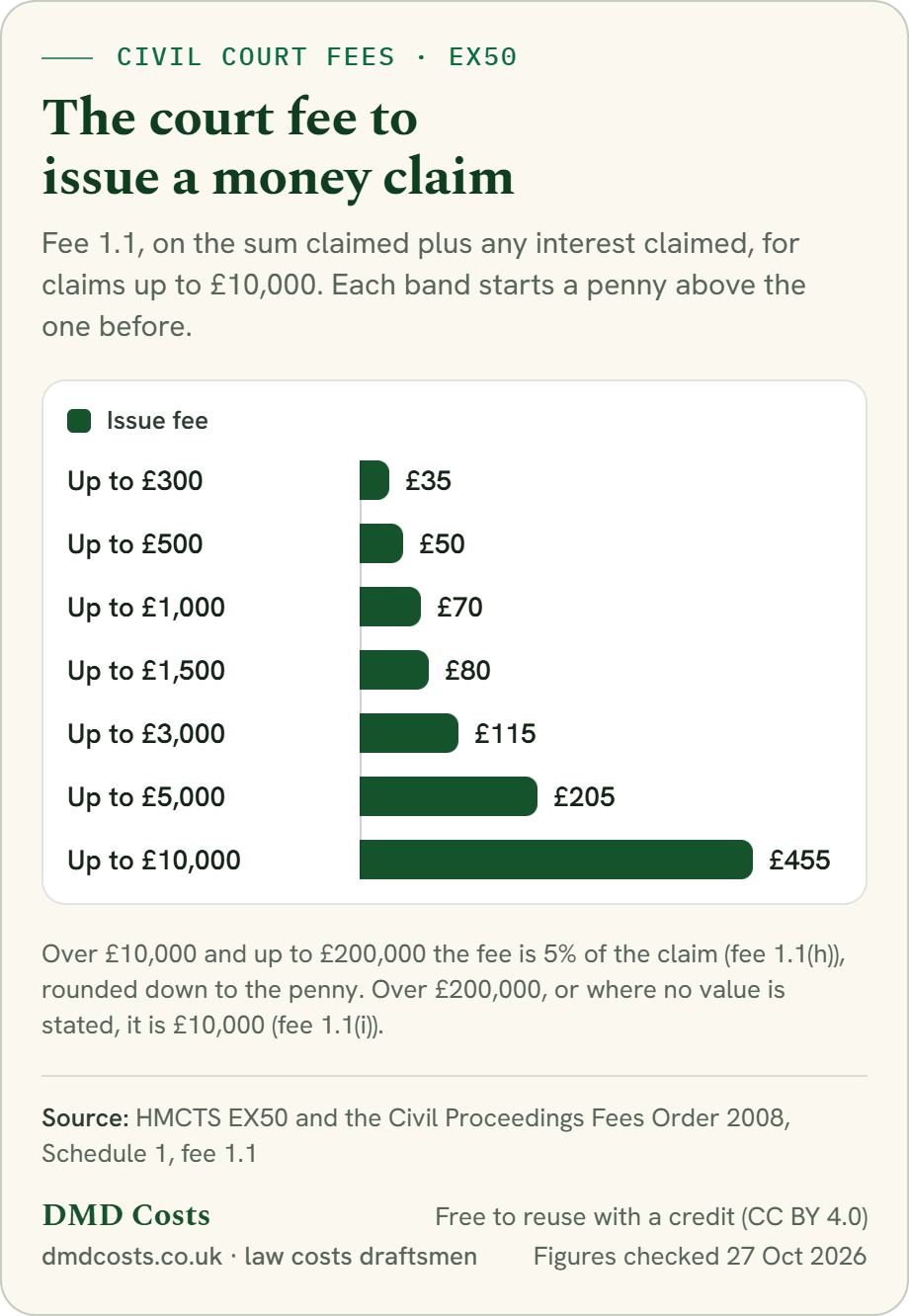
Bar chart of the court fee to issue a money claim: £35 for claims up to £300, rising in steps to £455 for claims up to £10,000

The court fee to issue a money claim in England and Wales depends on the sum claimed plus any interest claimed (Civil Proceedings Fees Order 2008, Schedule 1, fee 1.1, as listed in HMCTS’s EX50): £35 up to £300, £50 up to £500, £70 up to £1,000, £80 up to £1,500, £115 up to £3,000, £205 up to £5,000 and £455 up to £10,000. Over £10,000 and up to £200,000 it is 5% of the claim, rounded down to the penny; over £200,000, or where the claim form states no value, it is £10,000. The fees are the same in the High Court and the County Court.

Free to reuse under CC BY 4.0: credit “DMD Costs (dmdcosts.co.uk)” and link to this page. Download the PNG.

Text version of this diagram

Fee 1.1, on the sum claimed plus any interest claimed, for claims up to £10,000. Each band starts a penny above the one before.

Issue fee:

  • Up to £300: £35.
  • Up to £500: £50.
  • Up to £1,000: £70.
  • Up to £1,500: £80.
  • Up to £3,000: £115.
  • Up to £5,000: £205.
  • Up to £10,000: £455.

Source: HMCTS EX50 and the Civil Proceedings Fees Order 2008, Schedule 1, fee 1.1

Over £10,000 and up to £200,000 the fee is 5% of the claim (fee 1.1(h)), rounded down to the penny. Over £200,000, or where no value is stated, it is £10,000 (fee 1.1(i)).

Figures checked 27 October 2026.

Value of the claim, with interestFeeFee no.
Up to £300£351.1(a)
£300.01 to £500£501.1(b)
£500.01 to £1,000£701.1(c)
£1,000.01 to £1,500£801.1(d)
£1,500.01 to £3,000£1151.1(e)
£3,000.01 to £5,000£2051.1(f)
£5,000.01 to £10,000£4551.1(g)
£10,000.01 to £200,0005% of the claim1.1(h)
Over £200,000, not limited, or no value stated£10,0001.1(i)

Non-money claims, possession and Part 8 claims (fees 1.4 to 1.8)

Schedule 1 to the Fees Order has no fee for a Part 8 claim as such: its issue fees turn on what is claimed, so on our reading a Part 8 claim for money pays fee 1.1 on the sum claimed, and one for a declaration or another non-money remedy pays fee 1.5 (£387 in the County Court, £663 in the High Court). Costs-only proceedings, which are brought under Part 8 (CPR 46.14), pay fee 1.8(b), £69, and the Order says fees 1.1 and 1.5 are not payable on top. Check with the court office if in doubt.

ClaimFeeFee no.
Possession of land, County Court£4151.4(b)
Possession of land, High Court£5591.4(a)
Any other remedy, such as an injunction (including a respect order or housing injunction), an order for repairs or the recovery of goods: County Court£3871.5
Any other remedy: High Court£6631.5
Part 8 claim for a remedy other than money, such as a declaration£387 County Court, £663 High Court1.5
Part 8 claim to recover a sum of moneyAs a money claim, on the sum claimed1.1
Costs-only proceedings (Part 8, CPR 46.14)£691.8(b)
Assessment of a solicitor’s bill (Solicitors Act 1974, Part 3)£691.8(b)
Application for permission to issue proceedings£691.8(a)
Adding or substituting a party£691.6
CounterclaimThe same fee as a separate claim for it1.7

Hearing fees (fee 2.1)

Charged when the court fixes the trial date or trial period, and paid by the claimant, unless the case continues on the counterclaim alone.

TrackFeeFee no.
Fast track£6192.1(b)
Intermediate track or multi-track£1,3342.1(a)
Small claims track, sum claimed up to £300£272.1(c)(i)
Small claims track, sum claimed £300.01 to £500£592.1(c)(ii)
Small claims track, sum claimed £500.01 to £1,000£852.1(c)(iii)
Small claims track, sum claimed £1,000.01 to £1,500£1232.1(c)(iv)
Small claims track, sum claimed £1,500.01 to £3,000£1812.1(c)(v)
Small claims track, sum claimed over £3,000£3462.1(c)(vi)

Applications and consent orders (fees 2.4 to 2.8)

On notice means the other party has been told of the application, whether or not there is a hearing. A consent order is asked for by an application by consent.

ApplicationFeeFee no.
Application on notice, where no other fee is specified£3212.4(a)
Application by consent (such as for a consent order) or without notice, where no other fee is specified£1262.5(a)
Application on notice under section 3 of the Protection from Harassment Act 1997, or for a payment out of funds in court£1952.4(b)
The same, by consent or without notice£632.5(b)
Application by consent to adjourn a hearing, received at least 14 days before itNo fee2.5
Request for judgment in default or on admissionNo fee2.5
Application to vary a judgment or suspend enforcement, including a warrant of possession£162.7
Summons or order for a witness to attend court£42.6
Certificate of satisfaction (register of judgments)£192.8

Appeals (fees 2.2, 2.3, 5.4 and 13.1)

On filing an appellant’s or respondent’s notice.

AppealFeeFee no.
Appeal to the High Court£3022.2
Appeal in the County Court, small claims track£1512.3(a)
Appeal in the County Court, other claims£1752.3(b)
Appeal against a decision in detailed assessment proceedings£2905.4
Court of Appeal: appellant’s notice asking for permission to appeal or an extension of time£66313.1(a)
Court of Appeal: appellant’s notice where permission is not needed or was granted below£1,50413.1(b)
Court of Appeal: appeal questionnaire, unless fee 13.1(b) was paid£1,50413.1(c)

Detailed assessment and costs (fees 5.1 to 5.6)

Fee 5.2 is set by the costs claimed, and also applies to a request for a hearing date in a Solicitors Act assessment (N258C).

CostsFeeFee no.
Request for detailed assessment, legally aided party, no other party paying (N258A)£2965.1
Request for detailed assessment (N258), costs claimed up to £15,000£3985.2(a)
Request for detailed assessment (N258), costs claimed £15,000.01 to £50,000£8015.2(b)
Request for detailed assessment (N258), costs claimed £50,000.01 to £100,000£1,1925.2(c)
Request for detailed assessment (N258), costs claimed £100,000.01 to £150,000£1,5955.2(d)
Request for detailed assessment (N258), costs claimed £150,000.01 to £200,000£1,9925.2(e)
Request for detailed assessment (N258), costs claimed £200,000.01 to £300,000£2,9885.2(f)
Request for detailed assessment (N258), costs claimed £300,000.01 to £500,000£4,9805.2(g)
Request for detailed assessment (N258), costs claimed over £500,000£6,6405.2(h)
Request for a default costs certificate (N254)£825.3
Appeal against a detailed assessment decision£2905.4
Set aside a default costs certificate£1525.5
Request for a fixed costs determination (with Precedent U)£4085.6

Enforcement (fees 7 and 8)

County Court fees, with the High Court number where the High Court charges the same for the same process. Money claimed with a warrant or writ of possession or delivery adds no fee.

EnforcementFeeFee no.
Warrant of control£968.1
Warrant of possession or delivery£1528.6
Further attempt at a new address (fee 8.2 does not apply to a further attempt following a suspension)£388.2
Order to attend court for questioning£698.3; High Court 7.2
Bailiff service of that order£1398A.1
Attachment of earnings order (one fee for each defendant against whom the order is requested)£1398.7
Charging order (one fee for each charging order applied for)£1398.4(b); High Court 7.3(b)
Third party debt order (one fee for each third party against whom the order is sought)£1398.4(a); High Court 7.3(a)
Judgment summons£1398.5; High Court 7.4
High Court writ of control, possession or delivery£827.1

Winding-up and bankruptcy petitions (fee 3)

The same in the High Court and the County Court. The official receiver’s deposit is not a court fee, but it is paid with the petition; it is set by the definition of “deposit” in article 2 of the Insolvency Proceedings (Fees) Order 2016 (IPFO 2016). A debtor’s own bankruptcy application is made online to the adjudicator, not to the court: £680 in all.

Petition or applicationFeeFee no.
Creditor’s winding-up petition: court fee£3523.3
Creditor’s winding-up petition: official receiver’s deposit£2,600IPFO 2016 art 2, “deposit” (c)
Creditor’s bankruptcy petition: court fee£3523.1(b)
Creditor’s bankruptcy petition: official receiver’s deposit£1,500IPFO 2016 art 2, “deposit” (b)
Petition for an administration order£3523.2
Application under the Insolvency Act 1986 or the Companies Acts, not by petition and not in existing proceedings£3263.5
Application with notice in existing insolvency or Companies Act proceedings£1153.12
Application by consent or without notice in those proceedings£313.11
Debtor’s own bankruptcy application: adjudicator’s fee£130IPFO 2016 Sch 1
Debtor’s own bankruptcy application: official receiver’s deposit£550IPFO 2016 art 2, “deposit” (a)

How to use the civil court fees calculator

  1. Choose the court and the claim. County Court or High Court, and whether the claim is for money, for repairs or another non-money remedy, for the recovery of goods or for possession, is costs-only proceedings, or is a creditor’s winding-up or bankruptcy petition.
  2. Enter the value. Enter the sum claimed with any interest claimed, or tick that the claim form states no value. For a non-money claim, say whether damages are claimed in addition or as an alternative.
  3. Choose the track. Pick the track for the hearing fee. A small claim's fee depends on the sum claimed.
  4. Add applications and any appeal. Enter how many applications are made on notice and how many by consent or without notice, and choose an appeal if there is one.
  5. Add the costs stage. Tick a request for detailed assessment and enter the bill total with VAT, or tick a default costs certificate, a set-aside, an appeal or a fixed costs determination.
  6. Add enforcement. Tick any warrant, order or writ the case needs, with the number of third parties, charging orders or defendants where one fee is paid for each.
  7. Copy the fees. Copy the list, with each fee number, the total and the notes, for the file, the client or the bill.

Issue fees for money claims

The fee to start a money claim is set by the sum claimed, and where interest is claimed on a specified sum, by the total of the claim and the interest (fee 1.1; the bands are in the EX50 list). Over £10,000 and up to £200,000 it is 5% of that figure, rounded down to the nearest penny (GOV.UK’s money claim guidance). Where the claimant does not identify the value of the claim, the fee is the one for a claim that is not limited: £10,000. Where the claim form gives a range rather than a sum, GOV.UK’s guidance for a claim whose amount is not known is to estimate it and pay the fee for that amount; the calculator charges on the figure you enter, so entering the top of the range avoids paying too little. A counterclaim pays the same fee as if it were a separate claim (fee 1.7). Money Claim Online and Secure Data Transfer take claims up to £99,999.99.

Repairs, injunctions, goods, possession and Part 8 claims

A claim for a non-money remedy other than possession of land, such as an order that a landlord carry out repairs, an injunction or the recovery of goods, costs £387 in the County Court and £663 in the High Court (fee 1.5), paid once however many non-money remedies the claim seeks. How a money claim alongside it is charged depends on how it is made:

  • Damages in addition to a non-money remedy (other than possession of land or the recovery of goods): both fees are paid, fee 1.5 and fee 1.1. A housing disrepair claim for repairs and £8,000 damages pays £387 plus £455, £842, in the County Court.
  • Money as an alternative to a non-money remedy (other than possession of land or the recovery of goods): in the High Court only fee 1.1; in the County Court whichever is greater of fee 1.1 and fee 1.5.
  • Recovery of goods: a money claim made with it, in addition or as an alternative, adds no fee; only fee 1.5 is paid.
  • Possession of land: £415 in the County Court (fee 1.4(b)) and £559 in the High Court (fee 1.4(a)). A money claim made with it, such as for arrears, adds no fee.
  • Costs-only proceedings under CPR 46.14: £69 (fee 1.8(b)), with no fee 1.1 or 1.5 on top. The same fee applies to an application for assessment of a solicitor’s bill under Part 3 of the Solicitors Act 1974.
  • Part 8 claims: Schedule 1 has no fee for a Part 8 claim as such, because its issue fees turn on what is claimed. Costs-only proceedings, which are brought under Part 8, pay fee 1.8(b), and the Order says fees 1.1 and 1.5 are not payable on top; on our reading, any other Part 8 claim pays fee 1.5 for a declaration or another non-money remedy and fee 1.1 on a sum of money. Check with the court office if in doubt.

Judicial review fee (Form N461)

In the Administrative Court, filing the N461 claim form, which asks for permission to apply for judicial review, costs £179 (fee 1.9(a)). Asking for a refusal of permission to be reconsidered at a hearing costs £449 (fee 1.9(b)). Once permission is granted, the claimant pays £897 within 7 days of service of the order giving permission (fee 1.9(c)), or £447 where fee 1.9(b) was paid and permission was granted at that hearing (fee 1.9(ba)). Judicial review in the Upper Tribunal has its own fees order. For the time limits these fees go with, from the claim form to the acknowledgment of service, use the free judicial review time limit calculator; the fee finder has every N461 fee.

Hearing fees

The hearing fee is charged when the court fixes the trial date or trial period: £619 on the fast track and £1,334 on the intermediate track or multi-track (fee 2.1). The court sends the claimant a fee notice with the date for payment (CPR 3.7A1): at least 28 days before the trial, or the Monday of the first week of a trial period, where the notice comes 36 days or more ahead, and otherwise within 7 days of the notice. If it is not paid by then, and help with fees is not applied for, the claim (or counterclaim) is struck out. The claimant pays it, unless the case continues on the counterclaim alone, and it is not payable where the court fixed the trial date when the claim was issued. HMCTS states that the hearing fee is non-refundable, but it need not be paid if the parties settle before it falls due. On the small claims track the fee depends on the sum claimed, from £27 to £346: the bands are in the EX50 list.

On notice application fee, and applications by consent or without notice

Where no other fee is specified, an application costs £321 on notice (fee 2.4(a)) and £126 by consent or without notice (fee 2.5(a)); a consent order is applied for by consent. On notice means the other party has been told of the application, whether or not there is a hearing. Applications under section 3 of the Protection from Harassment Act 1997, or for a payment out of funds in court, are £195 on notice and £63 by consent or without notice (fees 2.4(b) and 2.5(b)). In insolvency and Companies Act proceedings, an application within the proceedings is £115 with notice and £31 by consent or without notice (fees 3.12 and 3.11) instead. An application by consent to adjourn a hearing that reaches the court at least 14 days before it is free. For fee 2.5, a request for judgment in default or on admission is not an application, so no fee is paid; but default judgment on a claim that includes a non-money remedy, such as an order for repairs, needs a Part 23 application (CPR 12.4(3)), unless the claimant abandons that remedy in the request (CPR 12.4(4)). If an application by consent or without notice is refused and ordered to be made on notice, the balance of the on-notice fee is paid.

Schedule 1 names neither a consent order nor a Tomlin order. A consent order in a civil claim is asked for by an application by consent, so on our reading it pays £126 where no other fee is specified (fee 2.5(a)), £63 for one under section 3 of the Protection from Harassment Act 1997 or for a payment out of funds in court (fee 2.5(b)), and £31 in existing insolvency or Companies Act proceedings (fee 3.11). A Tomlin order is a consent order that stays the claim on terms set out in a schedule, so on our reading it pays the same fee (the fee finder entry gives the reasons). An application by consent to adjourn a hearing that reaches the court at least 14 days before it is free. To draft the order itself, with its costs clause, use the free consent order and Tomlin order template.

How much does it cost to set aside a CCJ?

An application to set aside a county court judgment, such as a default judgment, is made on Form N244 and costs £321 on notice to the claimant (fee 2.4(a)), the figure GOV.UK’s guide gives, or £126 where the claimant consents (fee 2.5(a)). Where the judgment is paid in full within one month, GOV.UK says it can be removed from the register instead. GOV.UK says a certificate of cancellation (paid within a month) or of satisfaction (paid later) costs £19, applied for on Form N443; Schedule 1 names the certificate of satisfaction (fee 2.8). The free N244 builder has a preset for setting aside a default judgment, and the relief from sanctions checker sets out the CPR 13.2 and 13.3 grounds.

N245 fee: suspending a warrant or varying instalments

Form N245 asks the court to suspend a warrant or to vary a judgment or order, such as the instalments. The fee is £16 (fee 2.7), which covers an application to vary a judgment or suspend enforcement, including suspending a warrant of possession, and only one fee is paid where the same application asks for more than one of those (Schedule 1). The EX50 also puts staying a High Court writ under fee 2.7. A creditor asking for a warrant of control to be extended applies on Form N244 instead (see the fee finder entry).

Injunction application fee and committal application fee

Schedule 1 has no fee for an injunction or a contempt application as such, so on our reading each pays the fee for the claim or application it is part of. A claim for an injunction is a claim for a non-money remedy: £387 in the County Court and £663 in the High Court (fee 1.5). An application for an injunction in existing proceedings, made with Form N16A, is £321 on notice and £126 without notice (fees 2.4(a) and 2.5(a)); under section 3 of the Protection from Harassment Act 1997 it is £195 and £63 (fees 2.4(b) and 2.5(b)). A contempt (committal) application in existing proceedings is made under Part 23, on Form N600 (CPR 81.3(1)), so it pays £321 on notice (fee 2.4(a)); one about interference with the due administration of justice outside existing proceedings is a Part 8 claim in the High Court (CPR 81.3(3)), £663 (fee 1.5). Check with the court office. The fee finder entries for N16A and N600 set out each route.

Infant approval hearing fee (CPR 21.10)

Schedule 1 has no fee for the court’s approval of a settlement for a child or protected party. On our reading, a Part 8 claim that only asks for approval (CPR 21.10(2)) pays fee 1.5, the fee for a remedy other than money: £387 in the County Court and £663 in the High Court. An application for approval in existing proceedings pays £126 by consent or without notice, or £321 on notice (fees 2.5(a) and 2.4(a)). Also on our reading, no hearing fee is payable for the approval hearing; but a Part 8 claim is treated as allocated to the multi-track (CPR 8.9(c)), so if the court office asks for fee 2.1(a), check with it. The fee finder entry gives the reasons, and the free CPR 21.10 approval checklist sets out when approval is needed, the documents and the Court Funds Office forms.

Appeal fees

An appellant’s or respondent’s notice costs £302 in the High Court, and in the County Court £151 on the small claims track and £175 in other claims (fees 2.2 and 2.3). An appeal against a decision in detailed assessment proceedings is £290 instead (fee 5.4). The Court of Appeal fees are in the EX50 list. For the appeal court, the last day for the notice and whether permission is needed, use the free appeal deadline and route checker; the free N161, N164 and N162 builders fill in the notices.

Detailed assessment and other costs fees

The fee for a request for detailed assessment depends on the amount of costs claimed (fee 5.2, from £398 to £6,640: the bands are in the EX50 list), or is £296 where the party filing it is legally aided and no other party is ordered to pay the costs (fee 5.1; that request is made on Form N258A). The fees order does not say whether VAT counts in the costs claimed: the calculator uses the bill with VAT, the higher figure, because normally the court office will not accept a request until the appropriate fee is paid (SCCO Guide 2025, para 4.2), and tells you when leaving VAT out would put the bill in a lower band. Our free N258 builder fills in the form with the same fee. A request for a hearing date in a Solicitors Act assessment pays the same fee 5.2, on Form N258C, and default costs certificates do not apply to those assessments (PD 46 paras 6.8 and 6.10).

A default costs certificate costs £82 (fee 5.3) and usually also includes £80 fixed costs (PD 47 para 10.7), which are costs, not a court fee: our N254 builder adds both, and the N252 builder shows the total on the notice of commencement. Setting one aside costs £152 (fee 5.5). For the dates these fees attach to, use the detailed assessment deadline calculator.

Enforcement fees: warrant of control, writ of control and other orders

A County Court warrant of control costs £96 to issue (fee 8.1), requested on Form N323 or online for a claim started online, and a further attempt at a new address, after a notice that it could not be executed, £38 (fee 8.2). A County Court judgment transferred up to the High Court on Form N293A pays £82 on sealing the writ of control (fee 7.1); Schedule 1 sets no separate fee for the N293A certificate, so on our reading that is the whole court fee. The enforcement officer’s own fees are separate: they are set by the Taking Control of Goods (Fees) Regulations 2014, as amended from 1 May 2026 (SI 2026/366). For which court can enforce what, with the court fee, the fixed costs, the officers’ fees and the effect on interest side by side, use the free enforcement options calculator; the N293A builder fills in the transfer form.

The County Court fees for the common ways of enforcing a judgment, and the High Court writ, are in the EX50 list. Where a warrant or writ of possession or delivery also includes a claim for money, there is no additional fee. In the High Court, an order to attend court for questioning, a third party debt order, a charging order and a judgment summons cost the same as in the County Court, under fees 7.2, 7.3(a), 7.3(b) and 7.4.

Winding-up and bankruptcy petition costs

A creditor’s winding-up petition costs £352 to issue (fee 3.3) and a creditor’s bankruptcy petition £352 (fee 3.1(b)), the same in the High Court and the County Court. With either, the petitioner also pays the official receiver’s deposit: £2,600 on a winding-up petition and £1,500 on a bankruptcy petition (Insolvency Proceedings (Fees) Order 2016, art 2, definition of “deposit”), so presenting the petition costs £2,952 or £1,852 in all. The deposit is not a court fee: it is security for the official receiver’s administration fee, repaid less £50 if the petition is withdrawn or dismissed, and returned after an order except so far as the assets do not cover that fee (art 4). A debtor’s own bankruptcy application goes online to the adjudicator, not to the court, and costs £680: the adjudicator’s fee of £130 and a £550 deposit. GOV.UK’s guides: wind up a company that owes you money, apply to bankrupt someone who owes you money and apply for bankruptcy.

Sources

Frequently asked questions

Yes. It is completely free, with no sign-up, no paywall and no limit. It runs in your browser, and nothing you type is sent to DMD Costs.
The EX50 is HM Courts & Tribunals Service’s guide to the main court fees in the civil and family courts in England and Wales. It is published on GOV.UK as “Fees in the civil and family courts – main fees (EX50)”, with pages for civil court fees, family court fees and paying a fee or getting help with fees; the full list of fees is the EX50A. It is a list of fees, not a form to fill in, and it has been web pages rather than a PDF leaflet since October 2023. The fees themselves are set by the Civil Proceedings Fees Order 2008: the fee numbers in the EX50 and on this page, such as 1.1 or 2.4(a), are the numbers in Schedule 1 to that Order. The current EX50 lists the fees in force from 13 July 2026; the EX50 fees list on this page gives the main civil fees from it, each with its fee number.
From 13 July 2026 the issue fee depends on the sum claimed with any interest: £35 up to £300, £50 up to £500, £70 up to £1,000, £80 up to £1,500, £115 up to £3,000, £205 up to £5,000, £455 up to £10,000. Over £10,000 and up to £200,000 it is 5% of the claim, and over £200,000, or where the claim is not limited or its value is not identified, it is £10,000 (Civil Proceedings Fees Order 2008, fee 1.1). Where the claim form gives a range rather than a sum, GOV.UK’s guidance for a claim whose amount is not known is to estimate it and pay the fee for that amount; the calculator charges on the figure you enter, so entering the top of the range avoids paying too little.
Take the sum claimed including the interest claimed, multiply by 5% and round down to the nearest penny. A claim for £25,000 including interest pays £1,250; one for £12,345.79 pays £617.28, because 5% is £617.2895 and the fee is rounded down. The 5% band covers claims over £10,000 and up to £200,000.
Schedule 1 to the Fees Order has no fee for a Part 8 claim as such: its issue fees turn on what is claimed, so on our reading a Part 8 claim for money pays fee 1.1 on the sum claimed, and one for a declaration or another non-money remedy pays fee 1.5 (£387 in the County Court, £663 in the High Court). Costs-only proceedings, which are brought under Part 8 (CPR 46.14), pay fee 1.8(b), £69, and the Order says fees 1.1 and 1.5 are not payable on top. Check with the court office if in doubt.
A claim for an order that the landlord carry out repairs is a non-money claim: £387 to issue in the County Court (fee 1.5). Where damages are claimed in addition, the money claim fee on the damages with interest is paid as well (fee 1.1), so a claim for repairs and £8,000 damages pays £387 plus £455, £842. Where the damages are claimed only as an alternative, the County Court charges whichever of the two fees is greater. Fee 1.5 is paid once, however many non-money remedies the claim seeks.
£619 on the fast track, £1,334 on the intermediate track or multi-track, and £27 to £346 on the small claims track depending on the sum claimed (fee 2.1). It is charged when the court fixes the trial date or period, and the court sends a fee notice with the date for payment (CPR 3.7A1): at least 28 days before the trial, or the Monday of the first week of a trial period, where notice comes 36 days or more ahead, otherwise within 7 days of the notice. If it is not paid by then, and help with fees is not applied for, the claim is struck out. The claimant pays it, unless the case continues on the counterclaim alone, and it is not payable where the court fixed the trial date when the claim was issued.
£321, where no other fee is specified (fee 2.4(a)); the application is usually made on Form N244, and in the Court of Appeal an application notice is £663 (fee 13.3). On notice means the other party has been told of the application, whether or not there is a hearing. It is £195 for an application under section 3 of the Protection from Harassment Act 1997 or for a payment out of funds in court (fee 2.4(b)), and £115 for an application with notice within existing insolvency or Companies Act proceedings (fee 3.12). An application by consent or without notice is £126 (fee 2.5(a)); if one is refused and ordered to be made on notice, the balance of the on-notice fee is paid. A request for judgment in default is not charged as an application, but default judgment on a claim that includes a non-money remedy, such as repairs, needs a Part 23 application (CPR 12.4(3)), unless that remedy is abandoned in the request (CPR 12.4(4)).
Asking the court to make an order by consent is an application by consent: £126, where no other fee is specified (fee 2.5(a)). It is £63 for a consent application under section 3 of the Protection from Harassment Act 1997 or for a payment out of funds in court (fee 2.5(b)), and £31 within existing insolvency or Companies Act proceedings (fee 3.11). An application by consent to adjourn a hearing that reaches the court at least 14 days before it is free, and a request for judgment on admission or in default is not an application, so it pays no fee.
£16 (fee 2.7). Form N245 asks the court to suspend a warrant or vary a judgment or order, such as the instalments, and fee 2.7 covers an application to vary a judgment or suspend enforcement, including suspending a warrant of possession; only one fee is paid where the same application seeks more than one remedy (Civil Proceedings Fees Order 2008, Sch 1). The EX50 also puts staying a High Court writ under fee 2.7. A creditor asking for a warrant of control to be extended applies on Form N244 instead, which GOV.UK’s warrant guide says costs £126.
£96 in the County Court (fee 8.1), requested on Form N323, or online for a claim started online. GOV.UK’s guide says a County Court warrant can be for up to £5,000 and not for £10 or less; from £600 to £5,000 the creditor can choose the County Court or the High Court, and debts under an agreement regulated by the Consumer Credit Act stay in the County Court with no upper limit. In the High Court it is a writ of control, £82 (fee 7.1). A further attempt at a new address after a notice that the warrant could not be executed is £38 (fee 8.2), and reissuing a suspended warrant is free. GOV.UK’s “Apply for a warrant of control” guide still gave the earlier £94 and £80 when we checked on 22 October 2026; Schedule 1 to the Fees Order and the EX50 give £96 and £82 from 13 July 2026.
£82 on sealing a writ of control, possession or delivery (fee 7.1). A County Court judgment is transferred up with Form N293A, which is the certificate of judgment and the request for the writ in one. Schedule 1 sets no separate fee for that certificate (its only certificate of judgment fee, 7.5, is for use abroad), and GOV.UK’s guide names one fee, so on our reading £82 is the whole court fee. Money claimed with a writ of possession or delivery adds no fee. The High Court enforcement officer’s own fees are separate from the court fee: they are set by the Taking Control of Goods (Fees) Regulations 2014, amended from 1 May 2026 by SI 2026/366.
£139 for each charging order applied for (fee 8.4(b) in the County Court, 7.3(b) in the High Court). The application is made on Form N379 for land or N380 for securities.
£139 for each third party against whom the order is sought (fee 8.4(a) in the County Court, 7.3(a) in the High Court), on Form N349: an application naming two banks pays £278. The same fee applies to an application for the appointment of a receiver by way of equitable execution.
An order for a debtor, or an officer of a debtor company, to attend court to give information costs £69 (fee 8.3 in the County Court, 7.2 in the High Court), on Form N316 or N316A, plus £139 if a County Court bailiff is asked to serve it (fee 8A.1). An attachment of earnings order costs £139 for each defendant against whom it is requested (fee 8.7), on Form N337. A judgment summons is £139 (fees 8.5 and 7.4).
An application to set aside a county court judgment, such as a default judgment, is made on Form N244 and costs £321 on notice (fee 2.4(a)), the figure GOV.UK’s guide gives, or £126 where the claimant consents (fee 2.5(a)). Where the judgment is paid in full within one month, GOV.UK says it can be removed from the register; a certificate of cancellation (paid within a month) or of satisfaction (paid later) costs £19 on Form N443 (fee 2.8).
Schedule 1 to the Fees Order does not name Tomlin orders. A Tomlin order is a consent order that stays the claim on terms set out in a schedule, and a consent order is asked for by an application by consent, so on our reading the fee is £126 (fee 2.5(a)), as for any consent order where no other fee is specified, or £31 in existing insolvency or Companies Act proceedings (fee 3.11).
Schedule 1 to the Fees Order has no fee for the court’s approval of a settlement for a child or protected party (CPR 21.10). On our reading, a Part 8 claim that only asks for approval, the route where the settlement was agreed before proceedings started (CPR 21.10(2)), pays fee 1.5, the fee for a remedy other than money: £387 in the County Court and £663 in the High Court. An application for approval in existing proceedings pays the general application fee: £126 by consent or without notice (fee 2.5(a)), £321 on notice (fee 2.4(a)). Also on our reading, no hearing fee is payable for the approval hearing: fee 2.1 is not payable where the court fixed the trial date on issuing the claim, as it often does for a Part 8 approval claim. A Part 8 claim is treated as allocated to the multi-track (CPR 8.9(c)), so if the court office asks for fee 2.1(a), check with it.
In the Administrative Court the N461 claim form asks for permission to apply for judicial review: £179 (fee 1.9(a)). Asking for a refusal of permission to be reconsidered at a hearing costs £449 (fee 1.9(b)). Once permission is granted, the claimant pays £897 within 7 days of service of the order (fee 1.9(c)), or £447 where fee 1.9(b) was paid and permission was granted at the hearing (fee 1.9(ba)). Judicial review in the Upper Tribunal has its own fees order.
Schedule 1 has no fee for an injunction as such, and GOV.UK says Form N16A is used as part of an application or a claim, not on its own, so on our reading the fee is the one for that claim or application. A claim for an injunction is a claim for a non-money remedy: £387 in the County Court and £663 in the High Court (fee 1.5). An application within existing proceedings is £321 on notice and £126 without notice (fees 2.4(a) and 2.5(a)), and under section 3 of the Protection from Harassment Act 1997 £195 and £63 (fees 2.4(b) and 2.5(b)).
Schedule 1 has no fee for a contempt application as such. In existing proceedings it is made by an application under Part 23 (CPR 81.3(1)), on Form N600, so on our reading it pays the general fee for an application on notice, £321 (fee 2.4(a)). A contempt application about interference with the due administration of justice outside existing proceedings is a Part 8 claim in the High Court (CPR 81.3(3)), which on our reading pays fee 1.5, £663. Check with the court office.
It depends on the costs claimed: £398 up to £15,000, £801 up to £50,000, £1,192 up to £100,000, £1,595 up to £150,000, £1,992 up to £200,000, £2,988 up to £300,000, £4,980 up to £500,000 and £6,640 above (fee 5.2). It is £296 where the party filing the request is legally aided and no other party is ordered to pay the costs (fee 5.1). The fees order does not say whether VAT counts in the costs claimed; the calculator uses the bill with VAT and tells you when leaving VAT out would change the band. The higher figure is used because normally the court office will not accept a request until the appropriate fee is paid (SCCO Guide 2025, para 4.2).
The court fee is £82 (fee 5.3). The certificate usually also includes £80 fixed costs (PD 47 para 10.7), which are costs rather than a court fee. Setting a default costs certificate aside costs £152 (fee 5.5).
£69 to start costs-only proceedings under CPR 46.14 (fee 1.8(b)), and no money claim or non-money claim fee is paid on top. The same £69 applies to an application for assessment of a solicitor’s bill under Part 3 of the Solicitors Act 1974.
£302 for an appellant’s or respondent’s notice in the High Court, £151 in the County Court on the small claims track (the appellant’s notice there is Form N164) and £175 in other County Court claims (fees 2.2 and 2.3); other appeals use Form N161, and a respondent’s notice is Form N162. An appeal against a decision in detailed assessment proceedings is £290 instead (fee 5.4). In the Court of Appeal it is £663 where the appellant’s notice asks for permission to appeal or an extension of time for appealing, and £1,504 where permission is not needed or was granted below; where permission is sought from the Court of Appeal, a further £1,504 is paid on the appeal questionnaire (fees 13.1(a) to (c)). A respondent there who only asks for the order to be upheld for different or additional reasons pays £602 (fee 13.2).
A creditor presenting a winding-up petition pays a court fee of £352 (fee 3.3, “any other petition”) and the official receiver’s deposit of £2,600 (Insolvency Proceedings (Fees) Order 2016, art 2, definition of “deposit”, para (c)): £2,952 in all, the same in the High Court and the County Court. As the EX50 notes, some insolvency proceedings are allocated to the multi-track and then attract the multi-track hearing fee, £1,334 (fee 2.1(a)). The deposit is security for the official receiver’s administration fee: if the petition is withdrawn or dismissed it is repaid less £50, and if a winding-up order is made it is returned except so far as the company’s assets do not cover that fee (art 4). Where the petition is filed online, GOV.UK says the court fee is paid online and the court then emails how to pay the deposit. The figures do not include the cost of serving or advertising the petition, or legal costs.
A creditor’s bankruptcy petition costs £352 in court fees (fee 3.1(b)) plus the official receiver’s deposit of £1,500 (Insolvency Proceedings (Fees) Order 2016, art 2, definition of “deposit”, para (b)): £1,852 in all, the same in the High Court and the County Court. As the EX50 notes, some insolvency proceedings are allocated to the multi-track and then attract the multi-track hearing fee, £1,334 (fee 2.1(a)). The deposit is repaid less £50 if the petition is withdrawn or dismissed, and if a bankruptcy order is made it is returned except so far as the bankrupt’s estate does not cover the official receiver’s administration fee (art 4). A debtor asking to be made bankrupt does not petition the court: the bankruptcy application is made online to the adjudicator and costs £680, the adjudicator’s fee of £130 and a £550 deposit (Insolvency Proceedings (Fees) Order 2016, Sch 1, and art 2, definition of “deposit”, para (a)); GOV.UK says it can be paid in instalments.

Court fees on your bill?

We work for solicitor firms: we draft the bill of costs, with every court fee claimed as a disbursement, deal with the Points of Dispute and negotiate the costs. The fee is fixed and agreed before any work begins.