The deadlines at a glance
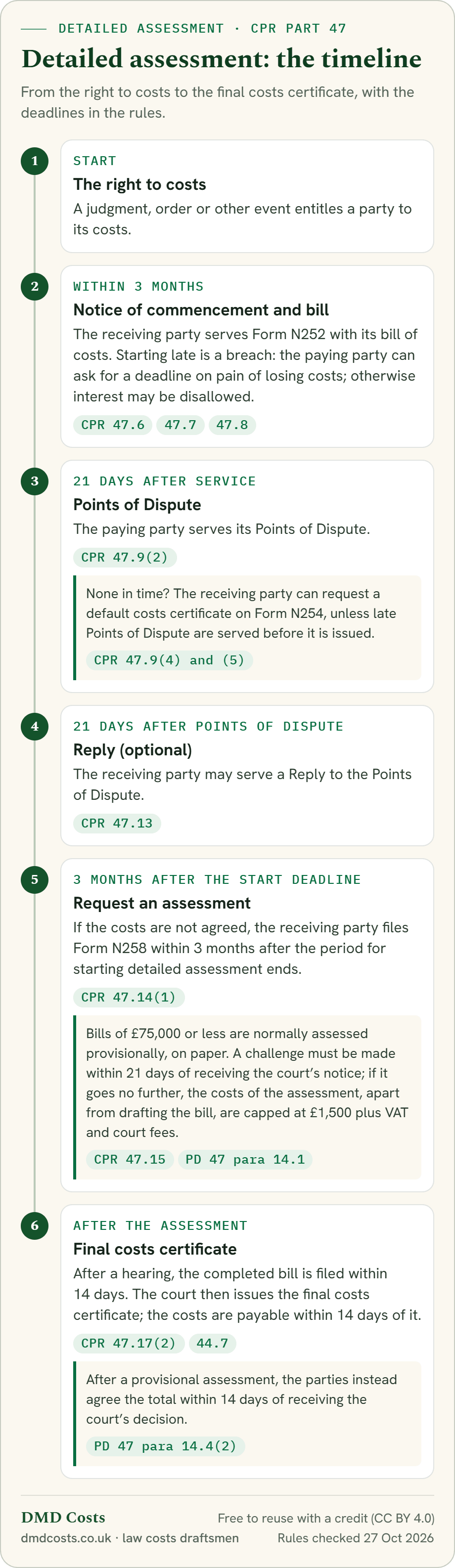
Detailed assessment timeline in England and Wales: the receiving party serves its notice of commencement (Form N252) and bill within 3 months of the judgment, order or other event giving the right to costs (CPR 47.7). The paying party has 21 days to serve Points of Dispute (CPR 47.9(2)), failing which a default costs certificate can be requested (CPR 47.9(4)). A Reply may follow within 21 days (CPR 47.13), and an assessment is requested on Form N258 within 3 months after the period for starting ends (CPR 47.14). Bills of £75,000 or less are normally assessed provisionally, on paper (CPR 47.15).
Free to reuse under CC BY 4.0: credit “DMD Costs (dmdcosts.co.uk)” and link to this page. Download the PNG.
Text version of this diagram
From the right to costs to the final costs certificate, with the deadlines in the rules.
- Start: The right to costs. A judgment, order or other event entitles a party to its costs.
- Within 3 months: Notice of commencement and bill. The receiving party serves Form N252 with its bill of costs. Starting late is a breach: the paying party can ask for a deadline on pain of losing costs; otherwise interest may be disallowed (CPR 47.6, 47.7, 47.8).
- 21 days after service: Points of Dispute. The paying party serves its Points of Dispute (CPR 47.9(2)).
- None in time? The receiving party can request a default costs certificate on Form N254, unless late Points of Dispute are served before it is issued (CPR 47.9(4) and (5)).
- 21 days after Points of Dispute: Reply (optional). The receiving party may serve a Reply to the Points of Dispute (CPR 47.13).
- 3 months after the start deadline: Request an assessment. If the costs are not agreed, the receiving party files Form N258 within 3 months after the period for starting detailed assessment ends (CPR 47.14(1)).
- Bills of £75,000 or less are normally assessed provisionally, on paper. A challenge must be made within 21 days of receiving the court’s notice; if it goes no further, the costs of the assessment, apart from drafting the bill, are capped at £1,500 plus VAT and court fees (CPR 47.15, PD 47 para 14.1).
- After the assessment: Final costs certificate. After a hearing, the completed bill is filed within 14 days. The court then issues the final costs certificate; the costs are payable within 14 days of it (CPR 47.17(2), 44.7).
- After a provisional assessment, the parties instead agree the total within 14 days of receiving the court’s decision (PD 47 para 14.4(2)).
Rules checked 27 October 2026.
| Step | Time limit | Rule |
|---|---|---|
| Commence detailed assessment: serve the notice of commencement (N252) and the bill | 3 months after the judgment, order or other event giving the right to costs | CPR 47.6 and 47.7 |
| Serve Points of Dispute | 21 days after service of the notice of commencement | CPR 47.9(2) |
| Request a default costs certificate (N254) | Once those 21 days have expired with no Points of Dispute served | CPR 47.9(4) |
| Serve Replies (optional) | 21 days after service of the Points of Dispute | CPR 47.13(2) |
| Request a detailed assessment hearing (N258) | 3 months after the end of the period for commencing detailed assessment | CPR 47.14(1) |
| Agree the sum due after a provisional assessment | 14 days after receipt of the provisionally assessed Precedent G | PD 47 para 14.4(2) |
| Request an oral hearing after a provisional assessment | File and serve on all other parties within 21 days of receipt of the notice of provisional assessment | CPR 47.15(7) |
| File the papers in support of the bill | Not more than 14 and not less than 7 days before the hearing | PD 47 para 13.11 |
| File the completed bill | 14 days after the end of the detailed assessment hearing | CPR 47.17(2) |
| Pay the costs | 14 days after the certificate stating the amount | CPR 44.7(1)(b) |
To fill in the forms themselves, use our free builders for the N252 notice of commencement, the N254 request for a default costs certificate and the N258 request for provisional or detailed assessment. They work from these same dates. For what each step involves, see our guide to detailed assessment step by step and our guide to Points of Dispute and Replies.
Appealing a detailed assessment decision
An appeal from an authorised court officer in detailed assessment proceedings goes to a costs judge or a District Judge of the High Court as a re-hearing, and needs no permission: the appellant’s notice, which should be in Form N161, must be filed within 21 days after the date of the decision (CPR 47.21 to 47.24; PD 47 paras 20.2 to 20.4). Any other appeal arising out of detailed assessment, such as one from a costs judge or a District Judge, follows Part 52 and needs permission (PD 47 para 20.1; CPR 52.3). The appeal checker gives the appeal court and the last day for the notice, and the free N161 builder fills in the appellant’s notice.
How the dates are counted
Days are clear days
A period expressed in days is counted in clear days: the day of the event that starts it is not included (CPR 2.8(2) and (3)). Points of Dispute due 21 days after a notice served on Monday 19 October 2026 are therefore due by Monday 9 November 2026. Periods of 5 days or less also leave out weekends, bank holidays, Christmas Day and Good Friday (CPR 2.8(4)), though none of the Part 47 periods is that short.
Months are calendar months
Three months after 18 October is 18 January: a period of months ends on the corresponding date. Where the later month has no such date, it ends on the last day of that month, so three months after 30 November is 28 February, or 29 February in a leap year (Dodds v Walker, House of Lords, 1981). The period for requesting a hearing is counted from the end of the period for commencing, which can differ by a day or two from six months after the order.
When the court office is closed
Where the last day for doing something at the court office, such as filing a request, falls on a day the office is closed, filing on the next day it is open is in time (CPR 2.8(5)). Court offices are closed at weekends, on bank holidays, Good Friday and Christmas Day, and on one further day over Christmas set by a table in Practice Direction 2A (24 December in 2026 and 2027), and on any other day the Lord Chancellor directs. That extension does not apply to serving documents on the other side.
Which court office a detailed assessment request goes to depends on where the case was dealt with (CPR 47.4; PD 47 paras 4.1 and 4.2). Our city-by-city guide names the County Court hearing centre for 30 cities, and the London centres whose requests for a hearing go to the Senior Courts Costs Office.
Deemed service
Documents other than a claim form are deemed served under CPR 6.26. A document sent by email, sent by fax, delivered to a permitted address or served personally before 4.30pm on a business day is deemed served that day; otherwise it is deemed served on the next business day. A document sent by first class post or document exchange is deemed served on the second day after posting if that is a business day, or else on the next business day. Email can be used only where the party to be served, or its solicitor, has previously indicated in writing that it will accept service by email and given the address to use; an email address on a solicitor’s letterhead counts only where it says it may be used for service (PD 6A para 4.1).
For the forms themselves, see our costs forms and precedents guide; the terms are defined in the legal costs glossary. For a summary assessment at a hearing, our N260 statement of costs builder fills in the statement of costs. Earlier in a claim, the deemed service calculator works out service and the defence; once the costs are fixed, the interest on costs calculator works out the 8% interest. For any other time limit under the rules, use the CPR deadline calculator. Every stage is explained on our costs help page.
Sources
- Civil Procedure Rules Part 2 (rules 2.8 and 2.11), Part 6 (rules 6.2 and 6.26), Part 44 (rule 44.7) and Part 47 (rules 47.6 to 47.17 and 47.21 to 47.24) and Part 52 (rule 52.3)
- Practice Direction 2A, Practice Direction 6A (para 4.1) and Practice Direction 47 (including para 20, appeals from authorised court officers)
- GOV.UK: bank holidays in England and Wales