A party can do better than the money in its own Part 36 offer and still not get the Part 36 costs consequences. In Cleveland Potash Ltd v Secretary of State for Business, Energy and Industrial Strategy [2026] EWHC 2781 (BP), handed down on 30 October 2026, Master Kaye, sitting as a Deputy High Court Judge, refused the applicant the benefits of CPR 36.17 although the court had set a lower rent than the one it had offered to pay. Its offer was a package of lease terms, and the court would not let it rely on the one term it had beaten.
So the question for every costs file is: you may have beaten the number, but have you beaten the offer? This article explains the Part 36 decision and what it means for offers that combine damages with repairs or other terms, a live issue in housing disrepair claims. It then covers the rest of the costs judgment: a £550,000 payment on account against £1,204,160.86 claimed, the Guideline Hourly Rates, and interest on costs from the date of the order.
The short answer: does beating the money in a Part 36 offer trigger CPR 36.17?
Not necessarily. For a claimant’s own offer, the Part 36 costs consequences apply where judgment against the defendant is “at least as advantageous” to the claimant as “the proposals contained in” the offer (CPR 36.17(1)(b)). For a money claim, or the money element of a claim, the comparison is in money terms: “more advantageous” means better “by any amount, however small”, and “at least as advantageous” is construed accordingly, so matching the figure is enough (CPR 36.17(2)).
Where the offer proposes more than money, the court compares the outcome with the offer as a whole. In Cleveland Potash the applicant had done better on the rent, but its offer also proposed the other terms of a lease, and on the evidence some of those appeared to have been superseded while others were still not agreed. The judge held that a party cannot pick and choose the parts of its offer it relies on, that it was for the applicant to show the outcome beat the offer overall, and that it had not done so (at [135]–[137]). The Part 36 consequences would have been unjust in any event (at [141]).
What happened in Cleveland Potash?
Cleveland Potash Ltd (CPL) operates Boulby Mine. It needed rights to continue working polyhalite from three respondents who claimed interests in the minerals and, after years of negotiation, applied for them under the Mines (Working Facilities and Support) Act 1966. The Secretary of State referred the application to the court in February 2023. The judge described it as apparently the first fully contested determination under the 1966 Act (at [157]).
A preliminary issue on whether the first respondent owned the potash and salt rights in part of the area, under a 1946 reservation, was decided against CPL in May 2024, and CPL was ordered to pay the respondents’ costs of it from 17 October 2023 to 2 July 2024. The main judgment, on 22 May 2026, decided the valuation and proprietorship issues ([2026] EWHC 1182 (Ch)). It adopted a Certain Rent, a rent per acre per annum subject to RPI uplifts, rather than the wayleave approach the respondents wanted, but it did not settle every term of the new leases, and some were still outstanding. The costs and other consequential matters were then decided on written submissions (at [2]).
| Date | What happened |
|---|---|
| 28 March 2024 | CPL makes its Part 36 offer: the heads of terms for a new lease, with the Certain Rent raised to £37.61 per acre per annum |
| 18 April 2024 | Last day of the relevant period; CPL later claimed the Part 36 benefits from 19 April 2024 |
| 28 May 2024 | The preliminary issue on the first respondent’s potash and salt rights is decided against CPL ([2024] EWHC 1292 (Ch)); CPL is later ordered to pay the respondents’ costs of it |
| 22 May 2026 | Judgment on valuation and proprietorship ([2026] EWHC 1182 (Ch)): a Certain Rent of £29.38, subject to RPI uplifts |
| 30 October 2026 | The consequentials judgment on costs ([2026] EWHC 2781 (BP)) |
From the key dates at [16] and the parties’ positions at [17] of the consequentials judgment; the offered rent is at [115] and the rent set by the court at [118].
Part 36 costs consequences: what CPR 36.17 requires
CPR 36.17 sets the costs consequences of a Part 36 offer after judgment. For a claimant’s own offer they apply where the judgment is at least as advantageous to the claimant as the proposals in the offer, so matching the offer is enough. The court must then, unless it considers it unjust, order that the claimant is entitled to (CPR 36.17(4)):
- interest on the whole or part of any sum of money awarded (excluding interest), at up to 10% above base rate, for some or all of the period from the end of the relevant period;
- costs, including recoverable pre-action costs, on the indemnity basis from the end of the relevant period;
- interest on those costs at up to 10% above base rate; and
- an additional amount, provided the case has been decided and there has been no previous such order: 10% of the sum awarded up to £500,000 and 5% of any amount above that, capped at £75,000, and calculated on the costs awarded where there is no money award.
In deciding whether those orders would be unjust, the court must take into account all the circumstances, including the terms of the offer, the stage of the proceedings when it was made, the information then available, the parties’ conduct in giving or refusing information, and whether the offer was a genuine attempt to settle (CPR 36.17(5)). On the last of those, see whether a 91% offer can be a genuine attempt to settle.
There are therefore two separate questions: is the judgment at least as advantageous as the proposals in the offer, and, if it is, would the consequences be unjust? CPL lost on both. The judge also doubted whether the offer, as drafted, could have been accepted at all, which she said was either fatal to it or a significant factor on injustice (at [126]).
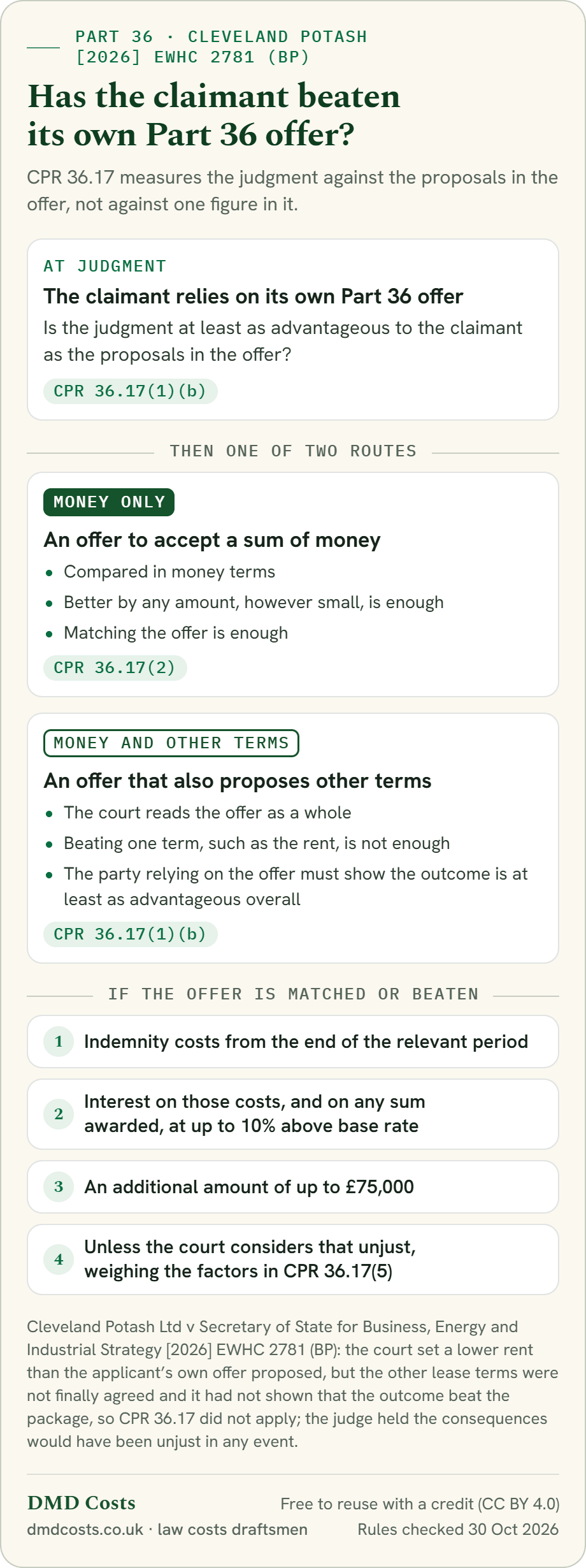
Under CPR 36.17(1)(b) a claimant’s own Part 36 offer has its consequences where the judgment is at least as advantageous to the claimant as the proposals in the offer; for a money claim or money element the comparison is in money terms, so equalling the figure is enough (CPR 36.17(2)). An offer that proposes other terms is read as a whole: in Cleveland Potash [2026] EWHC 2781 (BP) the applicant beat the rent in its own offer but had not shown that it beat the package of lease terms. The consequences are indemnity costs, interest at up to 10% above base rate and an additional amount of up to £75,000, unless unjust (CPR 36.17(4) and (5)).
Free to reuse under CC BY 4.0: credit “DMD Costs (dmdcosts.co.uk)” and link to this page. Download the PNG.
Text version of this diagram
CPR 36.17 measures the judgment against the proposals in the offer, not against one figure in it.
At judgment: The claimant relies on its own Part 36 offer. Is the judgment at least as advantageous to the claimant as the proposals in the offer? (CPR 36.17(1)(b)).
Then one of two routes:
- Money only: An offer to accept a sum of money.
- Compared in money terms
- Better by any amount, however small, is enough
- Matching the offer is enough
- Rules: CPR 36.17(2)
- Money and other terms: An offer that also proposes other terms.
- The court reads the offer as a whole
- Beating one term, such as the rent, is not enough
- The party relying on the offer must show the outcome is at least as advantageous overall
- Rules: CPR 36.17(1)(b)
If the offer is matched or beaten:
- Indemnity costs from the end of the relevant period
- Interest on those costs, and on any sum awarded, at up to 10% above base rate
- An additional amount of up to £75,000
- Unless the court considers that unjust, weighing the factors in CPR 36.17(5)
Cleveland Potash Ltd v Secretary of State for Business, Energy and Industrial Strategy [2026] EWHC 2781 (BP): the court set a lower rent than the applicant’s own offer proposed, but the other lease terms were not finally agreed and it had not shown that the outcome beat the package, so CPR 36.17 did not apply; the judge held the consequences would have been unjust in any event.
Rules checked 30 October 2026.
The rent was beaten. The offer was not shown to be
CPL’s offer of 28 March 2024 adopted the heads of terms for a new lease set out in a witness statement for CPL: ten clauses, revised on 20 December 2020. It made one change. The Certain Rent in sub-clause 4 went up from £29.20 to £37.61 per acre per annum, which the judge construed as running from the start of the lease on 1 July 2020 (at [113]–[117]). The May 2026 judgment set the Certain Rent at £29.38, subject to RPI uplifts. On rent, CPL, which will pay it, had done better than its own offer, and the judge accepted that the offer was a genuine offer of improved terms on the Certain Rent (at [118]).
| Term | What CPL offered or sought | Where it stood |
|---|---|---|
| Certain Rent | £37.61 per acre per annum from 1 July 2020 (the heads of terms had £29.20) | £29.38, subject to RPI uplifts, set by the 22 May 2026 judgment: better for CPL than its offer ([118]) |
| Rent reviews | Every three years, as in the heads of terms | Not agreed as proposed, or at all: the respondents proposed annual reviews in 2024, and the draft order contained unagreed wording on how the frequency would be settled, including by the court ([130]) |
| Length of lease | CPL sought 50 years | The respondents offered 25 years from 1 July 2022 before trial; at trial their counsel said that if CPL wanted a 50-year lease with a break clause they would grant it. The court did not know how their draft lease terms compared with the offer ([129]) |
| The other heads of terms | The rest of the ten clauses, unchanged | On the evidence, some appeared superseded by later negotiation and others were still not agreed: no final binding lease terms to measure the offer against ([128]–[135]) |
Paragraph numbers are those of [2026] EWHC 2781 (BP). The respondents said the heads of terms were not agreed in that form, and that revised heads of terms were broadly agreed by June or July 2022 except for the financial matters ([131]).
The trouble was that the offer was not just an offer about rent. In the judge’s words, “It is a multifaceted offer” (at [127]). To decide whether CPL had achieved something more advantageous, she had to compare the position with every term the offer proposed. The evidence suggested that some of those terms had been superseded by later negotiation and others were still not agreed (the frequency of rent reviews had not been agreed at all), and there were no final, binding lease terms against which the offer could be measured (at [128]–[135]).
Her conclusion was that although CPL had done better on the Certain Rent, it was not possible to say it had done better overall. Reliance on the offer was either premature, because the lease terms were not settled, or, if the respondents were right, the terms negotiated since, other than the rent, were not overall as advantageous as those in the offer (at [133]–[134]). A party cannot pick and choose the elements of a Part 36 offer it relies on: “One has to consider the Part 36 Offer as a whole” (at [135]). It was for CPL to satisfy the court that the outcome beat the offer, and it had not done so (at [136]–[137]).
Two more problems: how the offer was framed, and injustice
Could the offer have been accepted?
The respondents attacked the offer on several fronts, and some of their arguments failed. The offer was not ineffective because it was framed as the terms of a lease rather than as rights; it was not limited to a smaller area, as the second respondent argued; and it was not “no offer at all”, because it genuinely improved the rent. If the respondents did not understand it, they could have asked for clarification, and they did not (at [110]–[119]).
But the judge found real difficulties in how the offer was meant to work alongside the preliminary issue. CPL made it before that issue was decided and meant it to work whatever the outcome, so it was “in one sense conditional”: its full effect could not be known until the issue was resolved, although the parties did not need that decision before agreeing lease terms (at [122]). It also did not carve out the costs of the preliminary issue, leaving it unclear whether acceptance would have made the respondents pay CPL’s costs of that issue whatever its outcome (at [123]). The judge agreed with the respondents that this apparent conditionality and the potential costs issues presented difficulties (at [125]), and said the structural problems appeared to make the offer incapable of acceptance as drafted, which was either fatal to it or a significant factor on injustice (at [126]).
Unjust in any event
The second respondent argued that even an effective offer should not carry the Part 36 benefits, and the judge agreed. Even if the offer had been effective because of the improved rent, and capable of acceptance before the preliminary issue was decided, it would have been unjust to give CPL the benefit of Part 36 for a single term of the lease, given the scope of the issues the judgment decided and the fact that the lease terms were still not agreed (at [139]–[141]).
The offer remained one to be taken into account on costs, but with no greater status than the other offers the parties exchanged (at [138] and [141]), and the judge treated the parties’ offers and negotiations, taken together, as costs neutral (at [74] and [85]).
If CPR 36.17 had applied: interest at 4% above base
The judge also decided the one point in dispute about what would have followed had she been wrong: the rate of enhanced interest. The first respondent accepted that an effective offer would have given CPL indemnity costs and the maximum additional amount, while the second respondent argued that any Part 36 benefit would be unjust. CPL asked for the maximum, 10% above base rate; the first respondent proposed 2%. The judge would have allowed 4% above base: this was a substantial commercial dispute with no allegation of fraud or dishonesty, conducted partly over a period when interest rates were historically low (at [142]–[144]).
The 10% in CPR 36.17(4) is a ceiling, not a starting point. For a money claim, our free Part 36 calculator works out when the relevant period ended, whether the judgment beat the offer, the additional amount and interest at up to 10% above base rate.
What CPL lost: indemnity costs on most of its bill
The additional amount is the most visible Part 36 consequence because it is easy to calculate, but on a substantial bill the indemnity basis is often worth more. On the standard basis the court allows only proportionate costs and resolves any doubt in the paying party’s favour (CPR 44.3(2)); on the indemnity basis there is no proportionality test and doubt goes to the receiving party (CPR 44.3(3)). See why proportionality drops out on the indemnity basis.
On CPL’s own schedule, phases 6 to 11, which run from 3 July 2024 through the expert evidence, mediation, trial and the work after judgment, came to £937,697.46: more than three-quarters of the £1,204,160.86 claimed (our arithmetic). Had the offer succeeded, all of that would have been assessed on the indemnity basis, with enhanced interest on it and the additional amount, which the first respondent accepted would be the maximum. With no money award to CPL, that amount is calculated on the costs awarded and capped at £75,000, which it reaches only if the costs awarded are at least £1 million (CPR 36.17(4)(d)). Instead the whole bill will be assessed on the standard basis (at [145]).
Does Cleveland Potash create a new Part 36 test?
In our view, no. The judgment does not refer to the wording of CPR 36.17(1)(b) or (2), but its approach fits them: the rule measures the judgment against “the proposals contained in” the offer, and makes the comparison a purely money one only for a money claim or the money element of a claim. What the case shows is what that can mean when an offer proposes several terms: the court reads the offer as a whole, the party relying on it has to prove the comparison, and an offer that reaches beyond the issues the court will decide may be impossible to measure. In the judge’s words, the case shows the risk of relying on an offer “drawn more broadly than the issues which the Judgment addressed” (at [134]). It is a first-instance decision on unusual facts, but on our reading the same reasoning could apply to any offer that proposes more than money.
Part 36 non-monetary terms: offers you can prove you beat
The lesson is about structure, not about avoiding non-money terms. A party may genuinely be willing to settle only on a package, and Part 36 allows that. But the more terms an offer contains, the harder it may be to show later that the judgment beat it, and that burden falls on the party relying on the offer. Before serving an offer that combines money with other terms, ask:
- What exactly has to happen at trial for us to beat this offer? If the answer cannot be put in a sentence, the court may struggle too.
- Can each other term be compared with what the court could order? Terms the court will not decide, or that will still be open at judgment, can make the comparison impossible, or at least premature, as the unagreed lease terms did here.
- Should the money have an offer of its own? A Part 36 offer can relate to the whole of a claim, part of it or an issue in it, and must say which (CPR 36.2(3) and 36.5(1)(d)). A separate offer on the money can protect it even if the other terms stay in dispute; if an offer on part of a claim is accepted, the costs are generally for the court unless agreed (CPR 36.13(4)(c)).
- Is another issue pending that changes the offer’s effect? CPL’s offer was made before a preliminary issue was decided, which left its effect uncertain. Make the offer’s scope unambiguous, saying which part or issue it relates to (CPR 36.5(1)(d)), without adding costs terms: the judge noted that Part 36 offers are “more safely drafted without reference to costs” (at [123]). Or wait until the issue is decided, when there will be more clarity (at [125]).
- Will the offer still make sense if the case moves on? Repairs get done, expert evidence changes and pleadings are amended.
- Will a costs judge be able to follow it later? Keep the offer, proof and date of service, the relevant period, any clarification, variation or withdrawal, and a note of why the offer was framed as it was.
Our free N242A Part 36 offer builder fills in the official form, with the relevant period checked against CPR Part 36. If a package is the only basis on which your client will settle, a without prejudice save as to costs offer can give more flexibility, though the court then weighs it under CPR 44.2 rather than applying the Part 36 consequences; our Calderbank offer builder drafts one. And if you receive an offer whose terms are unclear, ask for clarification within 7 days (CPR 36.8(1)). The judge cited the White Book commentary that clarification may be particularly important where an offer is not purely in monetary terms and there is scope for argument, and said clarity was needed from the offeror when drafting as well as from the offeree (at [124]).
Why this matters in housing disrepair claims
Cleveland Potash was a mineral-rights dispute, but the same problem can arise in any claim where a Part 36 offer proposes more than money, and housing disrepair is an obvious example. A claimant’s offer may combine damages with a schedule of repairs, a completion date, access arrangements or other practical terms.
Take an offer to accept £5,000 in damages together with specified repairs. At trial the claimant is awarded £6,000, but the court orders narrower works. The £6,000 beats the money, but CPR 36.17(2) makes the comparison a money one only for the money element of the claim. On our reading of Cleveland Potash, the claimant would have to show that the judgment as a whole is at least as advantageous as the package it offered, and narrower works make that harder. And if the repairs are done before trial, it is worth asking early how a court would compare the works term with a judgment that orders none.
Which Part 36 rule applies in a disrepair claim, CPR 36.17 or the fixed costs version in CPR 36.24, and what beating your own offer is worth, is covered in our guide to Part 36 in housing disrepair costs. Cleveland Potash adds a question for the next stage: once you know which rule applies, can you prove the judgment beat the offer?
The costs order: no issues-based or percentage reduction
The respondents accepted that CPL was the more successful party, but argued for no order for costs up to April or July 2024 and only 80% after that, and the second respondent also claimed 20% of its own costs for the later period (at [18]–[20]). The judge rejected all of it. In a complex case with overlapping issues the successful party will rarely win every issue, and the court should not analyse each one at a granular level; taking a broad-brush, common-sense approach, CPL was plainly the more successful party (at [104]). It is entitled to its costs of the whole proceedings on the standard basis, subject to detailed assessment, including the costs reserved at the first directions hearing but not costs already covered by another specific order (at [5] and [107]).
The court also declined CPL’s request for an order running from 6 March 2020, when its 2020 offer was rejected: the order is neither limited nor extended by date. A general costs order needs no start date for pre-action costs to be recoverable, and whether particular pre-action work, such as negotiations and the referrals to the Secretary of State, is recoverable is for the costs judge on detailed assessment (at [5], [14]–[15] and [106]).
Payment on account of costs: £550,000 of £1,204,160.86
Where the court orders a party to pay costs subject to detailed assessment, it will order a reasonable sum on account unless there is good reason not to (CPR 44.2(8)), and the burden is on the paying party to show a good reason (at [146]). Here the respondents accepted that a payment was due and argued about how much. A reasonable sum is an estimate of the likely level of recovery, allowing for uncertainty, not an irreducible minimum (Excalibur Ventures LLC v Texas Keystone Inc [2015] EWHC 566 (Comm), discussed at [149]). The receiving party has to give the court enough information to make a safe order, and the paying party has to identify the factors it relies on (at [152]).
| Figure | Amount | Share of the costs claimed |
|---|---|---|
| Costs claimed (CPL’s figure, to its submissions) | £1,204,160.86 | 100% |
| Sought by CPL | £700,000 | About 58% |
| The first respondent’s figure | £207,000 (30% of 80% of the costs from 19 April 2024) | About 17% |
| 30% of the whole, as the judge worked it | £361,250 | 30% |
| Ordered | £550,000 | About 46% |
Figures from [153] and [186]. CPL said its figure excluded its preliminary issue costs; on our arithmetic of the phases it includes about £49,000 for the relief from sanctions application, which the judge left out ([176]), and without it the order is about 48% of the rest. The shares for the first respondent’s figure and the order are our arithmetic: the court set a sum, not a percentage.
The judge found the costs and the sum sought on the high side, with phases that appeared to include irrecoverable costs, but 30% still on the low side: considerable costs had been incurred that will be recoverable on any basis (at [185]). She settled on £550,000 as “a fair balance and a reasonable sum”, giving CPL a substantial payment while leaving substantial headroom for the concerns about recoverability and quantum (at [186]–[187]). Nothing in that figure stops either side running the same arguments on detailed assessment, where CPL may yet justify more than it sought on account (at [188]).
No fixed percentage: Cubic and Cleveland Potash compared
Earlier in 2026, in Cubic v Transport for London [2026] EWHC 211 (TCC), Transport for London said it had incurred £1,201,444.75 and was awarded the full £720,866.85 it sought, 60%. CPL claimed almost the same, £1,204,160.86, and was awarded about 46% (our arithmetic). On our reading, the difference is not a different rule but different evidence. In Cubic, on the costs of a one-day application, the judge had no doubt that TfL would recover at least the sum sought, noting that the paying party’s own costs of the same application were £1,182,020.75; in Cleveland Potash the judge could point to specific costs that might not survive assessment. As our note on Cubic v TfL and payments on account puts it, the percentage is an output, not an input.
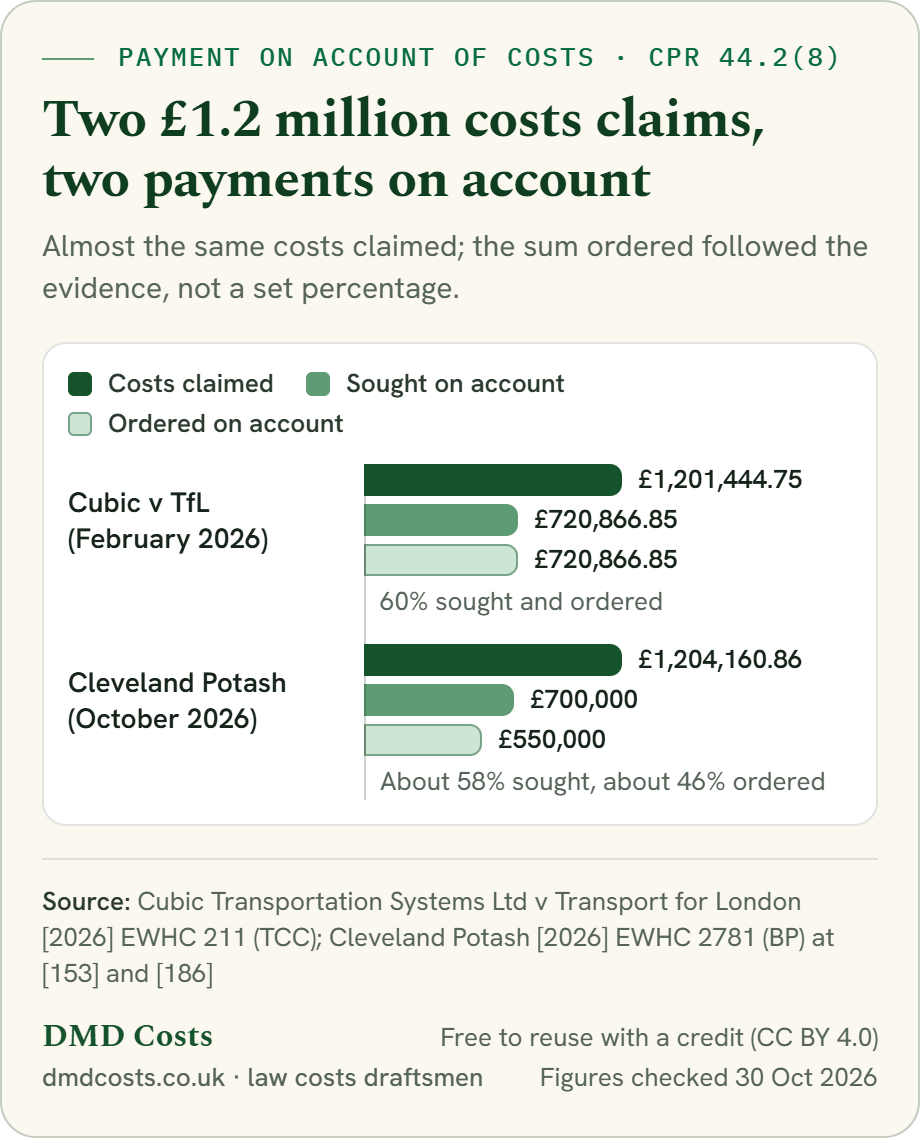
Payments on account of costs under CPR 44.2(8) in two 2026 High Court cases with almost the same costs claimed. In Cubic v Transport for London [2026] EWHC 211 (TCC) the receiving party said it had incurred £1,201,444.75 and was awarded the £720,866.85 it sought, 60%. In Cleveland Potash [2026] EWHC 2781 (BP) the receiving party claimed £1,204,160.86, sought £700,000 and was awarded £550,000, about 46%, after the judge identified costs that might not be recoverable on detailed assessment. Neither court applied a fixed percentage.
Free to reuse under CC BY 4.0: credit “DMD Costs (dmdcosts.co.uk)” and link to this page. Download the PNG.
Text version of this diagram
Almost the same costs claimed; the sum ordered followed the evidence, not a set percentage.
Costs claimed, Sought on account and Ordered on account:
- Cubic v TfL (February 2026): Costs claimed £1,201,444.75; Sought on account £720,866.85; Ordered on account £720,866.85.
- 60% sought and ordered
- Cleveland Potash (October 2026): Costs claimed £1,204,160.86; Sought on account £700,000; Ordered on account £550,000.
- About 58% sought, about 46% ordered
Source: Cubic Transportation Systems Ltd v Transport for London [2026] EWHC 211 (TCC); Cleveland Potash [2026] EWHC 2781 (BP) at [153] and [186]
Figures checked 30 October 2026.
What the judge weighed, phase by phase
CPL’s schedule split its costs into 11 phases from 6 March 2020 to 29 June 2026, with disbursements divided between counsel, experts and others, and solicitors’ time by fee earner and hours. It was neither a bill of costs nor as detailed as a budget, and it did not describe the work done, but the judge found it more than adequate for setting a payment on account (at [155]–[156]). These are the points she weighed:
| Phase | Period and work | Claimed | What the judge said |
|---|---|---|---|
| Phases 1 and 2 | 6 March 2020 to 7 June 2022: the first referral to the Secretary of State, its rejection and the run-up to the second | £46,457.06 and £28,543.46 | Mostly the costs of CPL’s part-time in-house solicitor and of its valuer (later its valuation expert): not discounted entirely, but treated with particular caution ([164]–[165], [169]–[172]) |
| Phase 3 | 8 June 2022 to 21 April 2023: the second referral and issue of the claim | £93,129.56 | Appears in principle to be recoverable ([173]) |
| Phase 4 | 22 April to 16 October 2023: interim hearings, notification under the 1966 Act and the first directions hearing | £49,199.15 | In principle recoverable ([174]) |
| Phase 5 | The relief from sanctions application | About £49,000 | Recoverable by CPL under the order on the preliminary issue, so left out of the payment on account: to be assessed with the preliminary issue costs, and the judge expected the parties to agree a set-off or seek an order ([176]) |
| Phase 6 | 3 July to 23 September 2024: trial directions and further details of claim | £48,388.10 | In principle recoverable ([177]) |
| Phase 7 | 24 September to 30 November 2024: expert evidence | £75,984.85 | Only £20,137 was the expert’s; the solicitors’ £46,331 may be high, though they also had to review the other side’s expert report ([178]) |
| Phase 8 | 1 December 2024 to 16 May 2025: settlement discussions, lease terms and mediation | £260,577.20 | On the high side at first sight: over 234 hours from the main fee earner and over 56 from a partner, plus two counsel and the expert ([179]) |
| Phase 9 | 17 May to 27 June 2025: trial preparation | £250,712.45 | The respondents said counsel’s £118,250 for the brief, refreshers and pre-trial work on a three-day trial was too high; the judge thought the brief and refreshers appeared on the high side given counsel’s heavy earlier involvement, and noted herself that over 50 hours from five eDiscovery fee earners were unexplained ([180]–[181]) |
| Phase 10 | The trial week and the days after | £97,274.71 | Two solicitors at a trial where only the experts gave evidence may be a solicitor and own client cost ([182]) |
| Phase 11 | After judgment, to 29 June 2026 | £204,760.15 | No information about what work it covered or what justified the sum ([183]) |
From [169] to [183]. The schedule did not appear to identify specifically any costs of the claim between 17 October 2023 and 2 July 2024; any such costs will be recoverable on the standard basis ([175]).
Three concerns ran across the phases. CPL claimed the fees of its part-time in-house solicitor, who charged as a consultant, as a disbursement, and the court could not tell how those fees were calculated or whether they were recoverable between the parties at all (at [164]). Its valuer’s work before the court gave permission for expert evidence, including on negotiations and the mediation, may raise similar questions (at [165]). And there were smaller oddities, such as travel and postage charged as disbursements, when postage is usually an overhead built into hourly rates (at [166]).
For receiving parties the lessons are practical. Leave out of the schedule costs that another order already deals with: CPL included its relief from sanctions costs, and the judge excluded them (at [176]). Give each large phase a line explaining the work, because £204,760.15 after judgment with no explanation attracted caution. Expect questions about in-house or consultant costs claimed as disbursements, expert work before permission, two fee earners at trial and counsel’s brief fees after heavy earlier involvement. The same discipline applies to a statement of costs for summary assessment, which our free N260 statement of costs builder fills in.
Guideline Hourly Rates at the payment-on-account stage
The respondents recalculated CPL’s costs at National 2 rates, the band for Boulby, or failing that at London 2. The judge found neither helpful. This was complex, high-value litigation that justified London 1 rates and might justify more, and both respondents had themselves instructed specialist national firms rather than local solicitors (at [157]–[158]). Recalculating a schedule at a lower band “is just a matter of arithmetic” and says nothing about the nature of the work (at [159]).
Nor did she set rates, which are for the costs judge on detailed assessment (at [160]). She compared the £550 an hour charged by the main fee earner, who did the great majority of the work, with the Grade A guideline rate for London 1, which ranged from £546 in 2024 to £579 in 2026, and concluded that rates did not appear to be a significant proportionality issue at that stage (at [162]). Every band and grade is in our Guideline Hourly Rates 2026 table.
That reasoning belongs to a complex, specialist dispute in which both sides used specialist firms. It is not a general licence to claim London rates in a local claim, but it does show that a paying party’s band-by-band recalculation is a weak answer to an application for a payment on account.
Interest on costs: 8% from the date of the order
The respondents asked for interest on CPL’s costs to be deferred until three months after the order, or a month after service of a detailed bill (at [189]). They relied on Involnert Management Inc v Aprilgrange Ltd [2015] EWHC 2834 (Comm), where judgment-rate interest was not to run until the paying party had a detailed statement of the costs claimed (at [196]).
The judge refused. Interest on costs comes from sections 17 and 18 of the Judgments Act 1838, CPR 40.8 and CPR 44.2(6)(g), and runs from the date of the costs order, not the date the costs are quantified, unless the court orders otherwise (at [190]–[193]). It is only ever paid on the sum eventually found due, so uncertainty about the amount claimed is usually beside the point (at [192] and [199]). Where a payment on account has been carefully calibrated there will rarely be a good reason to defer interest; the respondents’ detailed criticisms of the schedule sat uneasily with their claim that they could not assess their liability; and if they wanted more clarity they could, in due course, use CPR 47.8 to make CPL start detailed assessment (at [194], [197] and [200]). Interest runs at 8% from the date of the costs order on the sums eventually found due (at [201]).
Our free interest on costs calculator works out 8% a year from the date of the order, allowing for payments on account.
After judgment: a Part 36 and costs checklist
- List every Part 36 offer on the file, from the correspondence, not from memory or a settlement spreadsheet.
- Check each offer’s exact terms. The headline figure is not enough where the offer proposed anything else.
- Work out each relevant period and when it expired. The CPR 36.17(4) consequences run from that date.
- Compare every term with the judgment, not just the money, and keep a note of the comparison.
- Keep entitlement and injustice apart. First ask whether CPR 36.17 is engaged, then whether its consequences would be unjust (CPR 36.17(5)).
- Ask for a payment on account at the same time if costs are ordered subject to detailed assessment (CPR 44.2(8)), and deal with interest on costs then too.
- Make the bill follow the order. Where indemnity costs run from the end of a relevant period, divide the bill at that date so that each part is assessed on the right basis.
How DMD Costs can help
Part 36 should be checked before the bill is drawn, not after. Where a file holds several offers, DMD Costs works out what each one covered, when it was made, when its relevant period expired, whether it was clarified, varied or withdrawn, and what the judgment or settlement means for it, so that indemnity costs, enhanced interest and any additional amount are claimed from the right date, and only where they apply.
DMD Costs draws bills of costs and Precedent S electronic bills, prepares N260 statements of costs and the costs schedules behind payment on account applications, answers Points of Dispute with Replies, supports CPR 46.14 costs-only proceedings and handles costs negotiation to settlement, including Part 36 offers, for claimant solicitor firms in housing disrepair, clinical negligence and MoD NIHL claims. For disrepair bills, see our housing disrepair costs service. The fee is fixed and agreed before any work begins, and our free calculators and form builders are collected in the legal costs help hub.
Case details
| Case | Cleveland Potash Ltd v Secretary of State for Business, Energy and Industrial Strategy and others |
| Neutral citation | [2026] EWHC 2781 (BP) |
| Court | High Court, Business and Property Division, Business List (Rolls Building) |
| Judge | Master Kaye, sitting as a Deputy High Court Judge |
| Handed down | 30 October 2026, decided on written submissions |
| Earlier judgments | [2026] EWHC 1182 (Ch), 22 May 2026 (valuation and proprietorship); [2024] EWHC 1292 (Ch), 28 May 2024 (preliminary issue) |
| Part 36 | CPR 36.17 consequences of CPL’s offer of 28 March 2024 refused; had they applied, enhanced interest at 4% above base |
| Costs order | CPL’s costs of the proceedings on the standard basis, subject to detailed assessment; no issues-based, percentage or time-limited order |
| Payment on account | £550,000 (costs claimed £1,204,160.86; sought £700,000) |
| Interest on costs | 8% from the date of the costs order on the sums found due; deferral refused |
| Permission to appeal | Refused (sought by the first and second respondents against the 22 May 2026 judgment) |
| Rules discussed here | CPR 36.17 (including 36.17(5)), 36.2(3), 36.8, 44.2(6)(g), 44.2(8), 44.3, 40.8 and 47.8; Judgments Act 1838, ss.17–18 |
Sources
- Cleveland Potash Ltd v Secretary of State for Business, Energy and Industrial Strategy and others [2026] EWHC 2781 (BP) (Find Case Law)
- Cleveland Potash Ltd v Drummond and others [2026] EWHC 1182 (Ch) (Find Case Law)
- Cubic Transportation Systems Ltd v Transport for London [2026] EWHC 211 (TCC) (Find Case Law)
- Civil Procedure Rules, Part 36 (offers to settle)
- Civil Procedure Rules, Part 44 (general rules about costs)
- Civil Procedure Rules, Part 40 (judgments and orders), rule 40.8