A claimant who has paid nothing towards its legal costs can still be awarded interest on them from before judgment, if it is liable to compensate its solicitors, a funder or an insurer for the credit. In Município de Mariana v BHP Group (UK) Ltd [2026] EWCA Civ 1319, handed down on 16 October 2026, the Court of Appeal upheld an order that BHP pay interest at 1% above base rate on the claimants’ costs from 1 August 2023, almost two and a half years before the costs order. The claimants were funded under conditional fee agreements, and the court held that their liability to pay success fees, which were assumed to compensate their solicitors at least in part for working on credit, was enough.
That matters to every claimant firm that runs cases on CFAs, because in housing disrepair, clinical negligence and MoD NIHL claims the client usually pays little or nothing until the claim succeeds. This note explains what the Court of Appeal decided, why it is not a back door to recovering the success fee, how much it can add and when to ask for it.
The short answer: can a CFA-funded claimant get interest on costs before judgment?
Yes, if it is liable to compensate someone for the credit, as through a success fee, and the court decides to award it. CPR 44.2(6)(g) allows the court to order a party to pay “interest on costs from or until a certain date, including a date before judgment”. The Court of Appeal held that this is a broad discretion to compensate for the loss of the time value of money, either because the receiving party has been kept out of its money or because it is itself liable to compensate someone else, “whether the solicitors providing the legal services themselves, an insurer or a third-party funder”, for providing legal services on credit (at [10] and [38]).
A party does not have to have paid its lawyers, or borrowed to pay them (at [36]). Nor does the award breach the rule that success fees cannot be recovered from the other side (Courts and Legal Services Act 1990, s.58A(6)): interest on costs is “quite distinct and separate” from an order to pay a success fee (at [12]).
What happened in Mariana v BHP?
The claims arise from the collapse of the Fundão Dam in Brazil in November 2015. Some 450,000 individuals, businesses, municipalities and other bodies claim compensation from BHP. After a Stage 1 trial lasting about five months, from October 2024 to March 2025, O’Farrell J held BHP strictly liable as polluters under Brazilian environmental law, and liable in the alternative for fault, and held that the claims were not time-barred. She and the Court of Appeal both refused permission to appeal those findings (at [2]).
On the consequential issues the judge ordered BHP to pay 90% of the claimants’ costs of the Stage 1 trial on the standard basis, £43 million on account and interest on the costs from before judgment, and she refused an immediate detailed assessment. BHP’s appeal was against the interest (at [3]–[4]).
| Part of the order | What the trial judge ordered |
|---|---|
| Costs | 90% of the claimants’ costs of the Stage 1 trial, on the standard basis, to be assessed |
| Interest on costs before judgment | 1% above base rate on the total recoverable Stage 1 costs, from 1 August 2023, the date by which half of the fees had been incurred, until 26 January 2026 |
| Payment on account | £43 million (CPR 44.2(8)); the claimants put their Stage 1 costs at about £189 million and sought £113.5 million |
| Detailed assessment | Not immediate: the claimants’ application for an immediate assessment was refused |
| The appeal | BHP appealed the interest award; the Court of Appeal dismissed the appeal on 16 October 2026 |
From [3] of the Court of Appeal’s judgment and [25]–[27], [42], [52], [56] and [58] of the trial judge’s consequentials judgment, [2026] EWHC 73 (TCC), handed down on 19 January 2026; the order is dated 26 January 2026.
How the claimants were funded
The court was shown only indirect evidence of the funding: evidence given by Mr Goodhead in the Pan NOx emissions group litigation, as set out in a 2024 High Court judgment (at [14]). According to it, the claimants’ solicitors, Pogust Goodhead, acted for each client under a conditional fee agreement, no third-party funder had any agreement with the clients, and the firm was funded by a secured corporate debt facility of $552.5 million, repayable whatever the outcome of its cases (at [15]). It was common ground that the clients did not have to pay anything towards their costs until they succeeded, when they would owe their solicitors base costs and a success fee (at [5] and [16]).
The court was not shown the agreements. Both sides asked it to assume their terms, and BHP accepted that success fees payable under CFAs will generally include an element of compensation for the solicitors’ funding costs. The court therefore assumed that these success fees were intended, at least in part, to compensate the solicitors for the funding costs of providing their services without charge until the end (at [14]–[16]).
What BHP argued
BHP had two arguments (at [5]–[7]):
- The success fee point. The interest had been awarded only because the claimants might have to pay success fees reflecting the cost of funding the litigation. BHP said that section 58A(6) makes success fees irrecoverable, and that in Hirachand v Hirachand [2024] UKSC 43 the Supreme Court made clear the prohibition cannot be avoided by recategorising the fee. BHP added that even when success fees were recoverable, the former CPR 44.3B(1) stopped a party recovering, unless the court ordered otherwise, the part of a success fee relating to the postponement of the lawyers’ fees.
- The out-of-pocket point. Interest on costs before judgment can be awarded only to a party that is out of pocket or has borrowed to fund its costs, and these claimants had done neither, relying on Secretary of State for Energy and Climate Change v Jones [2014] EWCA Civ 363 at [17].
The claimants accepted that they had to be out of pocket in some sense, and said they were, because they were contingently liable to compensate their solicitors for the late payment of their fees through the success fee (at [9]).
The decision: a broad discretion over the time value of money
Sir Geoffrey Vos MR, with whom Zacaroli LJ and Cockerill LJ agreed, dismissed the appeal. He took the out-of-pocket point first, because it goes to the scope of the power (at [10]). An award of interest on costs before judgment is not an exceptional or unusual step, and it compensates one party for the loss of the time value of money. Nothing in CPR 44.2(6)(g) or elsewhere says it can be awarded only if the receiving party has spent money on costs or borrowed to pay them, and a rule like that would fetter the broad discretion the rule gives (at [36]).
The claimants, like many funded parties, owed nothing unless they won, and then owed base costs and a success fee that could be assumed to include some compensation for the credit their solicitors had given. That was enough: they were “obliged to provide compensation for the time value of the money used to fund their costs” (at [37]). The court endorsed what Akenhead J said in Fosse Motor Engineers Ltd v Conde Nast and National Magazine Distributors Ltd [2008] EWHC 2527 (QB): an application for interest on costs before judgment should not normally involve a minute examination of how the litigation was funded (at [37]).
Why this is not recovering the success fee
Hirachand decided that a success fee could not be included in an award under the Inheritance (Provision for Family and Dependants) Act 1975, because costs, including success fees, are dealt with only under the CPR costs regime, and such an order would itself be a costs order prohibited by section 58A(6) (at [40] and [43]). It “actually had nothing to say about the scope of the power” in CPR 44.2(6)(g), nor about its interaction with section 58A(6) (at [45]).
Funding costs cannot be recovered as costs, and section 58A(6) bars success fees, but it does not follow that interest on costs is barred whenever the receiving party has agreed to pay a success fee. Such a rule would be unjust to funded parties in a large number of situations. The award compensates for the loss of the time value of money; it is not the success fee, and it is not awarded to pay it (at [12] and [46]). The court found two separate indications that the power is distinct from an award of the success fee (at [47]):
- Nosworthy. The court agreed with Master Brown’s reasoning that funding costs are not, in general, recoverable in a bill, but that interest from the date of the costs order mitigates the position (at [48]–[49]; see below).
- No perverse incentive. Lord Justice Jackson’s objection to recoverable success fees was that they drove up costs, because claimants had no reason to negotiate them down. Here the funding arrangements were bespoke, and the chance of interest on costs had no influence on the success fees (at [50]). Put another way, the contingent liability, through the success fees, to compensate the solicitors for their funding costs is “merely a trigger” for interest to be claimed. It does not influence the amount, which is based on “what funding the costs would reasonably have cost the class of persons of which the claimants form part”, not on the value of the success fee, so claimants remain incentivised to limit success fees (at [51]).
The former CPR 44.3B(1) did not help BHP either: it applied unless the court ordered otherwise, and it had nothing to do with interest on costs (at [52]).
Funding costs still do not go in the bill
Mariana does not make funding costs an item of costs. The Court of Appeal said they have never been recoverable as costs, the only exception being the period from 2000 to 2013 when the original section 58A(6) allowed success fees to be recovered (at [18] and [25]). Success fees under CFAs made before 1 April 2013 can still be recovered, and the Supreme Court noted in Hirachand that they remain recoverable in mesothelioma claims. The Court of Appeal agreed with Master Brown in Nosworthy v Royal Bournemouth & Christchurch Hospitals NHS Foundation Trust [2020] EWHC B19 (Costs) that the cost of funding litigation is not, in general, recoverable as an item in a bill of costs, and that the normal rule that interest runs from the date of the costs order at least substantially mitigates the position (at [48]). What Mariana adds is that the court can also compensate for the period before the order, through interest, where the receiving party is liable for the cost of the credit.
Worked example: what a Mariana-style order adds
Suppose the court makes the same kind of order as in Mariana in a claim run under a CFA: £150,000 of costs are eventually allowed, half of them had been incurred by 1 April 2025, and the costs order is made on 1 October 2026. Interest at 1% above Bank Rate on the whole £150,000 from 1 April 2025 to the order comes to £11,134.94, on our arithmetic. From the order, interest runs at the judgment rate of 8% a year, which is £12,000 a year on £150,000.
| Period | Bank Rate | Rate charged | Days | Interest |
|---|---|---|---|---|
| 1 April to 8 May 2025 | 4.5% | 5.5% | 37 | £836.30 |
| 8 May to 7 August 2025 | 4.25% | 5.25% | 91 | £1,963.36 |
| 7 August to 18 December 2025 | 4% | 5% | 133 | £2,732.88 |
| 18 December 2025 to 1 October 2026 | 3.75% | 4.75% | 287 | £5,602.40 |
| Total before the costs order | 4.5% falling to 3.75% | Bank Rate + 1% | 548 | £11,134.94 |
Simple interest on a 365-day year, worked out as our interest on costs calculator does: each period counts its last day and not its first, so the day Bank Rate changed is charged at the earlier rate, and each period is rounded to the penny. Bank Rate as published by the Bank of England. An illustration, not a prediction: the rate and the start date are for the court in each case.
Interest on the whole sum from the date by which half of it had been incurred is a proxy. If the costs built up evenly, on our arithmetic it gives about the same result as interest on each item from the day it was incurred, without anyone having to work that out. Our interest on costs calculator works out both periods: a rate the court set before the order, including Bank Rate plus a margin, and 8% from the order.
How interest on costs fits together
| Period | Rule | Rate |
|---|---|---|
| Before the costs order | CPR 44.2(6)(g): the court may order interest on costs from a date before judgment, in its discretion | Set by the court: 1% above base rate in Mariana |
| From the costs order, before and after assessment | Judgments Act 1838 s.17 and CPR 40.8: interest on the sum later found due runs from the date of the order (Hunt v R M Douglas (Roofing) Ltd [1990] 1 AC 398) | 8% a year: the court can move the start date but not the rate, and can disallow interest for delay in the assessment (CPR 47.8(3), 47.14(4)) |
| A Part 36 offer accepted within the relevant period, after issue | A costs order is deemed to have been made, with interest from the date of acceptance (CPR 44.9(1), (2) and (4)) | 8% a year |
| Judgment at least as advantageous as the claimant’s own Part 36 offer | Indemnity costs from the end of the relevant period, with interest on those costs, unless the court considers it unjust (CPR 36.17(4)(b) and (c)) | Up to 10% above base rate |
In the County Court a judgment or order generally carries interest only if it is for £5,000 or more (County Courts Act 1984 s.74 and the County Courts (Interest on Judgment Debts) Order 1991); a qualifying debt under the Late Payment of Commercial Debts (Interest) Act 1998 carries interest below that, and some judgments, such as those on regulated consumer credit agreements, carry none.
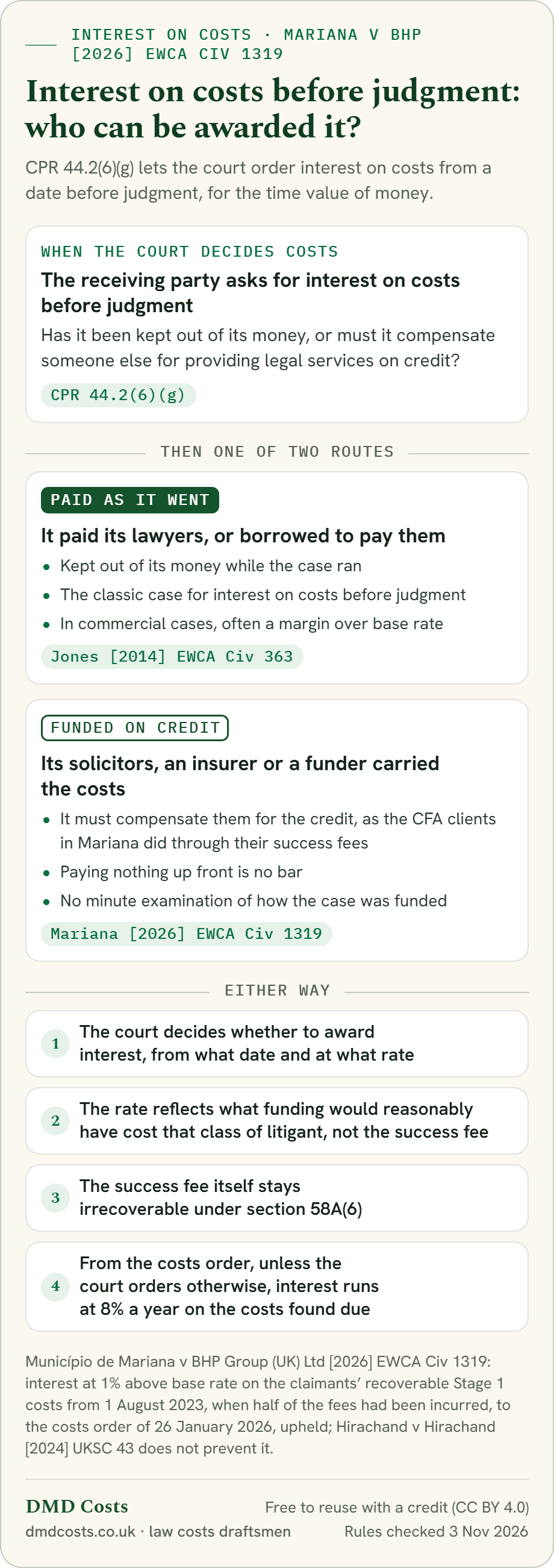
Under CPR 44.2(6)(g) the court may order interest on costs from a date before judgment. In Mariana v BHP [2026] EWCA Civ 1319 the Court of Appeal held that the power compensates for the loss of the time value of money, whether a party has been kept out of its money or must compensate its solicitors, an insurer or a funder for providing legal services on credit. CFA-funded claimants who had paid nothing qualified: they were contingently liable to pay success fees assumed to compensate their solicitors in part for the credit. The award is not the success fee, which stays irrecoverable (Courts and Legal Services Act 1990, s.58A(6)).
Free to reuse under CC BY 4.0: credit “DMD Costs (dmdcosts.co.uk)” and link to this page. Download the PNG.
Text version of this diagram
CPR 44.2(6)(g) lets the court order interest on costs from a date before judgment, for the time value of money.
When the court decides costs: The receiving party asks for interest on costs before judgment. Has it been kept out of its money, or must it compensate someone else for providing legal services on credit? (CPR 44.2(6)(g)).
Then one of two routes:
- Paid as it went: It paid its lawyers, or borrowed to pay them.
- Kept out of its money while the case ran
- The classic case for interest on costs before judgment
- In commercial cases, often a margin over base rate
- Rules: Jones [2014] EWCA Civ 363
- Funded on credit: Its solicitors, an insurer or a funder carried the costs.
- It must compensate them for the credit, as the CFA clients in Mariana did through their success fees
- Paying nothing up front is no bar
- No minute examination of how the case was funded
- Rules: Mariana [2026] EWCA Civ 1319
Either way:
- The court decides whether to award interest, from what date and at what rate
- The rate reflects what funding would reasonably have cost that class of litigant, not the success fee
- The success fee itself stays irrecoverable under section 58A(6)
- From the costs order, unless the court orders otherwise, interest runs at 8% a year on the costs found due
Município de Mariana v BHP Group (UK) Ltd [2026] EWCA Civ 1319: interest at 1% above base rate on the claimants’ recoverable Stage 1 costs from 1 August 2023, when half of the fees had been incurred, to the costs order of 26 January 2026, upheld; Hirachand v Hirachand [2024] UKSC 43 does not prevent it.
Rules checked 3 November 2026.
Once the order is made, interest at 8% runs from its date on whatever sum is eventually found due. In Cleveland Potash [2026] EWHC 2781 (BP) the judge said there will rarely be a good reason to defer it where the payment on account has been carefully calibrated (at [194]), as our note on Cleveland Potash and interest from the date of the order explains. Where the judgment is at least as advantageous to the claimant as its own Part 36 offer, CPR 36.17(4)(b) and (c) give indemnity costs from the end of the relevant period and interest on those costs at up to 10% above base rate, unless that is unjust; the rule does not say from when that interest runs. Our Part 36 calculator works out when the relevant period ended.
What it means for housing disrepair, clinical negligence and MoD NIHL claims
Most claimant work in these areas is done under conditional fee agreements, and the client usually pays little or nothing, beyond some disbursements, until the claim succeeds. Before Mariana a paying party could say, as BHP did, that such a client had not been kept out of any money and so should have no interest on costs before judgment. The Court of Appeal has rejected that argument where the client is liable, through the success fee, to compensate its solicitors for the credit. On our reading, five practical points follow:
- Ask when costs are decided. The power is part of the costs order. In Mariana the claimants asked for interest at the consequentials hearing, with a proposed rate and start date.
- Be ready to show the trigger. BHP accepted that success fees generally include an element for funding costs. Another paying party may not, so have the CFA’s success fee terms to hand, and do not treat Mariana as deciding the position of a client who owes nothing for the delay.
- Propose a rate and a date, with reasons. The rate reflects what funding would reasonably have cost the class of litigant, not the success fee. The trial judge accepted, as pragmatic and proportionate, the claimants’ proposal to use the date by which half of the fees had been incurred; time records are the natural evidence for that date.
- Settlements are different. Most claims settle. When a Part 36 offer is accepted within the relevant period after issue, a costs order is deemed to have been made and interest runs from acceptance (CPR 44.9(1), (2) and (4)); an offer accepted before issue gives no deemed order. In a negotiated settlement or a consent order, interest on costs for an earlier period is a matter for the terms, and our consent order and Tomlin order builder can record an agreed date for interest on costs to run from.
- Fixed costs are different. Mariana concerned costs to be assessed. Where fixed recoverable costs apply under Part 45, the recoverable costs are fixed sums, and the decision does not deal with them.
Checklist: asking for interest on costs before judgment
- Check the funding. Is the client liable to compensate anyone, through a success fee, a funder or an insurer, for carrying the costs on credit?
- Find the halfway date. From the time records and the disbursement invoices, work out when half of the costs had been incurred.
- Propose a rate. Explain what funding would reasonably have cost a litigant in the client’s position, for example a margin over Bank Rate.
- Ask at the hearing where costs are decided, together with a payment on account if the costs are ordered subject to detailed assessment (CPR 44.2(8)).
- Get the order right. State the rate, the start date and the end date for interest before the order, so that interest at the judgment rate takes over from the date of the order.
- Keep funding costs out of the bill. They are not an item of costs; the interest is claimed under the order instead.
How DMD Costs can help
DMD Costs draws bills of costs and Precedent S electronic bills from your time records, prepares N260 statements of costs and the costs schedules behind applications for a payment on account, answers Points of Dispute with Replies and handles costs negotiation through to settlement for claimant solicitor firms in housing disrepair, clinical negligence and MoD NIHL claims. A bill records the date of each item of work, so it also shows when the costs were incurred, which is the evidence an application for interest on costs before judgment needs. The fee is fixed and agreed before any work begins, and our free calculators and form builders are collected in the legal costs help hub.
Case details
| Case | Município de Mariana and the claimants identified in the schedules to the claim forms v BHP Group (UK) Ltd and BHP Group Limited |
| Neutral citation | [2026] EWCA Civ 1319 |
| Court | Court of Appeal (Civil Division), on appeal from the Technology and Construction Court (King’s Bench Division) |
| Judges | Sir Geoffrey Vos MR, Zacaroli LJ and Cockerill LJ, with Senior Costs Judge Rowley as assessor |
| Heard and handed down | Heard on 6 October 2026; handed down on 16 October 2026 |
| Decision under appeal | O’Farrell J, [2026] EWHC 73 (TCC), handed down on 19 January 2026; order of 26 January 2026 |
| Issue | Whether claimants funded under conditional fee agreements, who had paid nothing, can be awarded interest on costs before judgment under CPR 44.2(6)(g), and whether section 58A(6) and Hirachand prevent it |
| Result | Appeal dismissed: interest at 1% above base rate from 1 August 2023 to 26 January 2026 stands |
| Rules discussed here | CPR 44.2(6)(g), 44.2(8), 44.9, 36.17(4)(c) and 40.8; Courts and Legal Services Act 1990, s.58A(6); Judgments Act 1838, s.17 |
Sources
- Município de Mariana v BHP Group (UK) Ltd [2026] EWCA Civ 1319 (Find Case Law)
- Município de Mariana v BHP Group (UK) Ltd [2026] EWHC 73 (TCC), the consequentials judgment (Find Case Law)
- Hirachand v Hirachand [2024] UKSC 43 (Find Case Law)
- Secretary of State for Energy and Climate Change v Jones [2014] EWCA Civ 363 (Find Case Law)
- Civil Procedure Rules, Part 44 (general rules about costs)
- Courts and Legal Services Act 1990, section 58A (legislation.gov.uk)
- Judgments Act 1838, section 17 (legislation.gov.uk)
- Bank of England, Bank Rate history (for the worked example)