A former client who suspects that their solicitors took a commission on an after the event (ATE) insurance premium cannot use an assessment of the solicitors’ bill to find out. In Turner v Coupland Cavendish Ltd [2026] EWCA Civ 1204, handed down on 21 September 2026, the Court of Appeal held that a costs judge has no power, in Solicitors Act proceedings, to order the solicitors to answer a Part 18 request about ATE commission, because the cash account is not open to that kind of challenge. Giving the judgment, Andrews LJ added that a solicitor who is asked ought to answer.
The short answer: can a client ask about ATE commission in a Solicitors Act assessment?
Not in the assessment. A Part 18 request can be ordered only about a “matter which is in dispute in the proceedings” (CPR 18.1). An assessment under section 70 of the Solicitors Act 1974 is about the bill: whether the costs were reasonably incurred and reasonable in amount. After assessing the bill, the costs judge certifies what is due to or by the solicitor (s.70(7)), and uses the cash account only to see what has been paid towards the bill and what the solicitor holds for the client that can be set against it. Whether the solicitor received a secret commission on an ATE premium “is not, and never could be, a dispute in the proceedings” (at [77]).
The client still has routes, though the court accepted that they are neither easy nor cost-effective (at [101]–[102]). Andrews LJ said that, as a fiduciary, the solicitor “ought to tell them if they ask” (at [102]). If it will not, the client can bring proceedings for an account or complain to the Legal Ombudsman (at [101]), and in her view a refusal would, on the face of it, justify the client in seeking an account, for which the solicitor might end up paying the costs (at [5]).
What happened in Turner v Coupland Cavendish?
In August 2019 Mr Turner instructed the firm, which traded as Gowing Law, under a conditional fee agreement in a personal injury claim arising from a road traffic accident. The claim settled in around October 2020, before proceedings were issued, for £3,000 in damages plus a modest sum for his costs. The firm delivered its statutory bill on 11 March 2022, and within a month his new solicitors issued a Part 8 claim for an assessment under section 70(1), limited to the profit costs and the success fee (at [13]–[15]).
Nothing in the judgment suggests that the firm received a commission. The Court of Appeal noted that the Costs Judge had recognised there was “no particular reason to suppose” it had (at [10]), and no finding was made either way.
| Item | What the judgment records |
|---|---|
| Profit costs in the bill | £7,944 including VAT, more than twice the damages recovered |
| Success fee | £750 including VAT, 25% of the damages (the cap), deducted from the damages and paid to an associated company, apparently under a separate damages-based agreement |
| Disbursements | Two medical reports, £700 plus VAT; not in dispute |
| ATE premium | £245, deducted from the damages and shown in the cash account, not in the bill |
| Paid to the client | £2,005, the balance of the £3,000 damages; the cash account showed a nil balance |
| What the assessment covered | The profit costs and the success fee only, at the client’s request |
| Commission at stake | On the court’s estimate, no more than around 10% of the premium, so unlikely to be more than £25 |
From [8], [13]–[15] and [28] of the Court of Appeal’s judgment, handed down on 21 September 2026.
The Part 18 request and the decisions below
In July 2022 the client’s new solicitors served a request “pursuant to CPR Part 18” with 18 questions, including whether the firm had received any direct payment, by way of commission or otherwise, from the ATE insurer or an intermediary. It said that his liability to pay the premium, deducted from money held for him, had to be decided as part of determining the result of the cash account. The firm did not answer, and no formal application for an order was made (at [6] and [22]–[24]). The assessment was stayed behind two other cases, Belsner v CAM Legal Services Ltd [2022] EWCA Civ 1387 and Edwards v Slater and Gordon UK Ltd [2022] EWHC 1091 (QB) (at [25]).
At a hearing in September 2023 the client asked the Costs Judge, Costs Judge Rowley (now the Senior Costs Judge), to order answers. The request itself was not in the bundle. He refused, [2023] EWHC 2721 (SCCO): the questions were not before him and there was no evidence of any commission (at [33]–[37]). On appeal, Sweeting J reversed him, [2025] EWHC 1605 (KB). He held that the only threshold for a Part 18 request was that the information related to a matter in dispute, that it was for the solicitor to satisfy the court that the cash account was accurate, and that the client’s queries put the account in dispute; he ordered the request to be answered in full (at [45]). The firm appealed again.
The decision: the cash account is not a route to an account
The Court of Appeal allowed the appeal. The “proceedings” were the Part 8 claim for an assessment of the bill under CPR 67.3, and their subject-matter is the bill (at [60]). Section 70 is focused on the proper amount to be charged, and protects the client against overcharging (at [61], citing Oakwood Solicitors Ltd v Menzies [2024] UKSC 34). Mr Turner had asked for an assessment of two items in the bill; he had not asked for an account between solicitor and client, and “a dispute about costs is not a dispute about whether the cash account is accurate or complete” (at [63]).
Once the bill has been assessed, section 70(7) requires the costs judge to certify what is due to or by the solicitor in respect of the bill and the costs of the assessment. That is, on the face of it, an arithmetical exercise: add up what has been paid towards the bill and any balance held for the client, compare the total with the assessed amount, and certify the balance (at [64]–[65]). The cash account is separate from the bill and cannot form part of the assessment (at [66], as confirmed in Herbert v HH Law Ltd [2019] EWCA Civ 527). The only entries in it that matter are payments on account of costs, and money received for the client that it was agreed could be put towards the costs, or that the solicitor is entitled to keep until it is paid, such as a credit balance (at [96]).
Herbert had already decided that the amount of an ATE premium cannot be challenged in the assessment. The court held that no distinction can be drawn between a dispute about how much was debited for the premium and a dispute about whether a commission on it should have been credited (at [76]–[77]). A claim to recover secret profits cannot be brought within the assessment either (at [58] and [78], following Jones v Richard Slade and Company Ltd [2022] EWHC 1968 (QB)).
The court’s conclusions, at [100], were that:
- the request was not about a matter in dispute in the proceedings, so there was no power to order an answer;
- the costs judge had no power to inquire into the accuracy, let alone the lawfulness, of cash account items that were neither payments on account of the bill nor money that could lawfully be used to pay it;
- the costs judge did not have to resolve every dispute, actual or prospective, about the cash account before certifying under section 70(7); and
- even if the request had been legitimate, the Costs Judge was entitled to refuse to order an answer when no formal application had been made and the questions were not before him.
What the costs judge does with the cash account
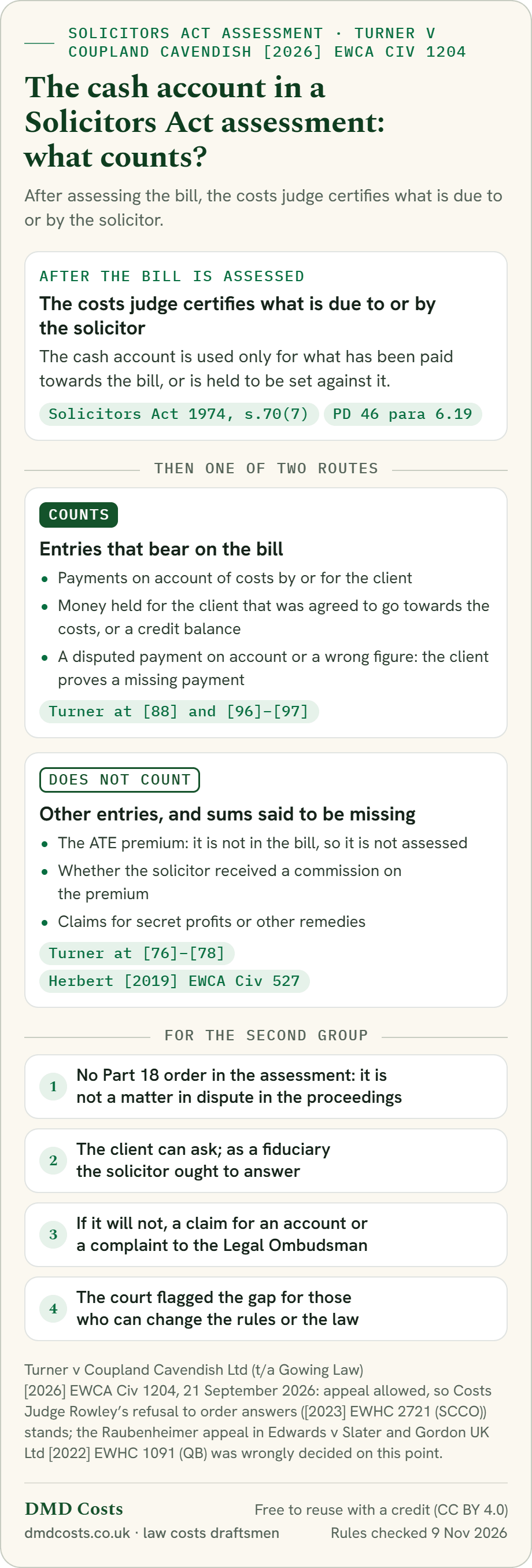
In an assessment of a solicitor’s bill under section 70 of the Solicitors Act 1974, the costs judge assesses the bill and then certifies what is due to or by the solicitor (s.70(7)). In Turner v Coupland Cavendish Ltd [2026] EWCA Civ 1204 the Court of Appeal held that the only cash account entries that count are payments on account of costs and money the solicitor may set against the bill. Whether the solicitor received a commission on an ATE premium is not a matter in dispute in the proceedings, so a Part 18 request about it cannot be ordered (CPR 18.1); the routes are a claim for an account or the Legal Ombudsman.
Free to reuse under CC BY 4.0: credit “DMD Costs (dmdcosts.co.uk)” and link to this page. Download the PNG.
Text version of this diagram
After assessing the bill, the costs judge certifies what is due to or by the solicitor.
After the bill is assessed: The costs judge certifies what is due to or by the solicitor. The cash account is used only for what has been paid towards the bill, or is held to be set against it (Solicitors Act 1974, s.70(7), PD 46 para 6.19).
Then one of two routes:
- Counts: Entries that bear on the bill.
- Payments on account of costs by or for the client
- Money held for the client that was agreed to go towards the costs, or a credit balance
- A disputed payment on account or a wrong figure: the client proves a missing payment
- Rules: Turner at [88] and [96]–[97]
- Does not count: Other entries, and sums said to be missing.
- The ATE premium: it is not in the bill, so it is not assessed
- Whether the solicitor received a commission on the premium
- Claims for secret profits or other remedies
- Rules: Turner at [76]–[78], Herbert [2019] EWCA Civ 527
For the second group:
- No Part 18 order in the assessment: it is not a matter in dispute in the proceedings
- The client can ask; as a fiduciary the solicitor ought to answer
- If it will not, a claim for an account or a complaint to the Legal Ombudsman
- The court flagged the gap for those who can change the rules or the law
Turner v Coupland Cavendish Ltd (t/a Gowing Law) [2026] EWCA Civ 1204, 21 September 2026: appeal allowed, so Costs Judge Rowley’s refusal to order answers ([2023] EWHC 2721 (SCCO)) stands; the Raubenheimer appeal in Edwards v Slater and Gordon UK Ltd [2022] EWHC 1091 (QB) was wrongly decided on this point.
Rules checked 9 November 2026.
| The question | In the section 70 assessment? | Where it belongs |
|---|---|---|
| Why was so much time spent on a task, or why did a partner do it? | Yes: a Part 18 order is possible if it relates to an item in dispute | Points of dispute on the bill (CPR 47.9; at [73]) |
| Was a payment on account credited, and are the figures right? | Yes, at certification; a client who says a payment is missing must prove it | The certificate under s.70(7) (at [88] and [96]–[97]) |
| Was the ATE premium too high? | No: the premium is not in the bill | Outside the assessment (Herbert v HH Law Ltd [2019] EWCA Civ 527; at [76]) |
| Did the firm, or an affiliate, receive a commission on the premium? | No: not a matter in dispute in the proceedings | Ask the firm; if it will not answer, a claim for an account or a complaint to the Legal Ombudsman (at [77] and [101]) |
| Breach of fiduciary duty that does not bear on whether the bill items are reasonable, or remedies under the Financial Services and Markets Act 2000 | No | Separate proceedings (at [59] and [78]) |
From Turner v Coupland Cavendish Ltd [2026] EWCA Civ 1204, handed down on 21 September 2026; the paragraph numbers are the Court of Appeal’s.
The Part 18 threshold
On the threshold itself, the court agreed with the High Court judge: the only threshold condition for a Part 18 request is that the information relates to a matter in dispute, and it is wrong to equate that with the stricter requirements for specific disclosure. But Part 18 cannot be used to get round those requirements when the application is in reality one for disclosure. There must be a genuine dispute when the request is made, and the request must be necessary and proportionate; a fishing expedition may be refused (at [69]).
Endorsing the Costs Judge’s point that a dispute “does not exist simply because someone says that there is a dispute”, Andrews LJ said that, save where the other side is being put to proof of something it must establish, there must be a reason for taking issue (at [94]). Saying that the client is not satisfied that the cash account is accurate, without saying in what respect, is not enough, and nor is the hypothetical possibility of an unaccounted commission (at [94]–[95]). The application should also set out the text of the order sought and the matters it concerns (PD 18 para 5); in Turner those requirements “were simply ignored” (at [57]). Requests about the bill itself remain open, such as “why was so much time spent on a particular task?” (at [73]).
The cash account is presumed accurate
The High Court judge had said that it was always for the solicitor to satisfy the court that the cash account was accurate, and that queries from the client put it in dispute. The Court of Appeal held that this was wrong: “The cash account is presumed to be accurate unless there is a good reason to suppose that it is not”, and a client who says that a payment on account should have been credited must prove it (at [88], following Re Lee, ex parte Neville (1868) LR 4 Ch App 43).
In theory at least, there could be disputes about payments on account or the arithmetic, and those are for the costs judge (at [97]). The court expected them to be identified once the cash account is served, and usually settled before the assessment, which it was told is what normally happens (at [98]).
Raubenheimer was wrongly decided on this point
In Edwards v Slater and Gordon UK Ltd, Ritchie J heard a group of appeals from Costs Judge Rowley. In one of them, Raubenheimer, he ordered answers to a similar Part 18 request, holding that the cash account could not be signed off in the assessment while items in it were in dispute (at [26] and [89]–[91]). Neither Ritchie J nor the Court of Appeal decided whether any commission was received.
The Court of Appeal held that Raubenheimer was wrongly decided on this point, and said it would have reached that view even without authority. Jones v James (1839) 1 Beav 307, which had not been shown to Ritchie J, puts the matter beyond doubt: the officer assessing the bill has no authority to take an account of money matters “foreign to the bills of costs”. So, through no fault of Ritchie J, Raubenheimer was decided per incuriam, and the Costs Judge’s decision in that appeal was right (at [79]–[81] and [93]).
The duty to disclose commission still stands
None of this relaxes the solicitor’s duties. It was common ground that a solicitor must tell the client if it obtains a commission or other financial reward from the ATE insurer (Tankard v John Fredricks Plastics Ltd [2008] EWCA Civ 1375; rule 16.1 of the SRA Financial Services (Conduct of Business) Rules), and must keep records of the amount and of how it accounted to the client for it (at [4]). Andrews LJ said she had described the firm’s refusal to say whether it had received a commission as “unattractive” at the hearing, and “might have added ‘unwise’”: if there was none, it would be simple to confirm that, and refusing reinforces suspicion (at [5]).
The court did not hide the gap this leaves. A client who suspects a commission must start proceedings for an account, or complain to the Legal Ombudsman, and the cost of an account claim is likely to dwarf any commission; and the court agreed that it is unfair to require evidence that a commission was paid in order to obtain that evidence. The court said it was not for it to propose a solution, and flagged the point for those who can change the rules or the law (at [102]).
The court was also blunt about proportionality. The amount at stake was unlikely to be more than £25, and, as in Belsner, the client had never had any real or economic interest in the litigation: the only people who stood to gain were “those who have made an industry out of challenging solicitors’ costs” (at [8]–[9]). Separately, the Civil Justice Council consulted in 2026 on reforming Part III of the Solicitors Act 1974; the judgment does not mention that work.
What it means for housing disrepair, clinical negligence and MoD NIHL firms
Many of these claims run under conditional fee agreements, often with ATE insurance arranged by the firm, and the success fee and the premium may be deducted from the damages. When a former client later applies for an assessment of the bill, the assessment is about the bill. The profit costs and the success fee can be assessed in the usual way, but Turner means that the court has no power to order answers to questions about ATE commission dressed up as a dispute about the cash account.
On our reading, the safer course is still to answer a direct question about commission, either way. The duty to tell the client stands, Andrews LJ criticised the refusal in Turner, and a refusal invites a claim for an account or a complaint to the Legal Ombudsman, with the risk of paying the costs of an account. The free Solicitors Act assessment checker works out whether a bill can still be assessed at all, from the dates of delivery and payment.
Checklist: when a former client applies to assess the bill
Our suggestions, not the court’s, with the paragraphs they draw on:
- Record any commission. Keep records of any commission or other benefit from the ATE insurer, and of how you accounted to the client for it (at [4]).
- Answer a straight question. If a client asks whether you received a commission, say so, whichever way the answer goes (at [5] and [102]).
- Serve an accurate cash account. It goes with the breakdown of costs within 28 days of the order (CPR 46.10; PD 46 para 6.6(b)). It shows money received to the client’s credit and sums paid out of it for the client, but not payments out made in satisfaction of the bill or of items claimed in it.
- Credit every payment on account. Check the figures and settle any query about them before the hearing (at [97]–[98]).
- Read any Part 18 request closely. Questions about items in the bill may have to be answered. Questions about ATE commission, or about cash account entries other than payments on account and sums that can be set against the bill, are outside the assessment (at [73], [96]–[97] and [100]).
- Request the hearing in time. Either party may file a request for a hearing on Form N258C once points of dispute are served and no later than 3 months after the order for assessment (CPR 46.10(5); PD 46 paras 6.9 and 6.10), with the documents para 6.10 lists. The N258C request builder prepares the form.
How DMD Costs can help
DMD Costs draws bills of costs and Precedent S electronic bills from your time records, prepares N260 statements of costs, answers Points of Dispute with Replies and handles costs negotiation through to settlement for claimant solicitor firms in housing disrepair, clinical negligence and MoD NIHL claims. The fee is fixed and agreed before any work begins. Earlier case notes are in the costs case law index, and our free calculators and form builders are collected in the legal costs help hub.
Case details
| Case | Mr Stephen Turner v Coupland Cavendish Limited (trading as Gowing Law) |
| Neutral citation | [2026] EWCA Civ 1204 |
| Court | Court of Appeal (Civil Division), on a second appeal from the King’s Bench Division and the Senior Courts Costs Office |
| Judges | Lewison LJ, Phillips LJ and Andrews LJ, with Costs Judge Whalan as assessor; Andrews LJ gave the judgment |
| Heard and handed down | Heard on 29 July 2026; handed down on 21 September 2026 |
| Decisions under appeal | Sweeting J, [2025] EWHC 1605 (KB), 26 June 2025, reversing Costs Judge Rowley, [2023] EWHC 2721 (SCCO), 31 October 2023 |
| Issue | Whether, in an assessment of a solicitor’s bill under section 70 of the Solicitors Act 1974, the court can order the solicitor to answer a Part 18 request about commission from the ATE insurer |
| Result | Appeal allowed: there was no power to make the order |
| Rules discussed here | Solicitors Act 1974, s.70; CPR 18.1, 46.10, 47.9, 67.2 and 67.3; PD 18 para 5; PD 46 paras 6.6 and 6.19 |
Sources
- Turner v Coupland Cavendish Ltd [2026] EWCA Civ 1204 (Find Case Law)
- Turner v Coupland Cavendish Ltd [2025] EWHC 1605 (KB), the first appeal (Find Case Law)
- Turner v Coupland Cavendish Ltd [2023] EWHC 2721 (SCCO), the Costs Judge’s decision (Find Case Law)
- Herbert v HH Law Ltd [2019] EWCA Civ 527 (Find Case Law)
- Oakwood Solicitors Ltd v Menzies [2024] UKSC 34 (Find Case Law)
- Jones v Richard Slade and Company Ltd [2022] EWHC 1968 (QB) (Find Case Law)
- Edwards v Slater and Gordon UK Ltd [2022] EWHC 1091 (QB) (Find Case Law)
- Tankard v John Fredricks Plastics Ltd [2008] EWCA Civ 1375 (Find Case Law)
- Belsner v CAM Legal Services Ltd [2022] EWCA Civ 1387 (Find Case Law)
- Solicitors Act 1974, section 70 (legislation.gov.uk)
- Civil Procedure Rules, Part 18 (further information)
- Practice Direction 46, section 6 (assessment of solicitor and client costs)
- Civil Procedure Rules, Part 67 (proceedings relating to solicitors)
- Civil Justice Council, Solicitors Act 1974 Part III reform project