A claimant that won its fast track trial was refused all of its fixed recoverable costs, about £15,000, because its Precedent U reached the court and the defendants about 19 hours before the hearing instead of the 24 hours that CPR 45.63(2) requires. In Ashi Group Ltd v Daniels [2026] EWCC 68, handed down on 12 November 2026, HHJ Berkley allowed its appeal. The rule carries no sanction, so relief from sanctions was never the test: the court should respond proportionately, and where a late Precedent U has caused no prejudice the costs should be assessed in the normal way.
The short answer: does a late Precedent U cost you your fixed costs?
Not automatically, on this decision. CPR 45.63(2) sets the deadline but says nothing about what happens if it is missed. It states no sanction, and HHJ Berkley held that it contains no implied one, so CPR 3.9 does not apply (at [31]). The court takes the failure into account and responds proportionately: for a “mere” failure it asks what prejudice the other side suffered, and if there was none it assesses the costs in the normal way (Macdonald v Taree Holdings Ltd, quoted at [34]). Aggravating factors, such as a deliberate failure or a history of lateness, can change that.
Ashi is a County Court appeal decision, so it is persuasive, not binding, and counsel told the court there was no direct authority on CPR 45.63 (at [7]). The deadline itself has not moved. As Birss LJ said in Yesss, “Mandatory provisions in orders, rules and PDs are meant to be adhered to. Full stop.” (Yesss at [35], quoted at [33]).
What happened in Ashi v Daniels?
Ashi Group Ltd, formerly Anglian Windows Ltd, sued two individuals over unpaid invoices. It succeeded on both of its claims for breach of contract at a fast track trial, the District Judge finding that there was no proper basis for withholding payment (at [2]). The defendants acted in person. The claimant had made a Part 36 offer, which it beat at trial (at [5]).
The case had never been assigned to a complexity band, which decides the fixed costs (CPR 26.14(3)). The District Judge said this seemed to be an error by the judge who had allocated it, assigned band 3 at the trial, and noted that the claimant’s counsel had prepared another banding just in case (his judgment, quoted at [10]).
The Precedent U was emailed to the court, with the defendants copied in, at 15.07 on 17 December, the afternoon before the hearing: about 19 hours before trial rather than 24 (at [3] and [10]). The District Judge raised the point himself (at [8]). “It is 24 hours. It is not 20 hours, it is not 15 hours, it is 24 hours”, he said, and, “harsh as it may seem”, he would not allow the claimant to claim the costs set out in its Precedent U (quoted at [10]). His order of 18 December 2025 recorded that the claimant’s oral application for relief from sanctions, “with no evidence in support”, was denied, and that “In reliance on the Claimant’s failure to comply with CPR 45.63, no order is made as to costs” (at [1], [11] and [12]).
| Item | What the judgment records |
|---|---|
| Claims | Two claims for breach of contract (refusal to pay invoices); the claimant succeeded on both |
| Costs regime | Fast track fixed recoverable costs; no complexity band until the District Judge assigned band 3 at trial |
| Defendants | Litigants in person; they did not appear and were not represented on the appeal |
| Precedent U | Emailed to the court, with the defendants copied in, at 15.07 the afternoon before the hearing: about 19 hours before trial instead of 24 |
| District Judge’s order | 18 December 2025: relief from sanctions refused and no order as to costs |
| At stake | About £15,000 in fixed recoverable costs, plus the consequences of the claimant’s Part 36 offer, which it had beaten |
| On appeal | Appeal allowed and not remitted; costs assessed at £18,850.47, using the Precedent U and taking the Part 36 offer into account |
From [1]–[12], [50], [53] and [58]–[59] of HHJ Berkley’s judgment, handed down on 12 November 2026; the District Judge’s words are quoted at [10].
The decision: no sanction, so CPR 3.9 did not apply
HHJ Berkley allowed counsel for the claimant to widen the grounds of appeal to raise what he called an anterior question of law: whether CPR 45.63(2) imposes any sanction at all. If it does not, the District Judge “proceeded upon the wrong legal footing from the outset” (at [14]).
CPR 3.9(1) applies “On an application for relief from any sanction imposed for a failure to comply with any rule, practice direction or court order”. Counsel argued that procedural defaults fall into three categories, those with express sanctions, those with implied sanctions and those with none (at [18], citing FXF v English Karate Federation Ltd [2023] EWCA Civ 891; FXF's own third category, at [59], is different: cases where a further step such as a default judgment follows the breach, which do engage CPR 3.9), and that implied sanctions are exceptional, arising where the expiry of a time limit takes away an existing procedural right, such as the right to pursue an appeal (at [19], citing Sayers v Clarke Walker [2002] EWCA Civ 645 and R (Hysaj) v Secretary of State for the Home Department [2014] EWCA Civ 1633). CPR 45.63(2), he pointed out, does not say that fixed costs stop being recoverable, that a late Precedent U cannot be relied on, or that permission or relief is needed (at [23]).
For the ruling, the judge turned to Birss LJ’s review of the authorities in Yesss (A) Electrical Ltd v Warren [2024] EWCA Civ 14 at [25]–[33] (at [30]). In Yesss, Birss LJ said that “the hurdle for identifying something as an unexpressed but implicit sanction must be a high one” (Yesss at [31]), and that outside the third category identified in FXF and the recognised implied sanctions for notices of appeal and respondent’s notices, “there is no relevant sanction for the purposes of r3.9, and so that rule does not apply” (Yesss at [33]). He had also agreed that a provision’s use of the word “must” does not mean there has to be a sanction for breaching it (Yesss at [29]).
Macdonald concerned the practice direction requirement to file and serve schedules of costs for a summary assessment, while the Precedent U requirement is in CPR 45.63 itself. The judge did not think that mattered, as Birss LJ had not distinguished between rules, practice directions and orders. More relevant was that PD 44 para 9.5 is “in almost identical terms to those of CPR 45.63, in particular the use of the word ‘must’”. Treating Macdonald as very persuasive authority and combining it with Yesss, he concluded: “I find that CPR 45.63 does not contain an implied sanction. Accordingly, CPR 3.9 does not apply for a breach of CPR 45.63(2).” (at [31]).
So the District Judge had made an error of law by approaching the late Precedent U through CPR 3.9 (at [47]). Having done so, he had not applied the three-stage test in Denton v TH White Ltd [2014] EWCA Civ 906 either, which the judge said was itself an error of law; the District Judge might have refused to entertain the application on broad case management grounds, “but that is not what he did” (at [47]).
The judge dealt with the other grounds briefly. He was “less convinced” that the District Judge was wrong to think litigants in person may need it emphasised what costs are at stake, but accepted that the decision to go to trial had, in the real world, already been made by the time the 24-hour period passed, and that with fixed costs, once the case was banded, it was, or should have been, clear to the defendants what costs they faced from the moment the case was listed in the fast track; so irrelevant matters had been taken into account (at [50]). The District Judge had also failed to take sufficiently into account that the court had not banded the case, which made it impossible to file and serve an accurate Precedent U in good time, and appeared to blame the parties unfairly for not asking for a band (at [51]). The remaining grounds, framed as a relief from sanctions challenge, the judge did not decide as such, but he treated the points in them as relevant to the Macdonald approach (at [52]).
Rather than send the case back to a District Judge, which would cause “more cost, delay and court resources”, the judge exercised the discretion afresh himself (at [53]). The appeal had been allowed at the hearing, with the reasons reserved so that the judgment could be published (at [7]).
What the judge said about Macdonald v Taree Holdings
Macdonald v Taree Holdings Ltd [2001] 1 Costs LR 147 is a decision of Neuberger J on schedules of costs served late for a summary assessment. HHJ Berkley set out the guidance at [23]–[27] of that judgment (at [34]). The core of it reads:
“Where there is a failure to comply with the Practice Direction and a schedule of costs is not served more than 24 hours before the hearing, the court should take that into account but its reaction should be proportionate. Where there is a mere failure to comply, that is a failure to comply without aggravating factors, it seems to me that the first question for the court should be: what, if any, prejudice has that failure to comply caused to the other party? If no prejudice, then the court should go on and assess the costs in the normal way.” (Macdonald at [23])
If the failure has caused prejudice, Neuberger J said there would normally be three answers:
- a brief adjournment, “of, say, quarter of an hour or so”, for the paying party to consider the schedule, with the court erring “in favour of a light figure rather than a heavy figure” in any case of doubt (Macdonald at [23]);
- standing the matter over for a detailed assessment, possibly requiring the receiving party to pay the costs of that assessment (Macdonald at [24]); or
- standing over the assessment but keeping it summary, which in many cases could be dealt with by written submissions and a written decision, without another hearing (Macdonald at [25]).
In a case of “mere failure to comply, without more”, he did not think it right to deprive a party of its costs altogether (Macdonald at [26]). But where there is a failure “plus some aggravating factor”, it “may very well be right” to deprive the party “of all or a significant proportion of his costs” (Macdonald at [27]). The part of that paragraph quoted in Ashi stops there. In full, as set out in Whittaker v Bertha UK Ltd [2023] EWHC 2554 (Ch) at [77], it gives two examples: a party specifically asked for its schedule in time whose failure was deliberate, and a party with a history of failing to serve schedules in time who still failed to comply after that had been drawn to its attention.
HHJ Berkley noted that Adam Johnson J had cited Macdonald with approval in Say Chong Lim v Chee Kong Ong [2022] EWHC 225 (Ch), on a costs schedule served late in breach of an order, saying that “the proper course is for the Court to take the failure into account and respond in a proportionate manner”. So, the judge said, Macdonald “remains good law” (at [32]).
He also bore in mind that this conclusion does not mean the Denton “ethos” has gone (at [33]). In Yesss, Birss LJ said that the ethos may apply even when CPR 3.9 is not engaged (Yesss at [25] and [31]), and that mandatory provisions in orders, rules and practice directions are meant to be adhered to (Yesss at [35]).
On our reading, there is one difference between the two regimes that the judgment does not mention. PD 44 para 9.6 expressly provides that a failure, without reasonable excuse, to comply with para 9.5 “will be taken into account by the court in deciding what order to make about the costs”. CPR 45.63 has no equivalent, so for Precedent U the proportionate response rests on Macdonald, as Ashi applied it, rather than on an express provision.
Applying Macdonald: no prejudice, so the costs were assessed normally
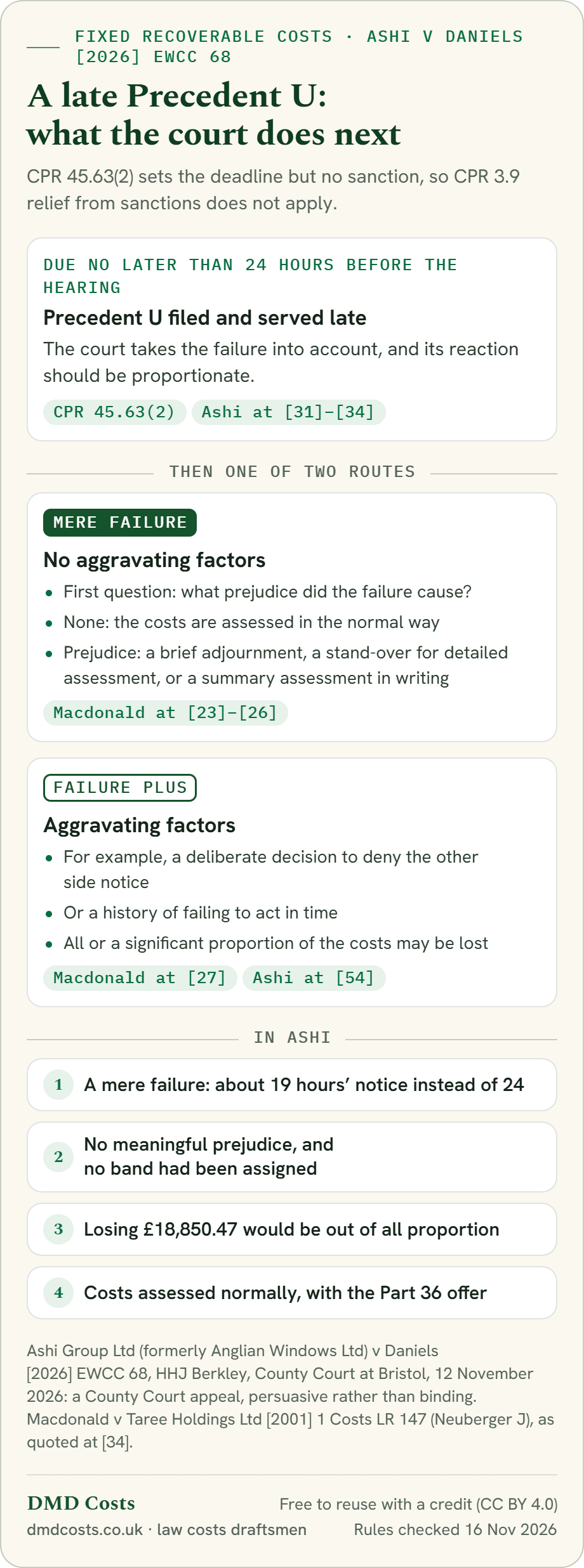
CPR 45.63(2) requires a party claiming fixed costs to file and serve a completed Precedent U no later than 24 hours before the hearing, but it states no sanction. In Ashi Group Ltd v Daniels [2026] EWCC 68, a County Court appeal that is persuasive rather than binding, HHJ Berkley held that CPR 3.9 relief from sanctions does not apply and followed Macdonald v Taree Holdings Ltd: for a mere failure the court asks what prejudice it caused, and with none it assesses the costs in the normal way. Aggravating factors can cost all or a significant proportion of the costs.
Free to reuse under CC BY 4.0: credit “DMD Costs (dmdcosts.co.uk)” and link to this page. Download the PNG.
Text version of this diagram
CPR 45.63(2) sets the deadline but no sanction, so CPR 3.9 relief from sanctions does not apply.
Due no later than 24 hours before the hearing: Precedent U filed and served late. The court takes the failure into account, and its reaction should be proportionate (CPR 45.63(2), Ashi at [31]–[34]).
Then one of two routes:
- Mere failure: No aggravating factors.
- First question: what prejudice did the failure cause?
- None: the costs are assessed in the normal way
- Prejudice: a brief adjournment, a stand-over for detailed assessment, or a summary assessment in writing
- Rules: Macdonald at [23]–[26]
- Failure plus: Aggravating factors.
- For example, a deliberate decision to deny the other side notice
- Or a history of failing to act in time
- All or a significant proportion of the costs may be lost
- Rules: Macdonald at [27], Ashi at [54]
In Ashi:
- A mere failure: about 19 hours’ notice instead of 24
- No meaningful prejudice, and no band had been assigned
- Losing £18,850.47 would be out of all proportion
- Costs assessed normally, with the Part 36 offer
Ashi Group Ltd (formerly Anglian Windows Ltd) v Daniels [2026] EWCC 68, HHJ Berkley, County Court at Bristol, 12 November 2026: a County Court appeal, persuasive rather than binding. Macdonald v Taree Holdings Ltd [2001] 1 Costs LR 147 (Neuberger J), as quoted at [34].
Rules checked 16 November 2026.
The nature of the failure. It was a “mere” failure, without aggravating factors “such as a deliberate decision to prevent the other side having advanced notice or the Appellant having a history of failing to act in time” (at [54]).
Prejudice. The defendants had not lost the opportunity to consider arguments about quantum; the five-hour delay could not realistically have affected their decision whether to go to trial, as it was too late by then; they raised no prejudice themselves; and the awareness point taken by the District Judge did not bear scrutiny (at [55]). There was “no meaningful prejudice (save for losing the windfall of avoiding to have to pay costs at all)” (at [56]).
Proportionality. Without a band, the claimant could not have filed and served a reliable Precedent U. The claimant did not seem to go so far as to say that this alone caused the lateness, but the judge took the impossibility into account (at [57]). Losing £18,850.47, the sum the judge assessed as the recoverable costs, for “a relatively small delay in filing and serving a Precedent U is out of all proportion”, particularly for a mere delay that caused the defendants no identifiable prejudice (at [58]).
So the court “should have gone on to assess the costs in the normal way, using the Precedent U and taking into account any Part 36 offers etc.”, which the judge had done in the order he had already made (at [59]). The judgment does not break the £18,850.47 down. On our reading, where a claimant beats its own Part 36 offer in a fixed costs case, CPR 36.24 modifies the CPR 36.17(4) consequences: instead of indemnity costs, the claimant gets additional costs of 35% of the difference between the fixed costs for the stage when the relevant period expired and those for the stage at judgment (CPR 36.24(4) and (5)). The free Part 36 calculator works out the consequences of a beaten offer, including that uplift.
How much weight does Ashi carry?
Ashi is a decision of a circuit judge in the County Court at Bristol, on appeal from a District Judge. It is persuasive, not binding. Counsel told the court that there was no direct authority on a failure to comply with CPR 45.63 (at [7]), and the respondents did not appear and were not represented (at [6]), so the court heard argument from one side only. The judge also stressed that the District Judge had not had the authorities cited on the appeal, nor the chance to consider the point in as much detail (at [9] and [46]).
High Court judges continue to apply Macdonald to late statements of costs. In Mktrchyan v 2Trom Media Group Ltd [2026] EWHC 1923 (KB), Fordham J went ahead with a summary assessment “without any costs reduction” where the statement of costs had been served 20 hours rather than 24 hours before the hearing, in circumstances that included the defendants’ “wholesale non-responsiveness”, finding the failure “pretty slight” with “zero prejudice” (at [21]). Courts have not always taken the same route. In Group M UK Ltd v Cabinet Office [2014] 6 Costs LR 1090, as described in Whittaker at [78], Akenhead J applied the Denton test to a statement of costs served three hours before a hearing, but still refused to deprive the receiving party of its costs and deducted £2,000. In both Macdonald and Group M the court responded to the prejudice the delay caused rather than taking away the costs (Whittaker at [79]). On our reading, Yesss makes the Denton route harder to justify where no sanction is stated.
What it means for claimant firms
Where Part 45 fixed costs apply. CPR 45.63(2) covers any party who intends to claim fixed costs or disbursements under Part 45. On our reading, that includes the fast track and intermediate track fixed costs in Sections VI and VII and the noise induced hearing loss costs in Section VIII. Ashi does not make the deadline optional. What it does, if other courts follow it, is take relief from sanctions out of the argument: a firm that serves late should expect the court to ask what prejudice the delay caused, and should be ready to answer that and to deal with any prejudice there was.
Housing disrepair. Usually outside these regimes. CPR 45.1(4) keeps a claim relating to a residential property or dwelling that includes a claim for disrepair out of the fast track and intermediate track fixed costs, unless it arises from a boundary dispute, and the Ministry of Justice has committed to keeping housing cases out of fixed costs until at least October 2028, a policy commitment reported by the Law Society Gazette (see our guide to whether housing disrepair costs are fixed in 2026). So a fast track disrepair trial usually needs an N260 statement of costs, filed and served not less than 2 days before the trial (PD 44 para 9.5(4)(a)), rather than a Precedent U. That is where Ashi still matters: Macdonald, the case it followed, was about a late schedule of costs, and on our reading the same proportionate approach is the starting point for a late N260, with PD 44 para 9.6 making the reason for the delay count. Our guide to statements of costs explains what happens if an N260 is late.
Clinical negligence. Fixed costs reach clinical negligence only narrowly. A claim that includes clinical negligence must be allocated to the multi-track unless it would normally be allocated to the intermediate track and the defendant admitted liability in full in its letter of response, without raising a limitation defence (CPR 26.9(10)(b)). On our reading, only those admitted claims can carry intermediate track fixed costs, and the proposed fixed costs scheme for claims up to £25,000 is not in force. Elsewhere the costs are assessed if they are not agreed.
MoD NIHL. Annex E of the Pre-Action Protocol for Disease and Illness Claims excludes military claims by members of the armed forces in respect of their service career, so an MoD NIHL claim is outside the Section VIII regime. On our reading, it may still fall within the ordinary fast track or intermediate track fixed costs, depending on its track, its value and when it began (see our guide to military NIHL and fixed costs). Where it does, Precedent U is due 24 hours before the hearing, and the claim needs a complexity band, so the banding problem in Ashi can arise. A claim within Section VIII is not assigned a band (CPR 26.14(1)): its Table 15 costs turn on the stage reached and the number of defendants.
Checklist: Precedent U before a fixed costs hearing
Our suggestions, not the court’s, with the rules and paragraphs they draw on:
- Diary it from the hearing time. Precedent U is due no later than 24 hours before the time fixed for the hearing (CPR 45.63(2)). The free fast track timetable calculator gives the date with the other pre-trial deadlines.
- Check the band at allocation. A fast track or intermediate track claim must be assigned a complexity band (CPR 26.14(1)), and each party states the agreed band, or the one it considers appropriate, in its directions questionnaire (CPR 26.14(6)). If the allocation order names none, ask the court to assign one well before trial.
- Serve on time even without a band. Use the band you contend for and have the figures for the alternative ready, as the claimant’s counsel did in Ashi (quoted at [10]). The judge thought that filing two or three Precedent Us could have confused litigants in person (at [51]).
- Put every claim the rule names in it. Any claim under rule 45.9 (exceptional circumstances), 45.10 (vulnerability) or 45.13 (unreasonable behaviour) goes in the Precedent U (CPR 45.63(2)).
- If it will be late, say so and say why. Serve it as soon as it is ready and explain the delay to the court and the other side. Be ready to deal with any prejudice the paying party raises, for example by agreeing time to consider the figures or written submissions on them (Macdonald at [23] and [25], quoted in Ashi at [34]).
- Argue the right test. On Ashi, CPR 3.9 is not engaged, and the question is a proportionate response to any prejudice (at [31] and [34]). If you also apply for relief in the alternative, CPR 3.9(2) requires evidence: in Ashi the order recorded an oral application “with no evidence in support” (at [11]). The free relief from sanctions checker works out which test applies to other missed deadlines.
- Avoid aggravating factors. A deliberate failure after being asked, or a history of lateness once it has been pointed out, can cost all or a significant proportion of the costs (Macdonald at [27]; Ashi at [54]).
- Where the costs are not fixed, it is the N260. For a fast track trial it is due not less than 2 days before the trial (PD 44 para 9.5(4)(a)); the N260 builder fills in the form.
How DMD Costs can help
DMD Costs prepares N260 statements of costs from your time records, disbursements and counsel’s fees, for your firm to check, sign, file and serve, draws bills of costs and Precedent S electronic bills, answers Points of Dispute with Replies and handles costs negotiation through to settlement for claimant solicitor firms in housing disrepair, clinical negligence and MoD NIHL claims. The fee is fixed and agreed before any work begins. Earlier case notes are in the costs case law index, and our free calculators and form builders are collected in the legal costs help hub.
Case details
| Case | Ashi Group Limited (formerly Anglian Windows Limited) v Daniels and another |
| Neutral citation | [2026] EWCC 68 |
| Court | County Court at Bristol, on appeal from District Judge Taylor |
| Judge | HHJ Berkley |
| Decided and handed down | Appeal allowed at the hearing, with reasons reserved; judgment handed down on 12 November 2026. The order under appeal was dated 18 December 2025 |
| Issue | Whether filing and serving Precedent U less than 24 hours before trial, in breach of CPR 45.63(2), engages relief from sanctions under CPR 3.9, and how the court should respond |
| Result | Appeal allowed: CPR 45.63(2) carries no sanction, so CPR 3.9 does not apply; on the Macdonald approach, costs assessed in the normal way at £18,850.47 |
| Status | A County Court appeal decision: persuasive, not binding. The respondents did not appear and were not represented |
| Rules discussed here | CPR 3.9, 26.9(10), 26.14, 36.24, 45.1(4) and 45.63; PD 44 paras 9.5 and 9.6 |
Sources
- Ashi Group Ltd v Daniels [2026] EWCC 68 (Find Case Law)
- Yesss (A) Electrical Ltd v Warren [2024] EWCA Civ 14 (Find Case Law)
- FXF v English Karate Federation Ltd [2023] EWCA Civ 891 (Find Case Law)
- R (Hysaj) v Secretary of State for the Home Department [2014] EWCA Civ 1633 (Find Case Law)
- Denton v TH White Ltd [2014] EWCA Civ 906 (Find Case Law)
- Whittaker v Bertha UK Ltd [2023] EWHC 2554 (Ch), which sets out Macdonald at [23]–[27] in full (Find Case Law)
- Mktrchyan v 2Trom Media Group Ltd [2026] EWHC 1923 (KB) (Find Case Law)
- Sayers v Clarke Walker [2002] EWCA Civ 645, cited in Ashi at [19] and in Yesss at [26] and [33] (not on Find Case Law)
- Say Chong Lim v Chee Kong Ong [2022] EWHC 225 (Ch), as cited and quoted in Ashi at [32] (not on Find Case Law)
- Macdonald v Taree Holdings Ltd [2001] 1 Costs LR 147 (Neuberger J), quoted in Ashi at [34]; no free official copy
- Group M UK Ltd v Cabinet Office [2014] 6 Costs LR 1090, as described in Whittaker at [78]; no free official copy
- Civil Procedure Rules, Part 45 (fixed costs), including rules 45.1 and 45.63
- Civil Procedure Rules, Part 3 (the court’s case management powers), including rule 3.9
- Practice Direction 44, paragraphs 9.5 and 9.6 (statements of costs for summary assessment)
- Civil Procedure Rules, Part 26, rules 26.9 and 26.14 (tracks and complexity bands)
- Civil Procedure Rules, Part 36, rule 36.24 (Part 36 in fixed costs claims)
- Practice Direction 45, with the Precedent U download